Guest Expert Column: College students find tar spot in corn plot
9-14-23 Tar Spot 2
MARYVILLE, Mo. — During a plant disease assessment exercise at Northwest Missouri State University corn field plots on Sept. 7, undergraduate students Josephine Mundorf and Alexis Plackemeier identified a corn leaf with symptoms they suspected to match those of the disease tar spot.
Upon closer examination of the symptoms, it was confirmed that the identified spots corresponded to those caused by the disease tar spot. A systematic assessment of the disease intensity in the field plot later that afternoon indicated an incidence of 80 to 100 percent, yet a severity below 5 percent on the involved hybrid.
Microscopic observations of the spots further confirmed they were the fruiting structures of the pathogen causing the disease.
Why is tar spot a concern?
Tar spot can cause severe yield losses on susceptible corn hybrids growing under favorable weather conditions for disease development.
In the Midwest, the disease is reported to cause corn grain yield losses of up to 30 percent.
Since it is a relatively newly discovered disease, there is still some gap in knowledge regarding its biology and epidemiology.
What are the symptoms of tar spot?
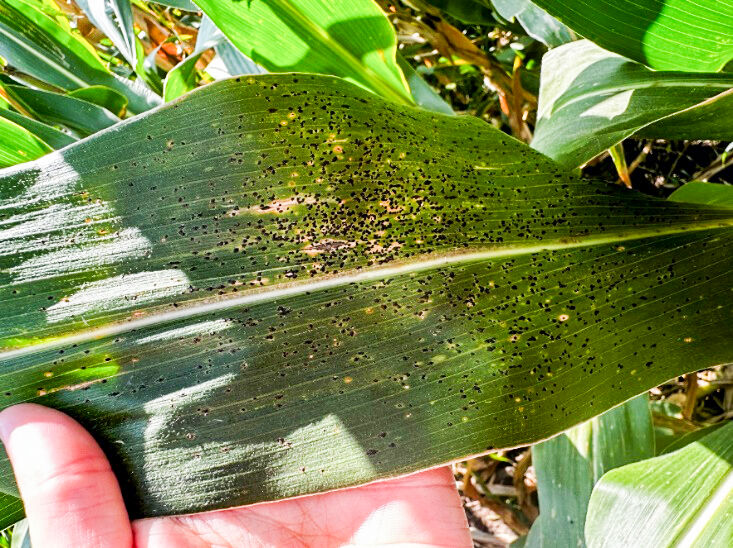
Tar spot symptoms appear as small, raised, black spots on both the upper and underside of the leaves, though in severe cases, the spots can also appear on leaf sheaths and husks. Spots first appear on the leaf surface scattered, but as the disease progresses, they form clusters. The spots contain the entire fungus fruiting structures called stroma.
What causes tar spot?
Tar spot of corn is caused by a fungus called Phyllachora maydis, which produces microscopic spores that infect corn plants during the growing season. The spores are produced within sac-like structures that are in turn enclosed into a flask-shaped body known as perithecium.
Once released, the spores are dispersed by wind or rain splash to foliage during periods of rain, high relative humidity, leaf wetness and moderate temperature.
Where in Missouri has tar spot occurred?
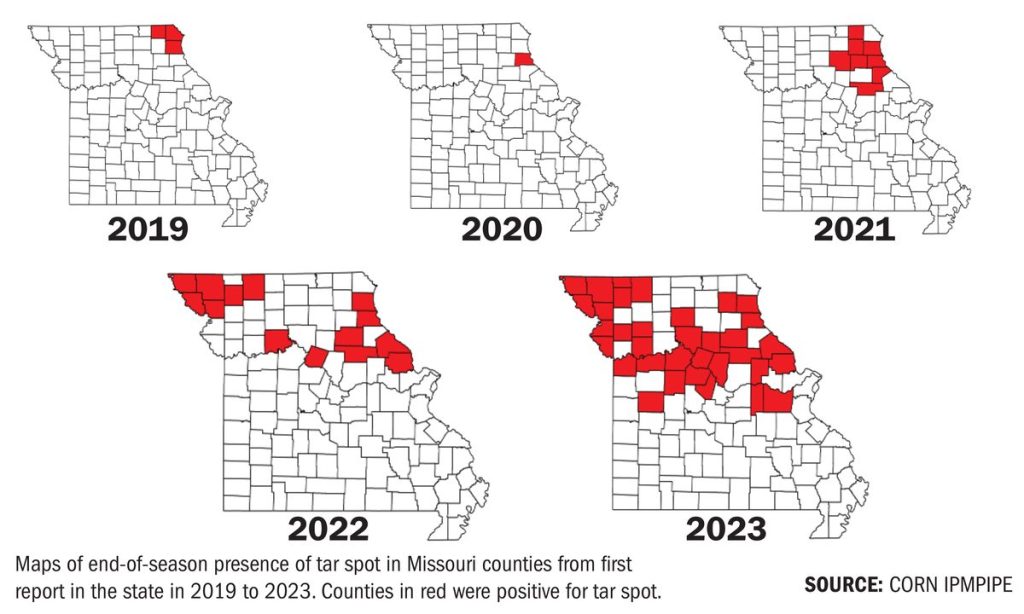
In Nodaway County this year, the first report of tar spot came on July 17, and as of Sept. 8, the disease presence was confirmed in 33 counties in the state since tracking began in 2019. In Missouri, the disease was first reported in three northeast counties in 2019 and has spread to other counties since then. The tar spot pathogen can survive in crop residue under Missouri cold weather.
Why is it important to know where tar spot occurs?
Knowing where the disease has occurred can help take management measures in subsequent years, as it is likely that the disease will recur in areas where it has already been present.
In summary, this is the second confirmed report of tar spot disease in Nodaway County in 2023. This report occurrence will be added to the Corn ipmPIPE website to contribute to the tracking of the disease in the state.
The ipmPIPE project is pest mapping and forecasting system that was developed by the National Institute for Food and Agriculture and its land-grant partners, along with the Animal Plant Health Inspection Service and Risk Management Agency, according to the ipmPIPE website.
For additional information on tar spot, including management practices, visit cropprotectionnetwork.org/encyclopedia/tar-spot-of-corn.
EDITOR’S NOTE: Josephine R. Mundorf and Alexis L. Plackemeier, undergraduate students in the School of Agricultural Sciences at Northwest Missouri State University, contributed to this column.
OSCAR PEREZ-HERNANDEZ
Raised, black spots on the underside of the leaf, typical of tar spot.