Honoring one who served
CREATIVE COMMONS
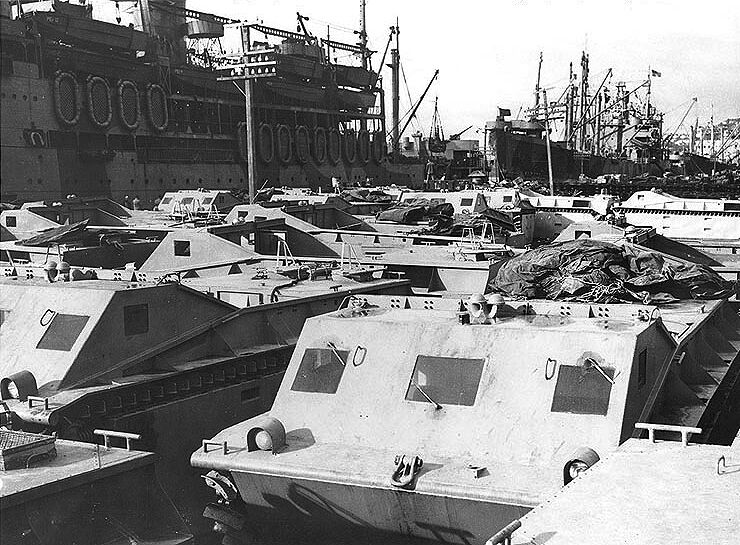
U.S. Marine Corps LVT-1 amphibian tractors on the dock at Wellington, New Zealand, on July 20, 1942, awaiting embarcation on board ships of the Guadalcanal-Tulagi invasion force. The ship in the background, to the left, is the U.S. Navy transport USS McCawley (AP-10).
MARYVILLE, Mo. — Members of the Nodaway County Chapter of the Daughters of the American Revolution met and honored World War II veteran Merle Ray White during a Nov. 13 meeting at the First United Methodist Church.
Each year the local organization recognizes a veteran in November. White died in October at the age of 99, just before the organization was set to honor him. His daughter, Sandy Alexander, was in the audience during the DAR recognition ceremony.
White was born on July 17, 1922, on a farm west of Maryville. He was a farm boy and was raised on the typical farm of that time, raising livestock, chickens and tending a large garden and orchard, according to a historical perspective written by DAR member Cindy Kenny.
White went to the country school, Pleasant Hill Elementary, and walked 5 miles to Maryville to attend and graduate from Washington High School, also known as Maryville High School.
Upon graduation, as required, he registered for the Selective Service military draft.
White was introduced to Mary Ellen Hall of Hopkins in the fall of 1941 at the Pickering Horse Show. They fell in love and were married on June 24, 1942, wrote Kenny. They moved into the home of White’s parents and both helped with farming.
On Dec. 7, 1941, Pearl Harbor was bombed, and White, being 20 years of age, knew that his drafting was imminent. So he enlisted and was commissioned into the U.S. Navy on Oct. 2, 1942. Asked later in life about why he chose the Navy, White responded with his characteristic sense of humor: “I like a good place to sleep!” he said.
After only four weeks of basic training at Great Lakes Naval Station in Chicago, White was commissioned on the USS McCawley out of Seattle. The ship’s mission was to transport American troops onto Rendova Island, part of the Solomon Islands, northeast of mainland Australia. According to Kenny, Japan had been conquering the Solomon Islands and these islands were important as they served as “stepping stone” bases for the Japanese for refueling plans and troop movement.
On June 30, 1943, the McCawley successfully delivered 1,200 troops to the north side of Rendova Island and began making its way toward Guadalcanal in spite of air raid warnings. White, as a seaman first class, was manning a .50-caliber machine gun on the well deck when he later recalled seeing a plane coming toward the ship just above the water, and then seeing a torpedo come through the water before impact as the plane banked to the left.
The torpedo struck the ship on the starboard side, putting an 18- to 20-foot hole in the engine room. Fifteen crew members and officers were listed as missing in action from the attack. Two more torpedoes passed close to the starboard side, causing the ship to list to port, jamming the rudder and stopping its engines — immobilizing the ship.
Orders were given to abandon ship and White said later he was able to grab his seabag and go back for Mary Ellen’s photo before being rescued.
“Merle didn’t remember much of what happened when they were rescued: just that he recalls waking up on another battleship,” Kenny wrote.
He continued to serve in the Navy on the USS President Jackson, an attack transport, as a storekeeper first class, although during combat he was assigned to the 40mm twin-bow gun. During his time in the Navy, White saw five major military engagements, earned campaign ribbons and stars.
White was on one of the four ships that landed troops onto Iwo Jima, stationed on the 40mm gun. Later, he joked that he ended up on the gun instead of “driving the boat” because he claimed he couldn’t swim.
“Our carrier landed the first Marine division on Iwo Jima,” he later wrote.
“(I) was told that on one occasion, I was the front tie designee on troop landing craft,” White wrote. “(A) pilot was shot and I took over as the pilot, landed the craft and returned it to the ship. I do remember walking onto the ship’s deck after the craft was hoisted up out of the water.”
He noted that seamen would have to go down to returning crafts on rope ladders to assist land troops back onto the ship due to their weary and weakened conditions. They were provided rations for a week, but often returned after 10 days.
White’s ship was also part of a four-ship fleet that liberated the Philippines by landing troops on the Len Jan Gulf on the west side of the Philippines. The transport ships were attacked by suicide dive-bombers on their way back out to sea, he said.
White was granted a 20-day leave to return home before he was released from the Navy on Sept. 27, 1945. Upon his release, he returned to the family farm. He and Mary Ellen became parents of two children Ronald (Ronnie) White, who died in 2002, and Sandra (Sandy Alexander). Using the GI Bill, he received education in agriculture.
In 1963, White and his family moved to a farm southeast of Hopkins. He continued to farm and with his father, built and operated the Roxy Center in Hopkins. White and Mary Ellen also operated theaters in nearby towns, including Skidmore, noted Kenny.
Mary Ellen died on Sept. 8, 2018. At that time, she and White had been married for 76 years.
“Theirs was a love story that is rarely surpassed and they are both sorely missed,” Kenny wrote. “Merle left a legacy of six grandchildren and 15 great-grandchildren along with daughter Sandy and daughter-in-law Linda White McKee, who are all proud of Merle, not only for his war efforts, but for the loving, kind, humorous and generous man that he was.
“Farewell ‘ornery.’”
CREATIVE COMMONS
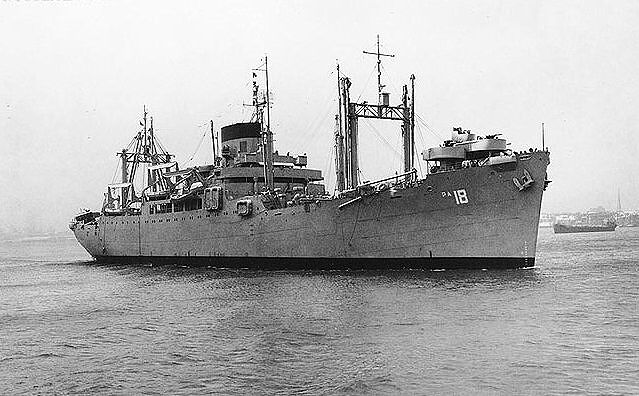
USS President Jackson (APA-18), photographed March 8, 1947, in the Elizabeth River below the Norfolk Navy Yard, Portsmouth, Virginia.
SUBMITTED PHOTO
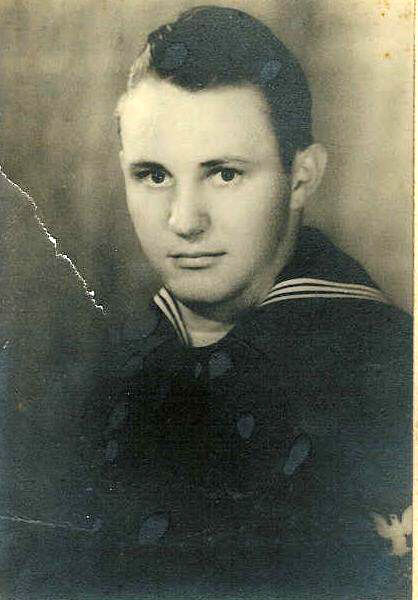
Merle White