
Study: Steep rate hikes needed to stabilize water/sewer fund
NEWGEN STRATEGIES & SOLUTIONS
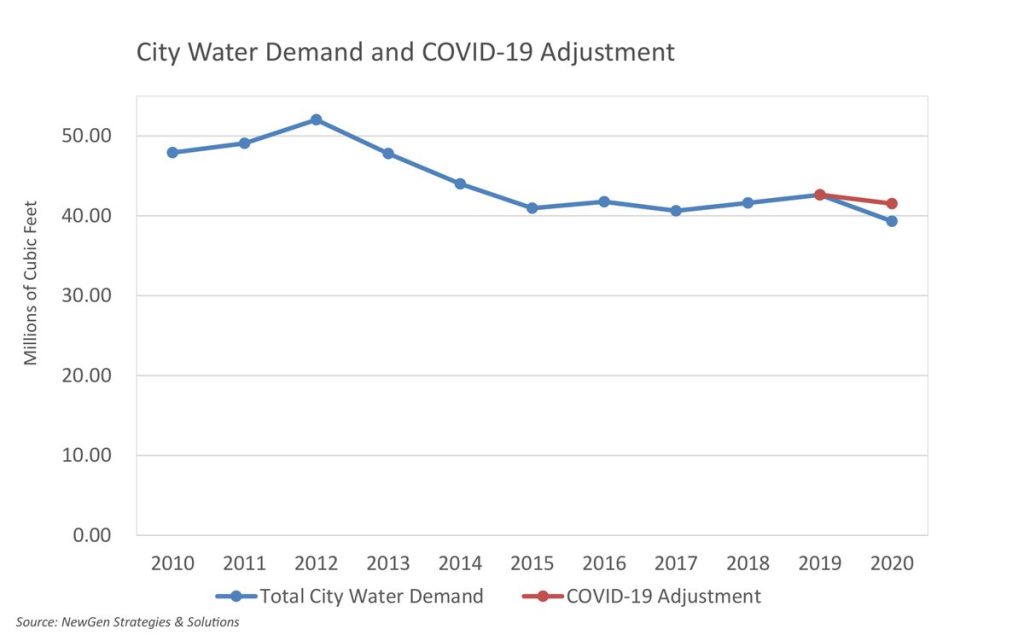
A graph from NewGen Strategies & Solutions showing historical water demand in Maryville starting in fiscal year 2010. The COVID adjustment is the estimated total without pandemic-related revenue losses.
MARYVILLE, Mo. — The Maryville City Council is weighing a recommendation to drastically raise water and sewer rates following the first in-depth analysis of the rate schedule in more than 15 years.
The sobering study, delivered by NewGen Strategies & Solutions to the council last week, showed that at the current pace, the water/sewer fund would be unable to keep up with expenses as soon as the end of the next fiscal year in October 2022.
To address the urgent need, NewGen recommended an increase of 25 percent to water rates and 50 percent to sewer rates, followed by annual three percent increases for each year thereafter for five years. Those increases would be accompanied by other recommended rate adjustments as well, part of a comprehensive overhaul.
Recommended Water/Sewer Rate Increases
| Water Rates | FY 2022 | FY 2023 | FY 2024 | FY 2025 | FY 2026 |
| Minimum Charge | 25% | 3% | 3% | 3% | 3% |
| Volumetric Charge | 25% | 3% | 3% | 3% | 3% |
| Wastewater Rates | |||||
| Minimum Charge | 50% | 3% | 3% | 3% | 3% |
| Volumetric Charge | 50% | 3% | 3% | 3% | 3% |
Source: NewGen Strategies & Solutions
Currently, the typical, residential customer inside Maryville city limits sees a monthly water and sewer bill of $46.08. Under the proposed plan, the same customer’s bill would rise to $63.03 next year — an increase of about $17. The study assumed that rates would go up starting Jan. 1, 2022.
The council commissioned the study back in May as one of the first steps toward determining how to absorb the cost of a potential new water treatment facility. However, the base recommendation outlined above only includes expected capital spending over the next six years — not the addition of a massive new project that could cost somewhere between $18-38 million over the next decade.
In order to fund a potential $20 million new plant, NewGen’s study recommended extending the annual three percent increases another year, followed by a 30 percent jump for water rates in FY 2028, and another three years of annual three percent increases after that.
Increases with Added Water Treatment Plant Estimate
| Water Rates | FY 2022 | FY 2023 | FY 2024 | FY 2025 | FY 2026 | FY 2027 | FY 2028 | FY 2029 | FY 2030 | FY 2031 |
| Minimum Charge | 25% | 3% | 3% | 3% | 3% | 3% | 30% | 3% | 3% | 3% |
| Volumetric Charge | 25% | 3% | 3% | 3% | 3% | 3% | 30% | 3% | 3% | 3% |
| Wastewater Rates | ||||||||||
| Minimum Charge | 50% | 3% | 3% | 3% | 3% | 3% | 3% | 3% | 3% | 3% |
| Volumetric Charge | 50% | 3% | 3% | 3% | 3% | 3% | 3% | 3% | 3% | 3% |
Source: NewGen Strategies & Solutions
Although city staff said the results of the study weren’t exactly a shock, the scale of just how quickly the water/sewer fund could go into the red seemed to take city officials and the City Council by surprise. Instead of laying out a path to fund a badly needed new addition to the city’s water infrastructure, the rate study outlined a sharp increase needed just to keep pace with expenses.
“I think most people in Maryville would agree, a new water treatment system is inevitable and needed,” said council member John McBride. “I think they know with that would come a rate increase. … But that’s just, that’s a tough pill to swallow if you’re a citizen of Maryville going paycheck to paycheck.”
Eric Callocchia, executive consultant for NewGen who presented the study to the City Council last Wednesday, said his agency ran several scenarios, and the recommendations presented in the final report was the one that had the lowest overall impact on customers that still kept revenues above the city’s minimum reserve fund policy.
The immediate hike, Callocchia said, allowed for the greatest cumulative increase to revenue over the long run. Otherwise, additional years of moderately high increases — like two years of 35 percent increases to sewer rates instead of one year of 50 percent and one year of three percent — would have been necessary to reach the same minimum funding level.
“So we did run scenarios in which we tried to phase this in over a two-year timeframe,” Callocchia said. “Unfortunately, because of this issue, you don’t have that long of a ramp. If this were a five- or six-year ramp, we could phase this rate increase to build this up and have a nice slope down and a slope up. The problem is, (the water/sewer fund is) dropping too fast unless we do a substantial amount.”
One of the factors that led to the need for an immediate and substantial increase, city officials indicated, was that this was the first rate study the city has commissioned since 2005, when the city was planning how to fund a new wastewater treatment plant that was eventually completed in 2015. City Finance Director Denise Town said that at the time, the city increased sewer rates by about 200 percent to fund the new plant, and since then, has only increased water and sewer rates incrementally.
Another significant factor is, naturally, COVID-19. In January, the city was set to implement a 10 percent increase to water and sewer rates, but ultimately did not go forward with the rate hike as part of its measures to ease the burden on customers during the pandemic — the city has also continued to pay the online processing fee for all customers since last summer to help encourage paying remotely.
Callochia, said the Maryville study’s recommendations aren’t outside the norm.
“It’s something that we’re seeing increasingly, major rate increases for various reasons,” he told The Forum. “One, costs are going up — materials, construction costs specifically, are going up. It is not unusual for us to come and recommend at least a double-digit percent rate increase.”
Additionally, the pandemic drove down water usage significantly, especially while businesses and the university were shut down to in-person contact. Town said that Northwest Missouri State University, one of the city’s largest customers, barely used water last spring when students were told to stay home during spring break.
But not all the water/sewer fund’s issues can be pinned on COVID-19. NewGen’s study found that revenues fell off starting in 2012 and have been in a general decline since — city officials agreed that the drop-off coincided with the closing of the Energizer plant, which began phasing out production late that year. Since then, water and sewer rates have not risen alongside costs.
In fact, among a sample of other regional water and sewer rates, NewGen’s study showed that Maryville’s current rates are among the lowest. The recommended increase would put the typical Maryville resident’s bill at about the average of the comparable communities.
Regional Water/Sewer Rate Comparison
| City | Monthly Rate (current total) |
| Excelsior Springs | $99.21 |
| St. Joseph | $87.66 |
| Moberly | $71.30 |
| Smithville | $66.85 |
| Marshall | $62.34 |
| Kirksville | $61.42 |
| Grain Valley | $58.36 |
| Mexico | $55.40 |
| Kearney | $52.64 |
| Maryville | $46.08 |
| Clarinda, Iowa | $44.87 |
| Chillicothe | $44.42 |
Source: NewGen Strategies & Solutions
Other rate changes
On top of the recommended increases of 25 percent and 50 percent to water and sewer rates respectively, NewGen also recommended the city change its rate structure to charge significantly more for private fire protection services, like those used for some privately owned sprinkler systems, typically in businesses.
Those systems require access to dedicated “firelines,” which run highly pressurized water at an accelerated speed.
The study showed the city only has 29 such customers, but using industry standard methodology, NewGen said the city has been undercharging the actual cost of the service by about 496 percent. Currently, a typical customer with fireline service pays about $7.71 per month for it. With NewGen’s recommendations, those costs would go up to $45.01 per month. Without that increase, the cost of that private water service would continue to be spread among the rest of the city’s public customers instead of paid for by that particular customer.
Including that adjustment would raise the annual revenues from fire protection services from $2,684 estimated for this year to $16,003.
Customers who live outside of the city’s limits but still get their water service directly from the city rather than from Public Water District No. 1 would also see their rates increase, for the most part. Under the system in place now, those customers are broken down into two categories: outside city and unannexed. Unannexed customers are those who live outside city limits and in the service territory of PWSD No. 1, but have been acquired by the city — typically large direct customers that use a relatively high amount of water like industrial businesses, not individual residents. There are only five unannexed customers currently, and they pay a 100 percent surcharge on water rates.
The second category, outside city customers, includes other direct customers who live outside Maryville’s city limits. Those customers pay a 10 percent surcharge, but to account for the extra cost associated with the infrastructure needed for those accounts, NewGen recommended raising the surcharge to 50 percent.
Currently, the typical outside city customer pays $48.03 per month for water and sewer services. With the surcharge increase and the proposed increases to water and sewer rates, next year that customer would pay $74.62 — about $8 more per month than if the surcharge had stayed at 10 percent.
Next steps
Council members briefly discussed the water and sewer rate recommendations during a budget workshop session Monday, and agreed that they need more time to assess options to help mitigate the impacts of the rate increases.
Among those options is using funds from the American Rescue Plan, the act passed by Congress in March as another round of COVID-19 relief, including payments made directly to municipalities. However, the $2.3 million that Maryville will receive from the federal government is already going quickly, with another water project — a pilot water plant required before proceeding with a new treatment facility — already earmarked for about half a million dollars, and a new police pay and recruitment initiative also tentatively slated for about $340,000.
But, Rescue Plan funds can be used in a number of ways to help offset water costs, including through direct payments to customers, especially those with lower incomes.
Additionally, council member Rachael Martin suggested that she would like to find ways to help businesses — particularly those affected by the recommended increase to fire protection rates — defray the added costs. That, too, would be possible by using Rescue Plan funds, including those that were already trending toward use for businesses.
The county commission, for example, has already indicated its willingness to take part in a program to supplement aid to local businesses, which could allow for easily expanding the program to include more of the county’s $4.3 million allocation specifically for water rate offsets that are necessary in part because of the pandemic. Outside city customers, too, could be an option since they are facing a surcharge increase. Thus far, the commission has not solidified its plans for its Rescue Plan funds.
Other than Rescue Plan funds, city officials have also expressed some hope that PWSD No. 1, which they have repeatedly praised for its officials’ willingness to partner with the city on multiple water infrastructure improvement projects recently, might be willing to help soften the impact of the water rate increases, too.
“And so, I want to make sure that they are in the loop as well as we start talking about some water rate changes,” said council member Tye Parsons. “That being said, I think that the report was pretty clear in that there are, just to be fiscally responsible and make sure that we can still cover our fixed costs — our debt service and our fixed operating costs — we should be looking at increases not only this year, but going forward.”
The deal with NewGen not only produced the water and sewer rate study, but also provided the city with the model the company used to calculate its recommendations, allowing the city officials to change any number of parameters — like proposed rates, costs and any other variables — to determine for themselves what increase would be most appropriate.
Complicating the timeline, Parsons pointed out, is the nearly $2 million replacement of new water filtration membranes at the current water treatment plant last year. Their operational life is usually about 7-9 years.
“I want to reiterate, and I’ve said it, I know, a number of times, but as soon as we put the new membranes in the old water plant, we started the clock,” Parsons said. “We have about a five-year timeframe before something — potentially major — has to happen with our water. And so we really need to keep those things in our mind as we start thinking about generating that revenue that we’re going to have to have to really put some substantial capital into our water infrastructure. And it’ll be here before you know it.
“But, I agree, we need to wait a little bit, get our partners on board — but don’t wait too long.”
The council is expected to discuss the rate increase again at its next meeting in October. Before that, the council will likely approve a placeholder budget for the next fiscal year on Sept. 30, starting another clock to approve new rates — not necessarily those recommended by NewGen — by the intended effective date of Jan. 1, though that is an arbitrary start date.
FORUM FILE
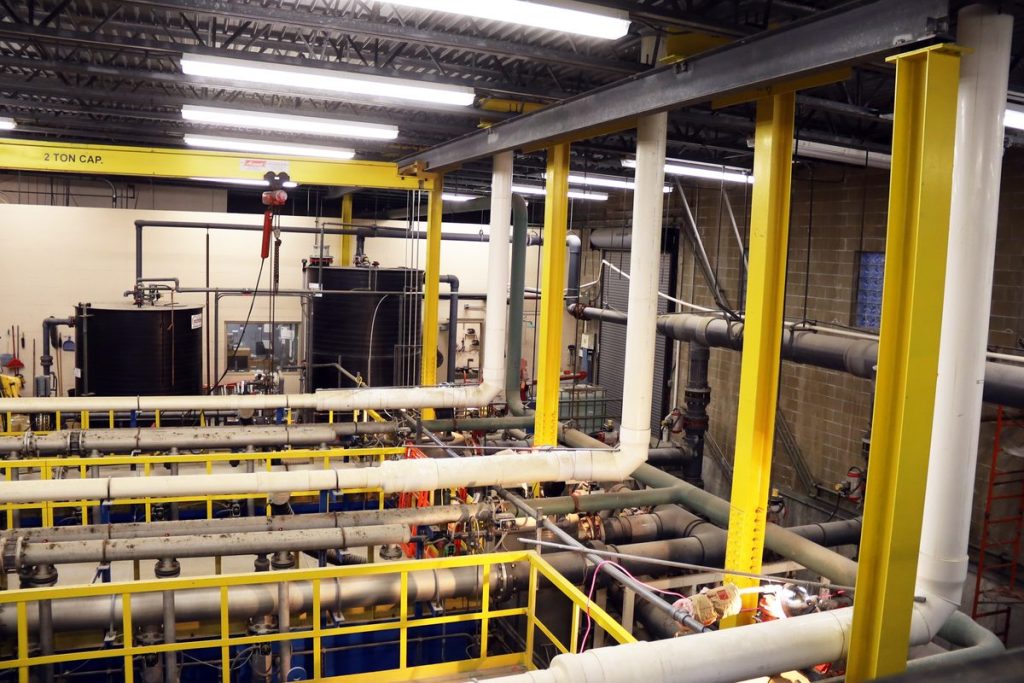
Inside the Maryville Treatment Plant during a tour in 2020 for city officials. The City Council last week received a study by NewGen Strategies & Solutions that recommended sharp increases in water and sewer rates.




