McCollum’s success keeps fueling Northwest legacy
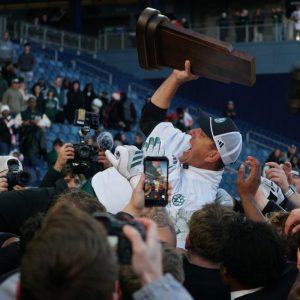
JON DYKSTRA/THE FORUM
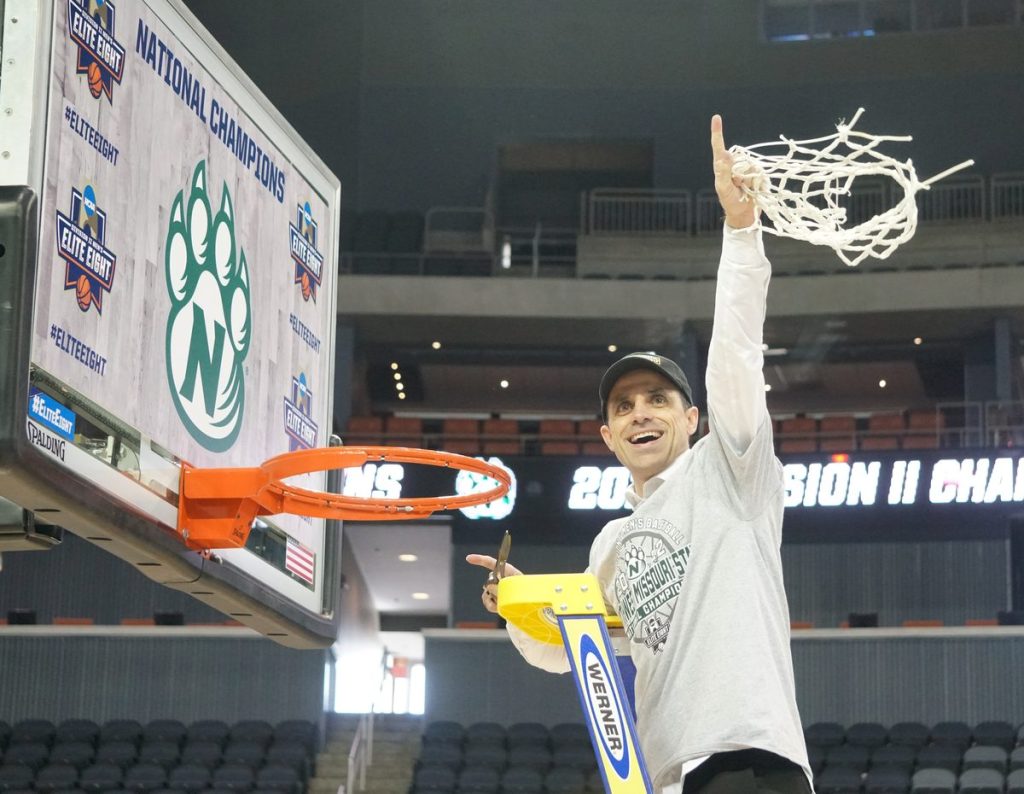
Ben McCollum cuts down the NCAA Division-II championship nets in Evansville, Ind., on March 26, 2022.
Editor’s Note: This is the third in a series highlighting the M-Club Hall of Fame Class of 2026. On July 9, the Forum featured volleyball’s Maddy (Bruder) Dreamer, men’s basketball’s Justin Pitts was featured on July 16, Trevor Adams was featured in July 23 and Voice of the Bearcats John Coffey was the July 30 feature.
MARYVILLE, Mo. — CBS Sports anchor and Iowa Hawkeye fan Chris Hassel opened his postgame show after Iowa beat Nebraska last season to advance to its first Elite Eight since 1987 by saying “I’ve been saying he’s a coaching genius longer than anybody.”
Hassel may have some arguments cropping up from northwest Missouri on who declared Ben McCollum a ‘coaching genius’ first, but McCollum will soon add another title to what is becoming a lengthy resume — M-Club Hall of Famer.
“It is probably more of an indication as to the amount of first-place people and high-level people that we brought into the program,” McCollum said. “… I’m just the beneficiary of a lot of good people who helped build that program.”
McCollum will go into Northwest Missouri State’s Hall of Fame this season alongside a special class for men’s basketball with Justin Pitts and the 2016-17 national champions joining him in the Class of 2026.
That 2017 national championship was eight seasons into the McCollum tenure in Maryville and McCollum remembers those first couple years in Maryville being a bit different than the instant success that he experienced at Drake with the best season in school history and Iowa with the best season since 1987 in his first seasons.
“Dr. Bob Boerigter hired me and took what, from the outside looking in, a risk,” McCollum said. “You just don’t see a lot of assistants getting hired, especially 27-year-old assistants. Getting the job and being able to coach with Coach (Austin) Meyer and Coach (Andy) Peterson and Coach (Chad) Van Riessen and taking that on with really good friends and really good coaches, we learned a ton. The first two years, we learned a ton.”
At Northwest, McCollum’s teams went 22-31 in his first two seasons as a head coach.
McCollum credits fellow Class of 2026 M-Club inductee John Coffey with dealing with his radio interviews during that slow start.
“He deserves every accolade that he gets because he had to interview me after every single one of those losses that I had those first two years,” McCollum laughed. “I’d get up there and he’d be like, ‘Well, hey Ben.’ And it’d be like, John, I’m not in a good mood right now and if we could just get through this quickly, let’s do it.
“But the uncomfortable feelings that he had to go through to be able to earn the ability to call national championships is fun. He’s the best. For me, I don’t get to listen to him, but for my family, they loved listening to him. He always has had a great ability to tell a story through the radio.”
Despite the losses during those seasons, McCollum was developing his first in a historic run of point guards. DeShaun Cooper and McCollum arrived at Northwest in the same season and as a junior, Cooper helped his third-year coach win the first of what would become 12 MIAA championships.
Cooper was injured the next season, but as a senior, the Bearcats started their run of 12-straight MIAA titles.
“Every year was a different challenge,” McCollum said.
The next challenge was to do it without Cooper and to take the next step as a program. McCollum answered that with Pitts and Northwest’s first national title. Again, the junior year was the breakthrough with the 2017 national title.
“Justin was one who you really didn’t have to coach a whole lot,” McCollum said. “He just understood the game of basketball. He understood when to score, how to run the offense, how to defend. He understood winning. He obviously had enough drive to win us a national championship his junior year and did that all at 5’9. Even the first couple times I saw him, I wasn’t like, ‘I think this kid can play for us.’
“Then he came up and played against our guys, and its like, ‘oh yeah, he’s a no brainer.’ Obviously he showed that throughout his 4-year career.”
Northwest was the No. 1 team in the country the next season again, but an injury to Pitts in the MIAA Tournament led to the end of his career with a loss in the NCAA Tournament without the National Player of the Year.
The next challenge was to do it without Pitts and take the next step as a program. McCollum answered that with the the best player Division-II has ever seen and the greatest dynasty it ever saw.
Northwest went 38-0 and won the national championship with Trevor Hudgins as a redshirt freshman. Hudgins and McCollum continued win with three-straight national titles and the only year they didn’t win it all was a season where they were the No. 1 team in the nation, but the tournament was canceled due to COVID-19.
The next challenge was to do it without Hudgins and take the next step as a coach. Enter Bennett Stirtz, and Stirtz’s junior season, McCollum made the leap to Division-I after 15 years in Maryville.
In his first season in Des Moines, McCollum set a program-record with 31 wins and won their first NCAA Tournament game since 1971. Stirtz became an All-American and the the Missouri Valley Conference Player of the Year.
After that season, McCollum was offered his childhood dream and the head coaching job at the University of Iowa. Stirtz became a repeat All-American and top-15 NBA draft pick as Iowa made its first Elite Eight run since 1987.
McCollum’s ‘basketball genius’ is now on the display for the entire basketball world and every game Iowa plays the television broadcasts takes a trip down Bearcat memory lane and gives Northwest free advertising courtesy of McCollum as they explain his path to success.
McCollum says he takes pride in highlighting Northwest as part of that journey.
“I think so often people try to create a past narrative,” McCollum said. “This guy came from JUCO. This guy came from D2. This guy came from D3 or whatever. But not every D2 is the same. Not every place and the opportunities we have are the same. The time we were at Northwest was different. The success we had was different. And the people we had in there were different. Whether it was D2, D1 or the NBA, it was different. You just don’t win at that level without a different kind of people. And that was the cool part.”