Black airs frustrations in forum with northwest Missouri principals
SKYE POURNAZARI/THE FORUM
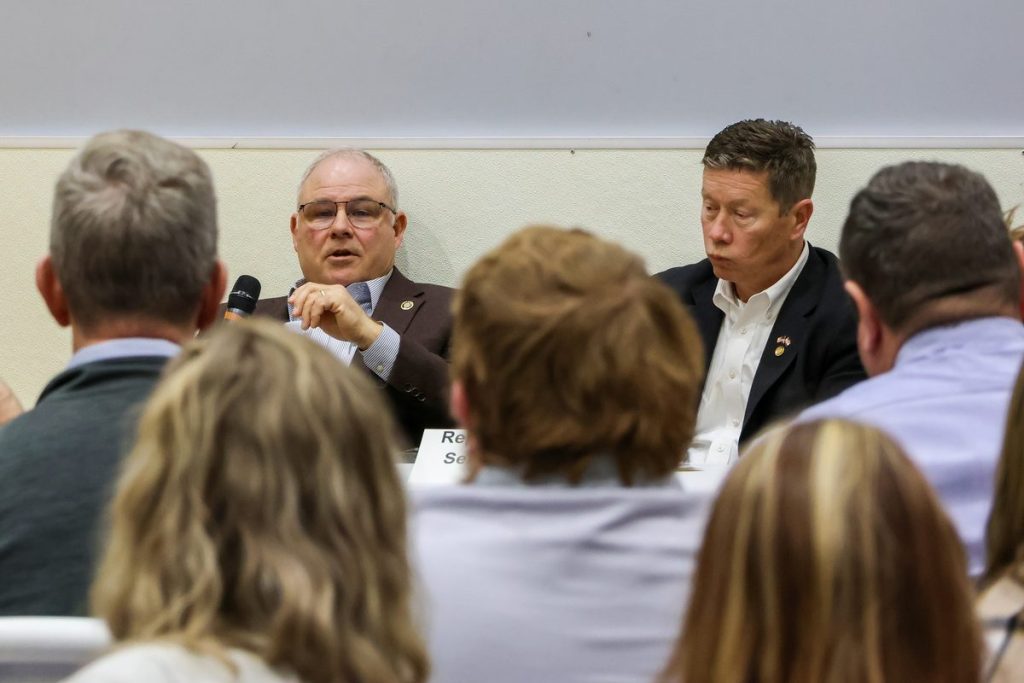
State Sen. Rusty Black opened last week’s legislative forum with northwest Missouri principals by blaming school administrators for bringing unwanted attention to small school districts he represents. Throughout the event, he referred to himself in sarcastic terms like “the anti-public-school person” because of blowback he has received from constituents following two reports in The Forum in December on public school funding.
ST. JOSEPH, Mo. — State Sen. Rusty Black last week aired his frustrations with public school officials, attempted to distance himself from the state’s private school vouchers program and, along with state Rep. Dean Van Schoiack, seemed to stun a meeting of northwest Missouri principals by dismissing concerns over children homeschooled in unsafe environments.
Black, R-Chillicothe, and Van Schoiack, R-Savannah, joined Rep. Bill Falkner, R-St. Joseph, and Rep. Sean Pouche, R-Kansas City, on a panel of local legislators who participated in a question-and-answer session at a regional meeting of elementary and secondary principals’ associations in St. Joseph on Friday.
During the hourlong session, Black was openly frustrated by the blowback he has received from constituents over his record concerning public school funding. He frequently used sarcasm to indicate that he believes he has been unfairly characterized as unsupportive of public education, and that he may not be reelected in November because of it. And at one point he apologized for his tone after an exchange with Maryville Middle School Principal Kate Lydon.
SPOTLIGHT
Before he had even been asked a question, Black opened the session by sarcastically thanking school officials for “putting a spotlight on me.” He later confirmed that he was referring to two Forum reports in December in which three Nodaway County superintendents shared their concerns that Black, the Senate Appropriations Committee chair and the chair of Gov. Mike Kehoe’s task force to overhaul the state’s public education funding formula, was ignoring constituents and pursuing policies that would hurt small schools.
“And now I got people coming up to me saying, ‘Rusty, do you know you have schools with only 20 kids in it?’ ‘Rusty, do you know you have schools that have less than 200 kids in them?’” he told the group of more than 60 principals and school leaders. “Spotlight’s helpful, because before this … (Senate President Pro Tem) Cindy O’Laughlin did not realize what northwest Missouri looks like. So people do know us better now. So thank you, and we’ll get through this.”
Later, Black told The Forum that others have begun questioning him about why some schools in his district are even open when they have so few students.
“We have become much more of a target (when we) used to be a secret,” Black said.
SMALLEST SCHOOL DISTRICTS IN SENATE DISTRICT 12
State Sen. Rusty Black said that after focus from school leaders who believe he is not serving the interests of small schools, those schools are receiving more unwelcome scrutiny from others across the state who did not know they existed before, especially those with very small enrollments. Overall, Black represents 74 school districts, the most of any state lawmaker. Thirty-six of those serve fewer than 200 students — more than the 32 total districts that Sen. Cindy O’Laughlin, R-Shelbina, represents.
| DISTRICT | COUNTY | ENROLLMENT |
| Cowgill R-VI | Caldwell | 38 |
| Kingston 42 | Caldwell | 33 |
| Mirabile C-1 | Caldwell | 30 |
| New York R-IV | Caldwell | 24 |
| Spickard R-II | Grundy | 21 |
Source: Missouri Department of Elementary and Secondary Education, January 2026 data
Prepared for a cool reception, Black came to Friday’s event with bullet-pointed handouts touting what he said is his legislative record of “supporting teachers, preserving local control, and directing resources where they are needed most, especially in rural and small school districts.” However, he had to be convinced by one of the event’s organizers, Northeast Nodaway R-V Principal Heidi Beatty, to actually hand them out.
“I’m not gonna hand them out because 90 percent of you will throw them in the trash. Don’t wanna waste state money for this,” he said after sarcastically referring to himself as “the ‘anti-public-school person.’”
The handout listed his support for legislation that has allowed retired teachers to come back to the classroom for longer without losing their retirement benefits, increasing the retirement benefit factor from 2.5 percent to the 2.55 percent it was until 2014 for retired teachers with 32 years or more of service, increasing Career Ladder funding, increasing the Small Schools Grant from $15 million statewide to $30 million, and several other items, like his support for a measure that raised the age of required testing for bus drivers from 70 to 75 and another bill that allows schools to utilize volunteer chaplains.
MOSCHOLARS
One of the chief criticisms leveled against Black by rural superintendents has been his support for open enrollment and for the MOScholars program. The handouts he distributed Friday did not mention open enrollment and the only mention of MOScholars was that Black voted against the program twice.
WHAT IS MOSCHOLARS?
MOScholars is a statewide scholarship program that gives tax credits to approved nonprofit organizations that pay for students they select to attend private schools. This year, the state budget included $51 million in general revenue funding for MOScholars, and Gov. Kehoe has asked the legislature for more next year.
Many officials at small schools, including three from Nodaway County who spoke with The Forum in December, see the program as diverting money from public schools, which are funded through the state’s general revenue, to private schools mostly in highly populated areas. About 80 percent of the money from MOScholars is spent in the St. Louis area, an analysis by Jon Turner at Missouri State University found.
Answering a question about his opinion of MOScholars, Black tried to distance himself from his “yes” vote on 2024’s Senate Bill 727, which expanded the scholarship program and significantly raised the income ceiling for eligibility along with a host of other changes to education policy, including raising the minimum teacher salary to $40,000.
To the principals on Friday, Black said the measure would have passed without his vote, but the Republican leadership wanted his support anyway. He said he secured five things in exchange, though he could not remember the fifth item and another appeared to have already been enacted five years earlier.
- Four-day school week carveouts. SB 727 required that if most districts wanted to have a four-day week, they would need to put the issue on the ballot for voters. Black said he wanted carveouts for some of his school districts that had been operating on four-day weeks for years, like in Lathrop and Plattsburg. But the final legislation failed to actually carve out Plattsburg. “I thought I had Plattsburg cut out,” Black said Friday. “And I didn’t. The language provided to me by the lawyers — because Plattsburg has some kids in Clay County — Plattsburg was gonna have to vote.” Subsequent legislation fixed the issue, he said.
- Raise Small Schools Grant from $15 million to $30 million. The increased total added tens of thousands of dollars to small schools, including those in rural Nodaway County.
- Limit how early in the calendar schools can start. Black said he asked for this as a condition of his support for SB 727 in 2024. However, the law he appeared to be referring to went into effect in 2019, preventing schools from starting earlier than 14 days before the first Monday in September. Black was in the House at the time and voted for the legislation. The State Board of Education this month denied more than 130 waiver applications from school districts that wanted to start earlier, including Maryville R-II. “I don’t know what you feel about school start date,” Black told the principals on Friday. “… but I changed, with two other people, the school start date — put those restrictions on you, took local control away.”
- Extend the sunset on a law that allows retired teachers to keep their benefits while serving as substitute teachers.
- “I forgot the fifth one now,” Black said.
Overall, he said that he could not have changed the outcome of the bill anyway and thought his vote was worth securing the additions he requested. He did not address whether he supported private school vouchers or his thoughts on proposed expansions of public funds going to private schools through MOScholars.
‘NO. DO IT NOW, PLEASE.’
In December, North Nodaway R-VI Superintendent Chris Turpin told The Forum that Black often seemed as though “he feels like he knows what’s best for all of us.”
Black did little to shed that label on Friday, eliciting multiple uncomfortable moments of silence from the school administrators.
It started with his defense of voting for SB 727.
“And here’s the important thing: Remember where I work at? It was gonna pass anyway,” he told the principals on Friday. “… How many votes does it take to pass something in the Senate?”
Black waited through six seconds of silence before trying again.
“How many votes does it take to pass something in the Senate? There’s 34 of us. I represent 3 percent of senators and 14-and-a-half percent of schools in the state of Missouri.”
No one answered for another three seconds.
“Does anybody know the answer?”
Finally, one principal in the back of room said “18.”
“Eighteen, yeah, simple majority,” Black said before moving on.
Though he showed his frustration throughout the question-and-answer session, it was an exchange with Maryville Middle School’s principal that resulted in him apologizing for his tone.
Lydon, MMS principal, asked the group of legislators about House Bill 2304, which would require parents to sign off on the creation of and changes to individualized education programs, or IEPs.
Lydon told the group that as it is, parents frequently do not return required forms and schools already have multiple requirements to notify parents of IEP changes.
Pouche and Van Schoiak did not comment on the content of the bill, but indicated they will keep her concerns in mind and did not expect the bill to advance very far with the time left in the current session.
Rather than address her question directly, when Black took the microphone, he asked an escalating series of questions to Lydon in a tone that prompted his apology.
BLACK: Ma’am, did you pick up one of these (handouts)? Did you choose that?
LYDON: Yes I did.
BLACK: Would you choose to turn it over on the back?
LYDON: I’m not gonna read it right this minute, but I will later.
BLACK: What?
LYDON: I can read it later.
BLACK: No. Do it now, please. (pause) I taught school for 33 years.
LYDON: You tell me, go ahead.
BLACK: Go to the middle, ‘Standing Up for Students, Taxpayers.’ Read bullet one.
Black went on to say that he had pulled similar language from prior bills and indicated he would not support measures like HB 2304 because of the reasons that Lydon had outlined.
“I’m sorry about that,” he said after a few moments, “but I get into this even in my own office as well — ‘Let’s cut to the chase, here’s the answer.’”
‘YOU’RE NOT GONNA BE ABLE TO SAVE EVERY ONE OF THEM’
The most charged discussion of the meeting, which ultimately ended the question-and-answer session, did not center around school funding — it centered around concerns from principals that the lack of regulations for homeschooled students is leading to children falling behind, or worse, being kept in dangerous situations at home without any oversight.
Under Missouri law, there is little regulation of standards for homeschool curriculums or for recordkeeping, which has prompted protests from school officials, including in Nodaway County, that homeschooled students are not held to the same academic or behavioral standards as public school students while still being allowed to participate in public school activities. Those same lax rules allow parents wide latitude in pulling their children from public school and reinserting them when they want, which poses significant challenges for administrators and teachers.
They must, for example, take the parents’ word on whether their children have met appropriate academic benchmarks without having access to what the students have actually mastered in the homeschool.
That can be very difficult when a parent wants a child to come back to public school after some time in a homeschool.
“The expectation of Mom is that now he’s 15 or 16, so he needs to be a freshman,” said Chillicothe Middle School Principal Abby Smith during Friday’s meeting. “But yet (the student) missed out on years of foundational skills needed to be a freshman.”
Smith acknowledged that there are plenty of homeschool programs that give students a quality education.
“But in my six years as the middle school principal at Chillicothe, I’ve lost 26 kids to homeschool parents that I know are not adequately homeschooling their children. So there are going to be people living in our community for a lifetime, I’m certain, working — I cross my fingers, hope so. But if they follow the same path as their parents? Probably not.”
Emily Petersen, the elementary and middle school principal at Mound City R-II, said that many parents are using the lack of homeschool regulations as cover to keep the school from looking into cases of child abuse or neglect.
“And these kids are going home to unsafe or neglectful homes, and the eyes are no longer on them,” Petersen said. “And they no longer are getting a free meal, they’re no longer seeing the school nurse, and there’s no way to ensure that those children are (cared for). And it’s concerning.”
The responses from legislators, which came primarily from Black and Rep. Van Schoiack, seemed to stun some of the school leaders in attendance.
“It’s happened forever,” Black said to Petersen. He went on to say that he wasn’t sure whether the legislature could address that sort of problem.
“Or whether there’s just been so much change in culture, including the people in leadership positions in schools — and I’m not saying one thing bad (about them),” Black said, referencing how principals during his time as a teacher were different.
Both lawmakers dismissed the concerns as unavoidable byproducts of modern culture and education policy shaped by 1960s and ’70s national initiatives that they wish had not happened.
Black twice told the principals they could feel free to laugh when he said that he wanted to “go back to about 1975 rules and start over again to try to fix it.”
No one in the room appeared to laugh.
Later, in his own response to Petersen, Van Schoiack said he understood that teachers, like his daughter, love their students.
“You’re not gonna be able to save every one of them,” he told the room full of educators. “There are probably some who are gonna fall through the cracks, and it’s not your fault.”
In his own explanation of why he believed not every child could be saved, Van Schoiack went farther back than 1975, saying he would go back to 1968 — “the Great Society, Lyndon Baines Johnson” — though most pieces of the Great Society had been passed well before that, except for the Civil Rights Act.
“Before the Great Society, minority families had more fidelity than white families did. That’s completely the opposite now,” Van Schoiack said during his response to Petersen. “The Great Society changed the lives of people of this country. It changed the way different parts of our nation look at family and look at government’s role in the family. When we’re paying people to stay home and not work, that’s a problem.”
But, the state representative said, lawmakers cannot legislate what parents do or how they raise their children. He recounted a story about a child in Savannah who told a teacher that he slept through her class because he didn’t care about getting an education. Instead, the boy planned to live off the government, like his grandpa.
“There is a society that we live in now where some people — many people wouldn’t dare do that, wouldn’t think of it — but a lot of people do. We can’t legislate that. I’m sorry, but we can’t. I wish there was some way to fix it.”
None of the legislators present otherwise addressed the principals’ concerns about children in abusive or neglectful homes.
Petersen pressed the lawmakers on why the legislature seemed unconcerned with that issue but has been focused more and more on adding complicated regulations to public schools.
“We are here because we are advocating for our students and our building,” Petersen said. “And I love them. And I know and I respect that I can’t save everyone, but we are inundated with legislation (to the point) that we can’t keep up with the changes. And yet, those families that do take their students out, there are zero regulations or expectations.
“… But we have kids that are homeschooling and they are not being educated, period. And there is no one looking after that. There is no accountability for those parents. And then we feel like we are being attacked as public educators. We are trying to educate kids, but we’re trying to keep up with all of these demands.”
After consulting with Black, Beatty ended the session shortly after the homeschool discussion with a message for the legislators.
“In school, we tell our teachers that they always have to have the end game in mind, right?” she said. “If you don’t know where you’re going, you don’t have a successful teacher or a successful classroom.”
An end game is what parents and school officials would like to see, too, she said.
“But I would venture to say that myself, and my school, and my parents and students are scared,” she said. “And rightfully so. And so I hope that you’ll remember the small schools and the great things that we do, and remember to help us. Because without your help, I know what will happen.
“And I don’t want to go there.”
SKYE POURNAZARI/THE FORUM
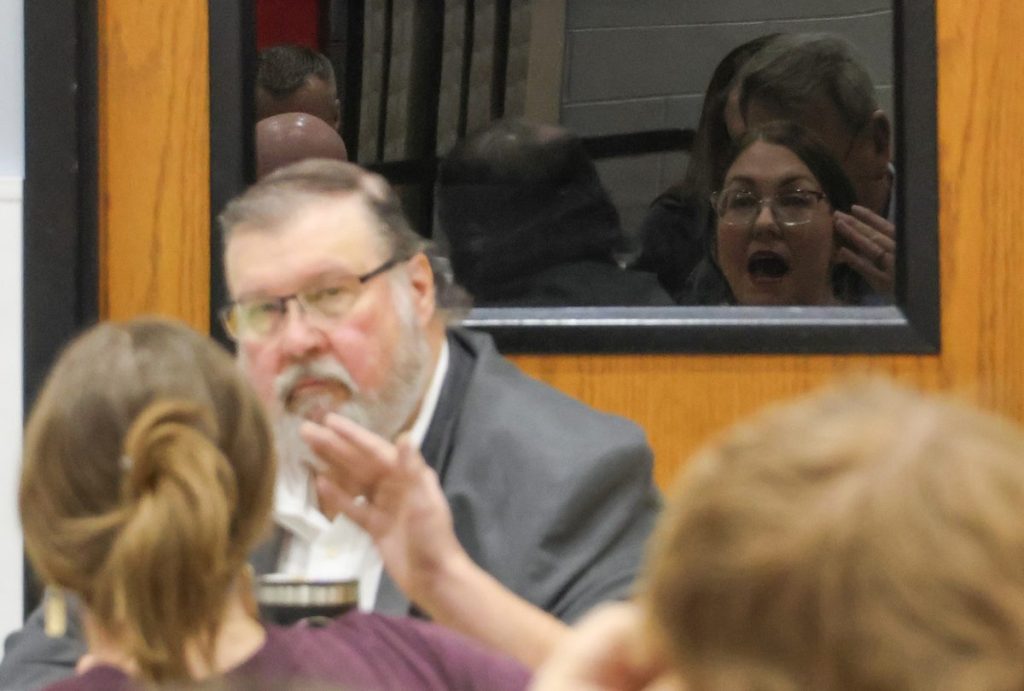
State Rep. Dean Van Schoiack, R-Savannah, listens to Emily Petersen, elementary and middle school principal at Mound City R-II, during Friday’s legislative forum for northwest Missouri principals. Petersen pressed the lawmakers on the lack of regulations for homeschooled students compared to more and more regulations created by the legislature for public schools.
SKYE POURNAZARI/THE FORUM
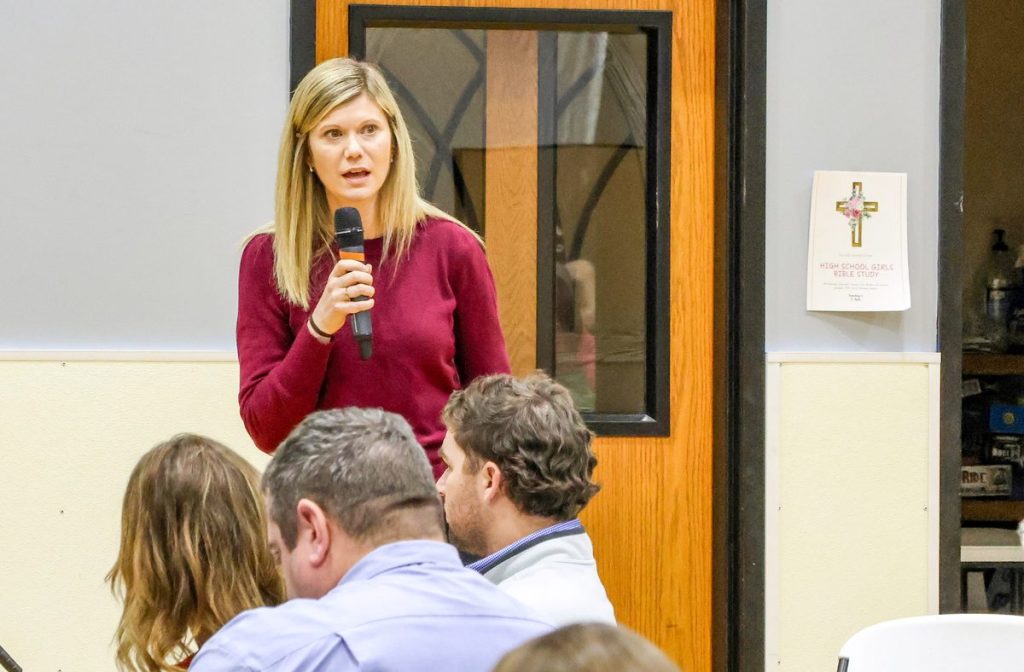
Heidi Beatty, Northeast Nodaway R-V principal and one of the event organizers, closed out Friday’s legislative forum by telling the lawmakers present that school staff, parents and students at her school are scared, “and rightfully so,” of what may happen to schools like theirs due to proposed changes to state funding sources.
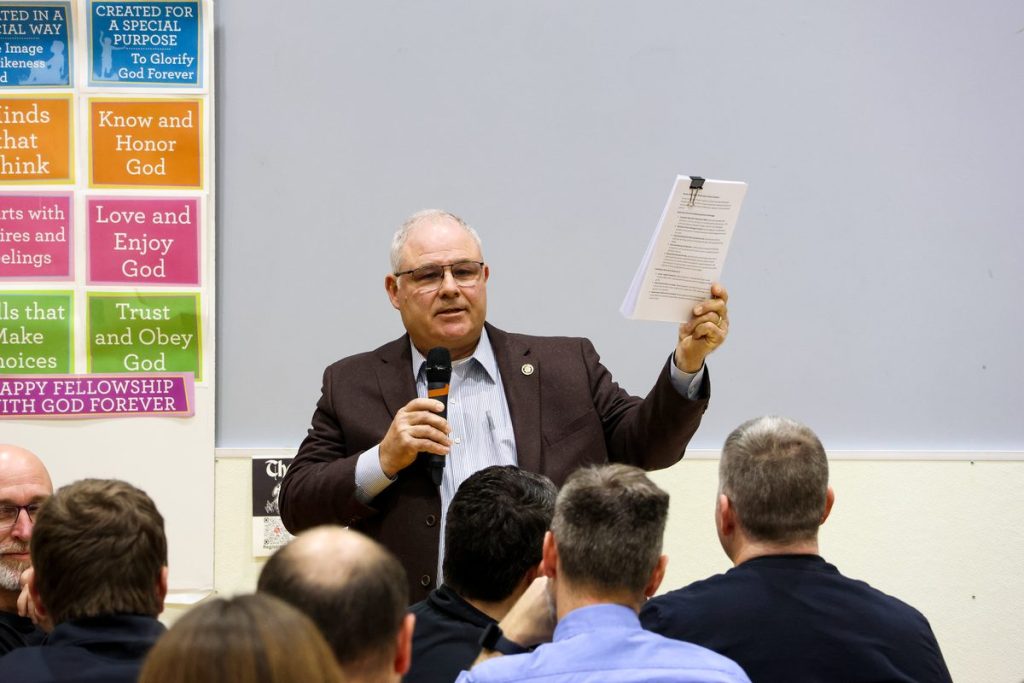
SKYE POURNAZARI/THE FORUM
State Sen. Rusty Black was one of four local lawmakers who spoke at a legislative forum during a joint meeting of northwest Missouri principals’ associations on Friday at the Frederick Boulevard Baptist Church in St. Joseph. Black brought handouts to the meeting that touted his record on supporting public schools, but he was reluctant to distribute them because “90 percent of you will throw them in the trash,” he said to the school leaders.