Crowd packs chamber talk on education funding
SKYE POURNAZARI/THE FORUM
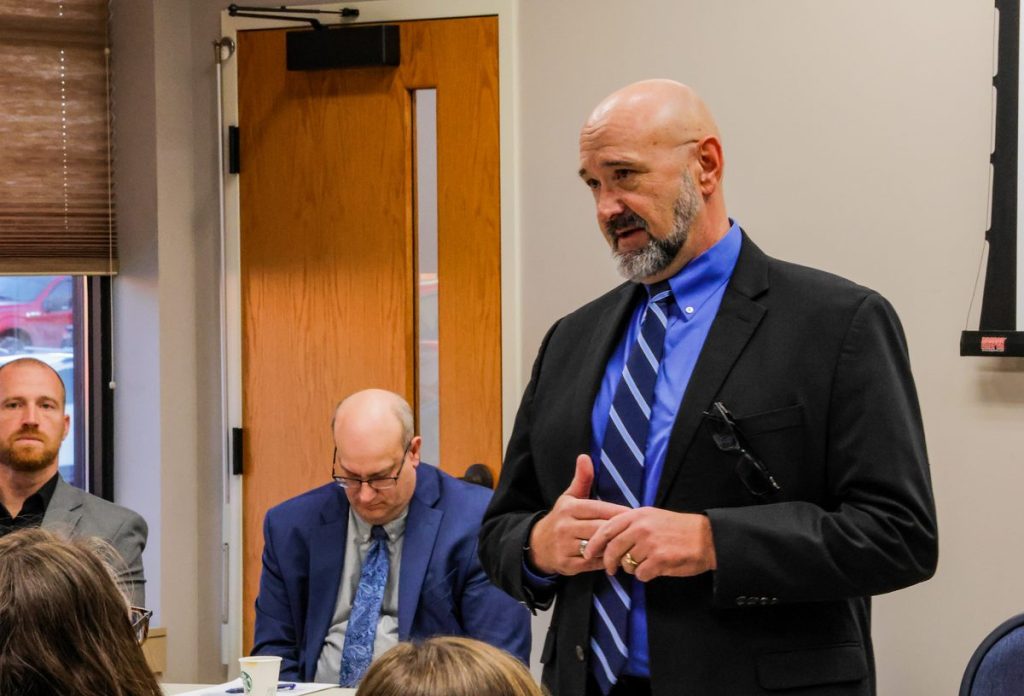
Duane Martin, an attorney with law firm EdCounsel, which consults with many school districts across the state to keep them in compliance with state law, was the keynote speaker during Tuesday morning’s Greater Maryville Chamber of Commerce Power Hour.
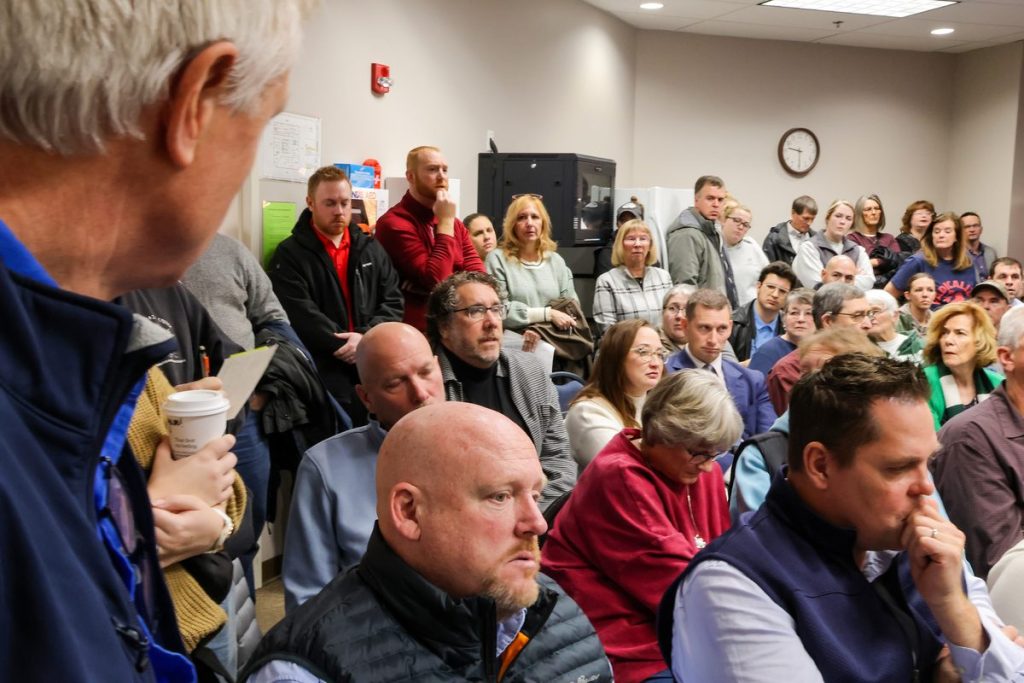
MARYVILLE, Mo. — About 140 people made up a standing-room-only crowd on Tuesday morning at the Greater Maryville Chamber of Commerce’s Power Hour presentation on education funding.
The attendees packed into the main-floor conference room of the Nodaway County Administration Center to learn more from state and local experts about how state policies are impacting rural school funding.
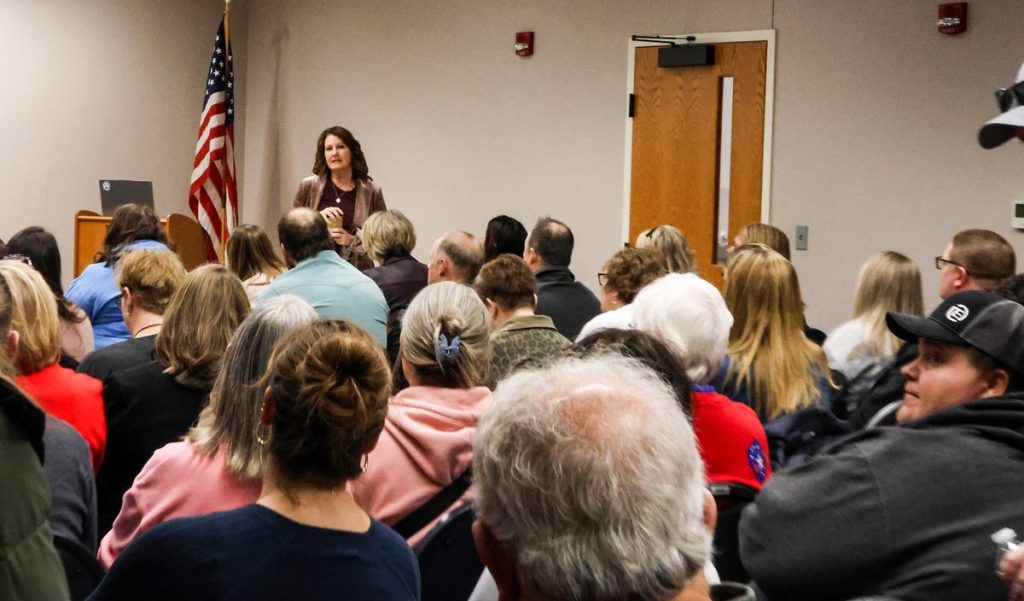
“It’s heartwarming to see so many people take an active interest that you’d leave your jobs and your warm homes on a cold day to come out and listen,” Becky Albrecht, chamber executive director, told the crowd.
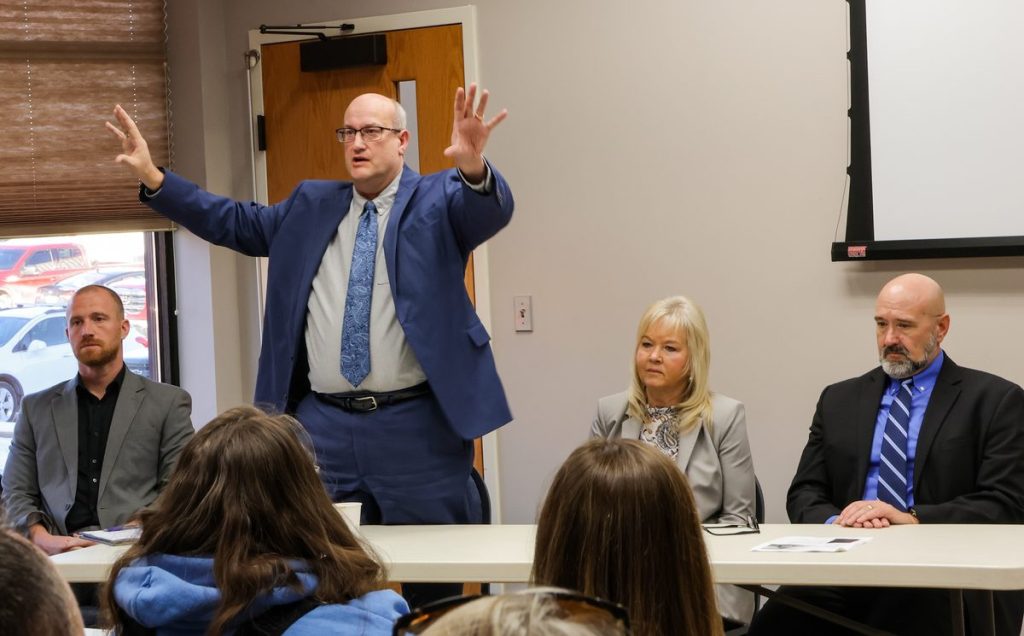
Duane Martin, an attorney for law firm EdCounsel; Nancy Greeley, Region H area supervisor for the Department of Elementary and Secondary Education; and John Rinehart, of financial consultants LJ Hart, spoke as part of a panel moderated by South Nodaway R-IV Superintendent Dustin Skoglund.
Martin focused on state policies that have resulted in less and less state funding for public schools.
“This is a policy choice that we’re all making,” he said. “We are shifting the funding responsibility for public school districts from state to local.”
Even compared to 2016, Martin said, the amount of state funding has dropped from about 49-51 percent split of state vs. local funding to about 44-56 in 2024.
Spilling out into the hallway, the over-capacity crowd gave its strongest reactions when Martin outlined how public money through the MOScholars program goes mostly to private schools in St. Louis.
For the first time last year, the state appropriated public money to go to the voucher program, which funds scholarships given out by approved nonprofits like the Herzog Foundation to their chosen recipients, helping to pay for private schooling. Last year’s appropriation was $51 million. Missouri Gov. Mike Kehoe has asked for that figure to go up to $60 million this year.
Martin highlighted that the program’s purported purpose was to serve students with disabilities or whose families could not typically afford private school, but said that a study of the program’s recipients showed about half of the scholarships are awarded to students who don’t fit into either of those two groups. During a presentation that elicited very few smiles from around the room, the biggest laugh of the day came when Martin pointed out that a family of four making up to just over $178,000 per year would meet the program’s low-income guidelines.
The speakers also nodded to other changes currently in progress, like the governor’s School Funding Modernization Task Force that is working to overhaul the state’s school funding formula, and proposals by Gov. Kehoe to eliminate the income tax, which is the largest source of state funding for schools, and to reduce property taxes, which is the largest source of local funding for schools.
“In addition to some of the facts you’ve heard, you’ve heard some hypothetical situations and things that are maybe in progress or in the pipe that could happen,” Albrecht, former superintendent of Maryville R-II, said. “I think it’s important to pay attention to those too, because like so many other things in life, we need to pay attention to what’s happening. … Sometimes if you sit back and you wait to see what happens, by the time we take action, it’s too late.
“So I encourage you to pay attention to things, draw your own logical conclusions and take the actions that you’re comfortable with.”
SKYE POURNAZARI/THE FORUM
John Rinehart, a former school administrator from Grant City who now works for LJ Hart, a financial consulting firm that works with school districts across the state, speaks during Tuesday’s informational event about education funding. Left is the panel’s moderator, South Nodaway R-IV Superintendent Dustin Skoglund, and to the right are Nancy Greeley, of the Missouri Department of Elementary and Secondary Education, and Duane Martin, of EdCounsel.
SKYE POURNAZARI/THE FORUM
Becky Albrecht, executive director of the Greater Maryville Chamber of Commerce, welcomes an over-capacity crowd to Tuesday’s Power Hour held at the Nodaway County Administration Center.
SKYE POURNAZARI/THE FORUM
A standing-room-only crowd packed the main-floor conference room of the Nodaway County Administration Center on Tuesday morning for a presentation hosted by the Greater Maryville Chamber of Commerce about how state policies impact rural schools. At center, Tim Wall, dean of the School of Education at Northwest Missouri State University, asks a question about Missouri’s low teacher pay during the meeting.