Skidmore to put $1M sewer bond on April ballot
SKYE POURNAZARI/THE FORUM
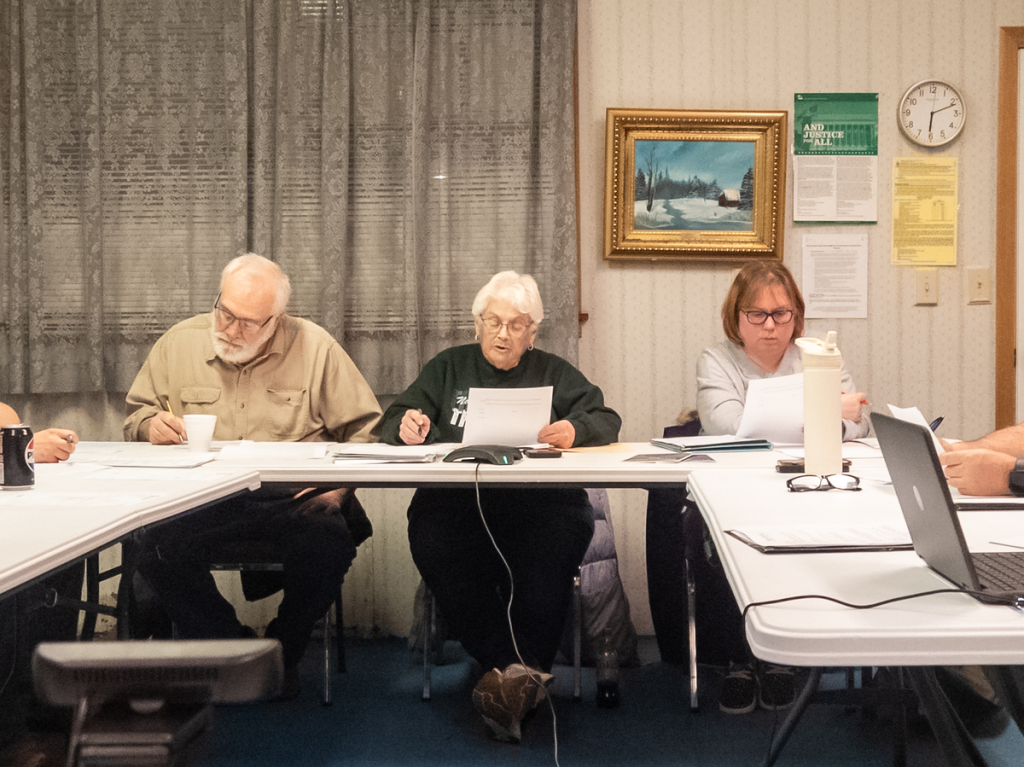
Beside Alderman Dennis Gladman, left, new Skidmore City Clerk Tisha Abrams, right, and Skidmore Mayor Teresa Carter reads a resolution to put a $1 million sewer bond on the April 7 ballot during the Jan. 8 regular board meeting at Newton Hall. Last week, the board approved another sewer project that may make the bond unnecessary, but the board is making sure it works before stopping the bonding process.
SKIDMORE, Mo. — The Skidmore Board of Aldermen voted Jan. 8 to put a $1 million bond on the April 7 ballot for its longtime sewer plant project, and last week approved moving forward on a new project that may accomplish the same end, but at a much more affordable cost.
The city approved placing the $1 million bond on the ballot in hopes of bringing the wastewater plant into compliance with state regulations. The plant has been out of compliance since around 2016, according to previous Forum reporting.
The city’s sewer project engineer, McClure Engineering, estimated the cost of the project at about $4 million. The city has around $1.1 million in unused bonding capacity previously approved by city residents, $1 million of which voters approved in 2018 for this very project.
Since around 2017, the city has struggled to get the project on track and in 2024, the Missouri Department of Natural Resources issued an order outlining required corrective actions, penalties and timelines for the city to get the plant back into compliance. If those deadlines aren’t met, the order noted, the agency may take action through the courts.
“Because you’re under the abatement order on consent, you guys are kind of up against some hard deadlines,” Mary West-Calcagno, of the Missouri Rural Water Association, said in a brief call during the Jan. 8 meeting. “You’re not kind of up against, you are up against some hard deadlines.”
During the call, West-Calcagno offered the board several options to find funding, including funds through Missouri DNR’s State Revolving Loan Fund and Community Development Block Grants.
Mayor Teresa Carter asked West-Calcagno what happens if the city doesn’t approve the bond.
“Then you do not qualify for grant money,” she said.
Another possible hurdle, West-Calcagno noted, is that Missouri DNR has told her office that it doesn’t seem likely that the federal infrastructure bill that provided a lot of this type of grant funding will be reauthorized, and that “the bucket will get smaller and the number of people who need to take money out of it will grow.”
The deadline for the city to apply for grant funds is March 1.
The problem and the project
For years, the city has worked with engineering firms on different plans to tackle Skidmore’s sewer problem. Reasoner explained that if the city weren’t to show some kind of progress on the effort, the plant would be sold by the state to the highest bidder, who would likely install some big apparatus like those that have previously been offered to the city as plans from engineering firms.
Three years ago, Mayor Carter and then-Alderwoman Kim Fetterer agreed that the project scope outlined by the city’s then engineering firm Snyder & Associates was larger than the city needed, with more bells and whistles than the small town with around 245 residents might require — plus the estimated cost was $2.1 million. They suggested focusing more on repairing the “trickling filter wheel.”
In a trickling filter system, pre-settled wastewater, meaning sewage with the solids removed via a clarifying tank, is continuously “trickled” or sprayed over a thick layer of rocks or other media. As the water migrates through gaps in the rock filter, organic pollutants are aerobically degraded by a microorganism-rich biofilm.
In Skidmore, the main problem is that the rotating sprayer that trickles effluent into the filter doesn’t always work and the bacteria don’t always function well, especially in cold weather. Output tests taken from water exiting the plant show the system isn’t cleaning the sewage well enough. In Skidmore, testing has shown high biological oxygen demand, meaning it contains more organic pollution and high ammonia, for which Reasoner said the limit is 1.3 mg/L.
“And we’re at 25,” he said.
New possibility
Since the project’s beginning in 2017, the city has faced numerous difficulties, including staff and elected official turnover, a pandemic and even a change of engineering company, which may happen yet again.
During the Jan. 8 meeting, City Maintenance Supervisor Mike Reasoner told the board that thanks to West-Calcagno, he was put in contact with Heartland Environmental Services, of Kingdom City, a company that does wastewater work in all 50 states, Canada and Poland, and which offered a proposal for services that may solve the city’s problems with a much more affordable price tag: $26,800.
In the special meeting held Jan. 13, the board met with West-Calcagno and Heartland representative BJ Baysinger remotely, then approved moving forward with a project that would mass produce microbes for wastewater treatment. Described as an “overdose” or an “inoculation” by Baysinger, the project would grow massive amounts of bacteria specifically selected to combat the very difficulties that the Skidmore plant is experiencing. The bacteria would have no other effect, he said.
Baysinger said the way the bacteria works is that there are 50 billion bacterial cultures per milliliter of liquid that is introduced into the system by way of large aeration kits, specifically made for Heartland.
“When that gets introduced into your water column, in 20 minutes that starts doubling,” he said. “And it keeps on doubling every 20 minutes.”
Heartland’s plan involves creating more aeration through three new aerator kits that increase oxygen to the system thus inspiring bacterial growth. He said for 250 gallons of the bacterial sludge, the cost is $5,000, which should last the city a year. The company proposed two types of bacteria to attempt to bring the effluent into compliance before it hits the creek system.
Baysinger told The Forum he has worked on hundreds of projects with a now very streamlined process and specially designed hardware that he has never seen fail.
“To be 100 percent honest with you, we have never failed and I mean that,” he said. “… The way we set it up and all the cities and towns that we’ve been in so far, we haven’t had a fail. … I’m not bragging that is just a fact.”
Selling live bacteria for 20 years, he said the company has a deep understanding of the science behind it.
Going forward
Reasoner said Heartland’s bacteria-based plan would increase the city’s maintenance cost going forward through further bacteria applications, though obviously not as much as a $4 million addition to the wastewater treatment plant.
However, Reasoner said that although this alternative would bring the city into compliance with Missouri DNR’s requirements, it would not solve the problem of the aging plant itself.
“This really doesn’t change a whole lot,” he said.
However, there are necessary repairs to complete before the new Heartland system can be installed. The old pump house will need a new roof and the windows bricked closed. A new, very flat concrete pad will need to be poured and new electrical will need to be run. Also, Alderman Gladman and Reasoner will need to complete the reconstruction of the trickle-wheel.
Fetterer, who was in the audience for the Jan. 8 meeting, said she was excited to finally hear the city find someone to come at the problem from this direction.
Also in the audience, Nick Sowards, with PeopleService, said it’s possible the city could get by another 10 years with its system with Heartland’s proposal.
Baysinger said when the city gives the go-ahead, Heartland could be in town and have the system installed within a month, weather permitting.
For now, the city is continuing with the bonding process in case the Heartland proposal falls through in some way.
Other news
- The board approved an update to an ordinance setting the mayor’s pay to the state’s current minimum wage.
- Three of the four board members, with Alderman James Duncan the lone dissenting vote, approved making a $2,500 payment to the principal of the water tower debt. Assistant City Clerk Laura Stark told them that they found a third CD that had a small amount of funds ($6,900) left from the USDA loan for the water tower project. She said the city could use those funds to pay down the principal. “It’s like we bought a pickup we couldn’t afford,” Alderman Gladman said. He said the city payment on the water tower loan is $1,291 a month and is currently paying more in interest than principal.
- Carter introduced new City Clerk Tisha Abrams at the beginning of the Jan. 8 meeting. According to Stark, Abrams previously worked as clerk from 2014 to 2017.
- Board members voted 3-0-1 to accept the CDBG demolition grant funds and make Carter the signer for all documentation. Gladman abstained due to one of his properties being on the list approved for demolition funding.
- Carter said the city has received the new playground equipment for both city parks and is waiting until spring to install them. If anyone is interested in helping with the install, they should contact City Hall.
- The board voted unanimously to rescind a 3 percent water cost increase that would have been on the Feb. 1 billing. Carter explained that the city was not included in a water increase by Public Water Supply District No. 1, so the city needn’t increase rates.