Southern corn rust in NW Missouri: A look back at this year’s season and what it taught us
ADAPTED FROM A MAP BY REEM ABOUKHADDOUR
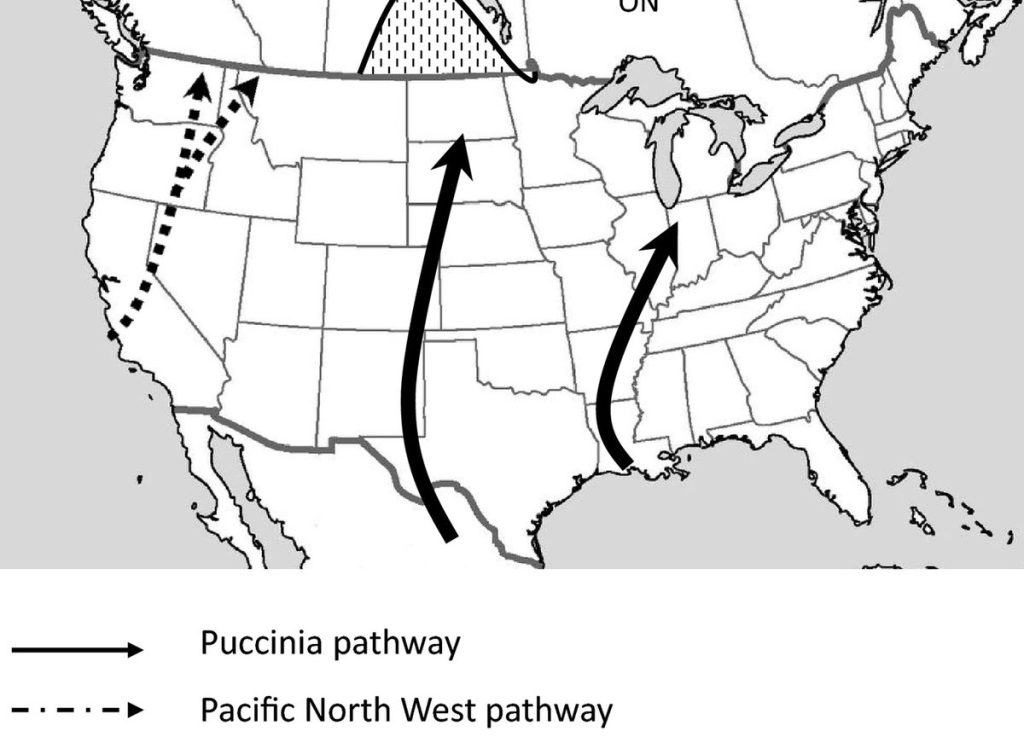
Map showing the Puccinia pathway (solid arrows) and the Pacific North West Pathway (dotted arrows) for typical cereal rust migration. Southern rust reaches Missouri and other parts of the Midwest primarily via the Puccinia pathway.
As production fields across Northwest Missouri settle into winter and the 2025 growing season ends, it is a good time to reflect on the season’s challenges, and leverage on those experiences to prepare for potential issues in the coming season. One concern many growers may look back on is southern rust and the role it played in corn production across this region of Missouri.
What is southern rust and how it arrived this year
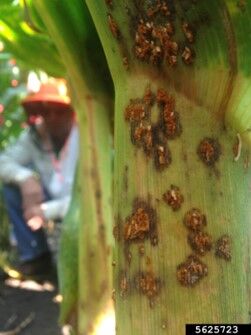
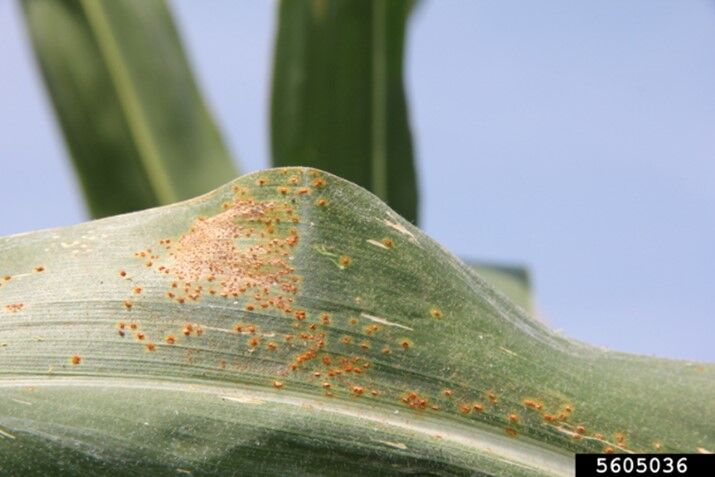
Southern rust is a fungal disease of corn characterized by producing orange erumpent lesions (called pustules) that develop primarily on the upper part of leaves and, in severe cases, on leaf sheaths. The orange pustules contain thousands of spores of the fungus Puccinia polysora, which causes the disease. Southern rust is related to common rust of corn as well as the rust diseases that affect wheat and other cereal crops.
Southern rust reaches Missouri and other parts of the Midwest primarily via the well-known aerial seasonal migration route for rust fungi known as the Puccinia pathway. The fungus cannot overwinter in most of the northern U.S. or Canada due to sustained freezing temperatures, but it persists year-round in parts of Mexico and the southern United States, including Texas, Louisiana, Arkansas, Oklahoma and Florida, where the pathogen can survive mild winters. From overwintering regions, spores produced by the fungus in early spring are carried northward by atmospheric transport along the Puccinia corridor, primarily via southerly winds and low-level jets.
The timing and intensity of southern rust in northwest Missouri, and other areas of the Midwest, vary considerably from year to year. In 2025, cornfields in Missouri saw a relatively earlier arrival of the disease than in previous years, with confirmed detections by July 15. In addition, in the U.S., southern rust was more widespread in 2025 than in the previous four seasons. This pattern suggests either an earlier regional introduction of the pathogen or a combination of factors that favored disease development, including susceptible hybrids, favorable weather (high humidity and temperature) and potentially a more aggressive rust strain.
What yield data suggested
There are no formal estimates of corn yield losses due to southern rust in this part of Missouri for the 2025 season. However, local reports and conversations with growers suggest that losses were moderate to high. This was driven by the unusually early arrival and rapid spread of the disease, particularly in fields planted to susceptible hybrids. Fields without fungicide protection commonly showed large yield penalties, with observed differences reaching up to around 60 bushels per acre. Although some hybrids displayed strong tolerance, most fields benefited from fungicide treatment.
Overall, southern rust was a major contributor to corn yield decline in the region in 2025. The disease showed its potential to cause significant damage when conditions are favorable. For context, the Crop Protection Network estimated yield losses from southern rust across 29 U.S. corn-producing states at 0.24 million bushels in 2024 and 0.9 million bushels in 2023, illustrating the disease’s potential impact when widely established. As with most foliar diseases, the severity of yield impact of southern depends largely on how early the disease becomes established, the susceptibility of the hybrid, and weather conditions favor disease development, particularly sustained humidity, frequent rainfall and high temperatures.
Scouting lessons from 2025
Southern rust can increase rapidly under the right conditions, but at early stages of development it can be mistaken for common rust or other, less aggressive midseason diseases. For that reason, accurate recognition of the disease in the field is essential. In 2025, most cornfields in northwest Missouri remained disease-free until early July, after which southern rust appeared and reached 100 percent incidence in most fields. Growers who scouted their fields weekly from mid-July through mid-August were able to track the slow buildup and make more informed fungicide decisions, sometimes choosing not to spray, which is just as valuable as choosing to spray in a high-pressure disease year. This year provided a useful scenario to observe disease progression and reinforce the importance of regular, timely scouting.
What to keep in mind for 2026
Looking ahead, here are the key takeaways from this season’s southern rust story:
- Scout your corn fields earlier in the season, even if disease pressures are low.
- Know your corn hybrid ratings to southern rust: resistant or tolerant hybrids can slow rust intensity.
- Watch rust confirmation in southern states: Texas, Oklahoma and Kansas. They give Missouri a reliable early warning.
- Remember that late-arriving rust rarely pays to treat, but early arrival can result in a lot of damage if the weather conditions are favorable for disease increase on susceptible hybrids.
- Be familiar with fungicide options and timing of applications to control the disease.
Final reflection
Every cropping season has its “personality.” The 2025 one reminded Missouri growers that diseases such as southern rust can offer lessons on scouting habits, hybrid selection, and how weather patterns steer disease development. As we look toward 2026, the best approach remains the same: stay informed, stay observant and make decisions based on local, real-time conditions rather than fear or habit.
Readers interested in learning more about plant disease can obtain additional information from local University of Missouri Extension agents or the state Extension specialists. Information on fungicide efficacy for control of corn foliar diseases can be found here: cropprotectionnetwork.s3.amazonaws.com/corn-foliar-efficacy-2025.pdf.
ALISON ROBERTSON/BUGWOOD.ORG
Southern corn rust pustules on the sheath of a corn leaf. The pustules sometimes develop on leaf sheaths in severe cases.
ADAM SISSON, IOWA STATE UNIVERSITY/BUGWOOD.ORG
Southern corn rust pustules on the upper part of a corn leaf. The orange pustules contain thousands of spores of the fungus Puccinia polysora, which causes the disease.