Missouri Hope simulation helps students, emergency personnel hone skills
TODD WEDDLE/NORTHWEST MISSOURI STATE UNIVERSITY
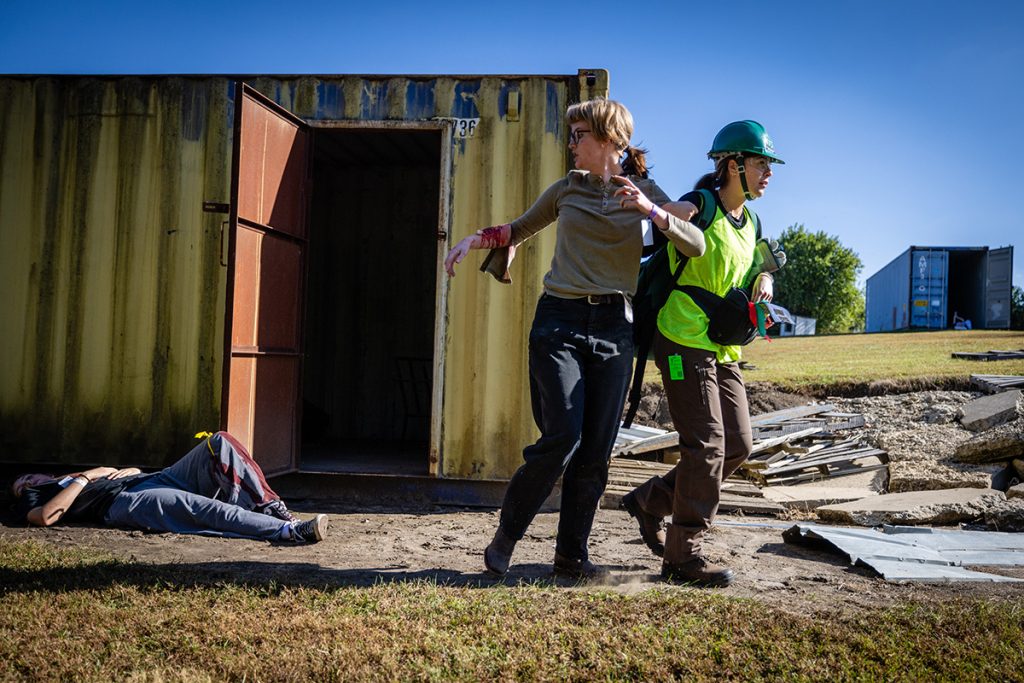
University of Missouri-Kansas City student Jackie McDonald assists a victim on Oct. 17 at Missouri Hope, which simulates the aftermath of a tornado strike on a small town. The 13th annual training exercise hosted by Northwest Missouri State University was held at the Mozingo Outdoor Education Recreation Area.
MARYVILLE, Mo. — A fall sun shone brightly at the Mozingo Outdoor Education Recreation Area throughout last weekend, but the environment was tense as Northwest Missouri State University hosted its 13th annual Missouri Hope emergency response field training exercise.
The simulation centers on the aftermath of a tornado that has devastated the fictional town of Redden Village. Participants in the simulation rotate through training lanes and response team roles that help them practice search-and-rescue, assessment of traumatic injuries and evacuations from difficult terrains, such as cliffs and rivers.
Additionally, participants work at an emergency operations center, where they are charged with making important decisions about how resources are distributed.
“They’ve got to coordinate helicopters, get with the highway patrol and block off streets,” Travis Surprise, a Northwest instructor of emergency and disaster management, said in a news release from the university. “Everybody gets that ‘aha’ moment, and they understand when they move to the profession; they understand exactly what’s happening on the other side.”
This year’s exercise attracted more than 50 participants with basic skills in emergency and disaster management as well as participants with advanced experience in emergency and medical operations. In addition to Northwest — where participation in Missouri Hope is required for emergency and disaster management majors — student participants came from the University of Missouri-Kansas City, Northern Oklahoma College, the University at Albany in New York, Paul Smith’s College in New York and The Citadel, the Military College of South Carolina.
Dozens of staff and disaster management experts representing regional partner agencies also provided support to participants and worked behind the scenes. Volunteer role players were dressed with moulage to mimic real injuries and portray disaster victims.
“Our goal out here is to not only train the nurses on medical skills in the field, but to train our emergency managers on what it looks like to hit some of these environments,” Surprise said.
At the start of each iteration of the simulation, a response team assembled near Redden Village and discussed their assignments before being dispatched to the epicenter of the disaster. The teams hiked into the village, where they immediately confronted a field with overturned shipping containers and buses, piles of concrete, and scattered debris. Bodies were scattered across the landscape as victims screamed and yelled for help.
This year, residents’ injuries ranged from an electrical burn to a pregnant woman who was impaled with a piece of wood. It was up to volunteers, first responders and advanced medical teams to search the damaged area and care for victims.
One by one, the team members approached victims to gather information and assess their wounds. To help the medical teams coming behind them, the response team tied colored bands around victims’ arms to characterize their injuries. Some were transported from the village to a field hospital; others, the first responders determined, could not be saved.
Jackie McDonald, a University of Missouri-Kansas City student pursuing a master’s degree in biology with a rural medicine emphasis, was among the first responders tending to victims at Redden Village. She said she was happy to get the opportunity to practice her skills — and to develop new ones.
“It’s kind of difficult because you don’t know what to do when there’s someone who’s bleeding in the neck and someone else is screaming at you at the same time,” she said. “So it’s really good to get that really submerged experience where you can decide on the clock what to do.”
Colby Kusinitz, a 2023 graduate of Utica College in New York, participated in Missouri Hope as a professional with firefighting and emergency medical services experience.
“Even I learned something here, and there’s not another program that I’m aware of that gives students the opportunity to do high-fidelity disaster exercise,” he said.
Missouri Hope is sponsored each fall by Northwest’s Consortium for Humanitarian Service and Education, a nonprofit organization that coordinates full-immersion experiences for individuals in the fields of disaster response and humanitarian relief. Partner agencies this year included the Maryville Police and Fire departments, Nodaway and Buchanan County Emergency Management and the Nodaway County Ambulance District, as well as representatives from the American Red Cross and Federal Emergency Management Agency.