Skidmore likely to see water, sewer rate increases
SKYE POURNAZARI/THE FORUM
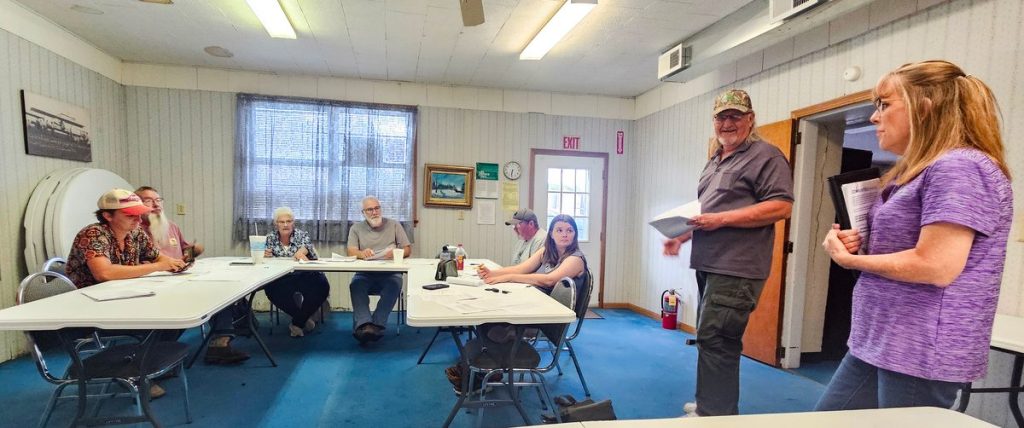
Kerri Peters and Dave Akins with the Midwest Assistance Program, a member of the Rural Community Assistance Partnership, talk to the Skidmore Board of Aldermen on Thursday, Sept. 11, about the importance of having an emergency response plan in order to seek funding.
SKIDMORE, Mo. — The Skidmore Board of Aldermen discussed the city’s low water and sewer rates and the need to increase them at its meeting on Sept. 11 at Newton Hall.
Valarie Main, a technical, managerial, financial specialist with the Missouri Rural Water Association, told the board that according to a study of the city’s water rates conducted by the rural water association, the city is losing about $18,000 per year on water and about $14,500 per year on sewer.
“It is substantial, but it’s also very common right now,” Main said. “… You’re not alone. Pretty much anybody who hasn’t raised their rates since COVID happened looks about the same.”
She explained that a lot of small towns are in the same situation. Having received American Rescue Plan Act funds and low-cost grant funding to complete longtime and short-term infrastructure projects, the increased municipality demands to complete those projects as well as a lack of available materials during that time with the supply chain issues pushed construction service and utility providers to increase the cost in water, sewer and broadband.
“The cost in this industry has increased drastically since 2020,” Main said.
She said the city’s current minimum water rate is $44 for the first 1,000 gallons and $10 for each additional 1,000 gallons.
An analysis from the rural water association suggests setting a new minimum water rate at $54.75 for the first 1,000 gallons and $12.75 for each additional 1,000 gallons. That would only make the city’s surplus around $6,500, Main said.
The city has 141 water accounts, according to city maintenance supervisor Mike Reasoner. He said a typical family uses around 3,000 gallons per month. This increase would take a typical 3,000-gallon user to a monthly water bill of about $80.25.
On the sewer side, an increase also is necessary, Main said. Currently, the city minimum sewer rate is $40 for the first 1,000 gallons of water used and sent into the sewer system, and $5 for each additional 1,000 gallons.
The proposed increase would set the minimum rate at $48 for the first 1,000 gallons and $8 for each additional 1,000 gallons.
This increase would take a typical 3,000-gallon user to a monthly sewer bill of $64. Together, the increases would see the typical 3,000-gallon user pay $144.25 per month for water and sewer. Under the current rates, such a user pays $114 per month.
“You’re gonna not be able to go to Starbucks one more time a month, and I know it’s crummy,” Main said.
Main said this increase in the sewer rate would provide the city a small surplus of $2,700 per year.
“It will be excruciatingly important to look at that in the future,” she said, noting that these increases will only help to stop the city from losing funds and doesn’t do much for saving anything for a dedicated fund for water, sewer, tower or line emergencies.
She said another city that she’s working with is looking at a 180 percent increase in its rates because the city hadn’t raised its rates since 1993.
“You’re raising rates to be sure that you’re substantial enough to continue to provide a service to the best of your ability at the best, most reasonable cost for your citizens,” Main said.
The last time the city raised rates was in 2022, and it was just enough to stay out of the red at that time. Since then the cost of water has increased as well as labor and parts. Mayor Teresa Carter asked Main how often the city should look at raising rates to keep up with repairs and growth.
“Next year you should adjust them again because you’re just making enough to make ends meet,” Main said.
Carter said the city will work to have updated ordinances to show this increase at the board’s Oct. 9 meeting.
Other news
- McHugh told the board that the city received its first funds from the voter-approved use tax which passed in April. The city received $814.02 for the month of August. These funds come from purchases made from out-of-state or online vendors, matching the local sales tax.
- The board approved an insurance policy from Clodfelter Insurance, with the proviso that the city will discuss removing the items listed on the policy that the city no longer owns.
- Board members reviewed the 2025 audit performed by CPA Kenney Hales, of Liberty, Missouri. McHugh said no significant findings were noted. The report notes that Hales did “not express an opinion on the effectiveness of the City of Skidmore, Missouri’s internal control.”
- The board heard an update from Rana Killingsworth with Skidmore Community Betterment that the organization is planning to divide the funds donated and matched through the Gladys M. Rickard Charitable Trust to place playground equipment at both Wildkat Park and Little People’s Park. No discussion was held.
- Board members approved an ordinance to control weeds, trees and shrubs within city limits. Noted in the ordinance are the charges for use of city equipment in the event the city must utilize its employees, equipment or contractors to abate a nuisance. For mowing or trimming performed with mechanical equipment and operator, the charge is $100 per occurrence. For mowing or trimming performed with non-mechanical equipment and operator, the charge is $50 per occurrence.
- The board approved an ordinance establishing that all inhabited buildings within city limits must have functional plumbing and water service. The ordinance also sets standards for recreational structures, interruption of service, penalties and puts in place a path for exceptions to be granted solely at the discretion of the city.