New local transport service hopes to cut wait times for patient care
SKYE POURNAZARI/THE FORUM
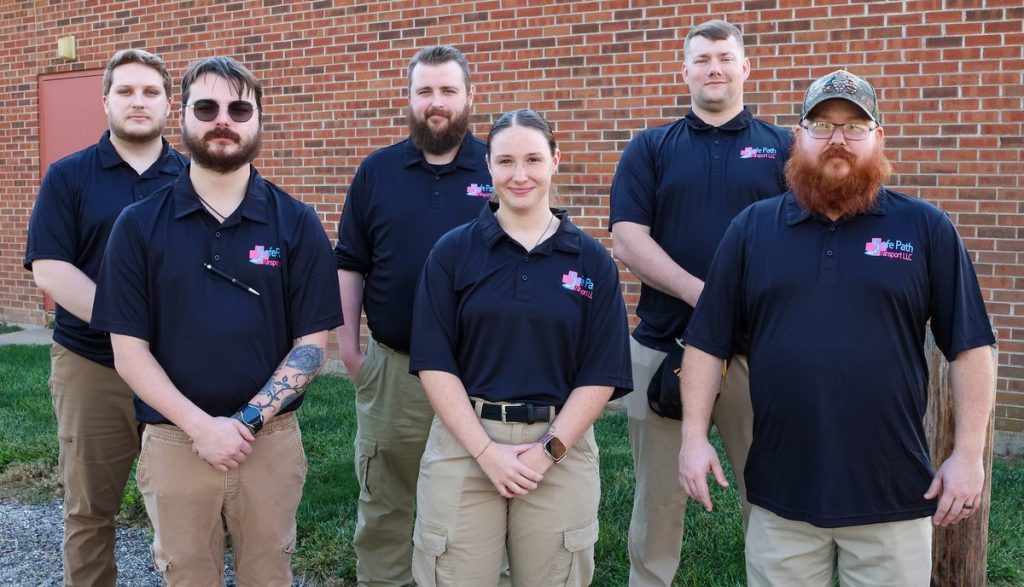
Safe Path Transport owner Mark Taylor, center back row, stands with the employees of the new local transportation company providing service to Mosaic Medical Center – Maryville and others in the region. The company contracts with medical facilities to transport psychiatric patients between facilities for inpatient care. Shown from the left are Jonathan Peters, Samuel Taylor, Mark Taylor, Skylar Johnston, Derek Dean and Randy Busse.
MARYVILLE, Mo. — Psychiatric patients at hospitals across the country can experience long wait times for available inpatient care beds. The same is true here in Maryville; however, the addition of a new local transportation service may help to shorten the time between a patient’s mental health crisis and care.
Local man Mark Taylor, owner of Safe Path Transport, has worked in security at Mosaic Medical Center – Maryville for four years, and during that time he’s seen the long wait times that some pediatric psychiatric patients have had to endure in the emergency room, sometimes as long as one or two days.
“It’s hard seeing all these people go through this stuff,” he told The Forum last week.
Deciding to do something about it, Taylor began research, contacted attorneys and said that “brick-by-brick,” the company came together, transporting its first person in June of this year.
Designed specifically to help hospitals safely and efficiently transfer patients without medical complications between health care facilities, Safe Path Transport is currently utilized by Mosaic in Nodaway and Buchanan counties, and by the Harrison County Community Hospital in Bethany to transfer patients to open beds throughout the state and beyond.
Paula Goodridge, director of emergency services at MMC-M, told The Forum over the phone last week that the Nodaway County Ambulance District doesn’t provide transport for psychiatric patients waiting to be moved to receive inpatient care at other facilities. She said that Mosaic doesn’t have a secure transportation service to help those patients either.
“As a result, we must rely on outside contractors to facilitate the transfer of patients to psychiatric facilities,” she said.
The result is that psychiatric patients can sometimes wait a long time for care.
She said the shortest time they’ve had a psychiatric patient in the ER after a crisis is four hours. During that time, the caregivers are performing a medical screening, finding an appropriate bed and arranging transportation to a facility that offers the type of mental health care necessary. The behavioral health unit at Mosaic doesn’t have pediatric beds, so children will wait for transfer after a crisis in the ER. Taylor said that geriatric psychiatric patients are sometimes transferred to a facility in St. Louis, if it has a bed available. He said there is no longer a facility in Kansas City that focuses on elder psychiatric care.
The longest time a patient has waited in the ER has been one or two days, Goodridge said. That’s not only waiting on transportation, but also for a bed in an appropriate facility to become available.
“Sometimes bed availability for pediatrics (is) very restrictive,” she said, noting that while some of those patients — juveniles or those having thoughts of self-harm — are waiting, a hospital staff member is required to stay with them “one-on-one.”
Goodridge explained in an email on Monday that there are a few other vendors throughout the state that provide secure transportation; however, problems arise when the number of patients needing transport surpasses the number of drivers available.
“A patient being transported to Springfield can tie up a driver all day,” she said. “We are competing with other statewide hospitals to get our patients where they need to go. The more options we have for transportation the faster we can get a patient to the care they need.”
She said given the limited availability of inpatient psychiatric beds and the frequency with which facilities that have them reach capacity, once placement is secured, there “is an urgent and immediate need to initiate transport in order to ensure continuity of care and timely admission.”
The faster a bed can be located and transportation set up, the better it will be for the patient who will receive the inpatient care they need, and also for the one-on-one staff member who can be back in rotation helping other patients.
“There’s always somebody ready to go,” Taylor told The Forum on Monday, noting his company’s response time is between 40 minutes to an hour from the first call to being on site for service, which he said helps decrease the time patients have to wait.
Taylor works as the company dispatcher as well as a driver. Upon his call, drivers get moving and provide up-to-date arrival times for pickup and drop-off. To be clear, the new transport service is not an ambulance service. Though not medical professionals, the drivers are certified in basic life support, CPR and maneuvers, and trained in the Crisis Prevention Institute’s nonviolent crisis intervention, which involves de-escalation.
They’re only allowed to transport a person based on a hospital’s medical staff’s decision, Taylor explained. The people being transported have been medically cleared by the hospital for transport. He said most of the people they have been transporting include people on a 96-hour psychiatric hold, or are seeking rehabilitation or an open bed for inpatient mental health care.
Having traveled throughout the state taking people to those open beds, Taylor said his company is providing a necessary service. Taking calls at all hours of the day and night, he said the company is providing transport for around 24 people every two weeks in St. Joseph and has probably provided that number of rides in Maryville since the company started in June. He said while Safe Path Transport is still very local and small, he’d prefer to keep it that way so response times stay low.
“It won’t take near as long as it used to,” Taylor said. “So getting local mental health (care) is a lot easier than it used to be.”
He said that during a transfer, he and the other Safe Path Transport drivers often hear from the person in crisis they’re transferring. He said trying to keep to the line of transporter and not become involved can be tough, because a lot of people are just looking for someone to talk to about what they’re going through. He said a driver also has to be reassuring to the passenger, letting them know that they’re making the right decision asking for help.
“We’ve had kids go down there who’ve obviously never had someone to talk to and they’re trying to talk to you about all this stuff,” Taylor said.
Goodridge said Safe Path Transport, is “absolutely,” meeting a need.
“The more options we have, the better we’ll be able to take care of our community,” Goodridge said.