Reports paint dire picture of local child care needs
CHRISMAN CONSULTING
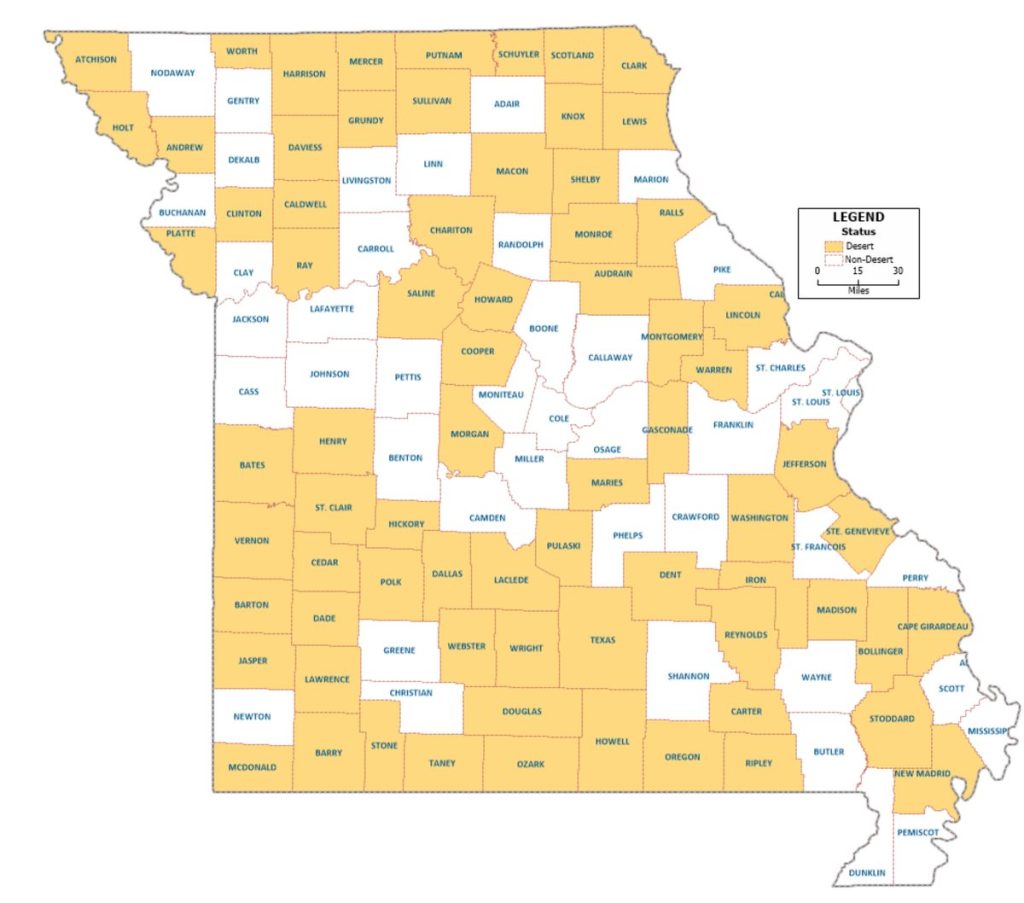
April 2025 data from Child Care Aware of Missouri shows counties considered to be “child care deserts” for children ages 0-6. Child care deserts are areas in which three children need care for every available child care slot. According to a new child care report, Nodaway County is around a 2-to-1 ratio, which does not meet the definition of a child care desert, but is a significant barrier to community growth.
MARYVILLE, Mo. — Two new studies highlight a lack of child care providers and affordable housing, along with low wages and a mismatch between the skills of potential employees and the needs of employers, as the top issues constraining the labor market in Nodaway County and the surrounding region.
Reports produced by Chrisman Consulting, which conducted the studies, said that while there are plenty of job openings in Nodaway County, there appear to be few job seekers available to fill them. The reports analyzed barriers to employment, including a separate study centered on child care challenges.
“These reports give us the data needed to understand better our labor force and the challenges facing working families,” said Maryville City Manager Ryan Heiland in a news release. “The findings will guide the City’s efforts to strengthen our community by investing in the resources that support both employers and residents.”
The studies were initiated by the city of Maryville, which partnered with Nodaway County, Nodaway County Economic Development and the Maryville Industrial Development Corporation.
Child care
The child care report estimated there are currently about 1,050 children in Nodaway County in potential need of child care, and only about 529 slots available at both licensed and unlicensed child care providers. That leaves a gap of about 521 slots, the report concluded.
“Licensed child care capacity in Nodaway County falls well short of meeting the needs of working families,” the report stated. “The demand for child care is not isolated to a few high-population areas — it is consistent across most zip codes, with 60% to 75% of young children living in homes where every adult is employed. This widespread need highlights the urgency of expanding child care infrastructure throughout the county.
EMPLOYER SURVEY
Of the 19 employers surveyed:
- 88% believe labor force participation would increase if more child care options were available
- 83% experience employee absences due to child care issues
- 33% have lost employees due to lack of child care option
“Moreover, child care needs assessments and subsidy data underscore that the gap is even more pronounced for families living in poverty. These households not only struggle to find available care, but also face affordability challenges that limit their options even further.”
While those figures are estimates based on census data, the study also included survey feedback. In a survey of 19 area employers, they said a total of 75 slots for certain could be filled immediately by children whose employed parents are in need of reliable child care services. The shortage is particularly acute for the 0-2 age range.
The report noted that even though availability is itself a massive barrier, affordability is just as big a worry. The report found that of the 362 employees who responded to a survey, 41 percent said that between 11 and 20 percent of their income went to child care, while 14 percent said that more than 30 percent of their annual income is spent on child care. The U.S. Department of Health and Human Services requires states to cap child care copays at 7 percent of a family’s income for families who receive child care subsidies, making that figure a generally accepted benchmark for what a family should be expected to spend on child care.
Part of the affordability problem stems from low wages in the county. The separate laborshed report stated that noncompetitive wages is a major obstacle to growing labor force participation.
Even those that are eligible for the child care subsidy, however, often aren’t able to use it. According to the report, there are eight child care programs in Nodaway County licensed with the state. Representatives from an additional 25 unlicensed programs — which are in-home operations allowed to care for up to six children and are not subject to safety and background check regulations like licensed facilities — took a survey as part of the study. In total, only four providers in the county accept child care subsidies, which are paid directly by the state to the provider. In survey responses, providers who don’t accept the subsidy largely cited the paperwork involved, requirements and having to wait for the payments to arrive while operating on shoestring budgets.
In survey responses, several parents specifically bemoaned the loss of the Mosaic Child Care Center, which shut down just ahead of the start of the 2020 school year.
“Child care is a MASSIVE need for this community, not just in my line of work,” said one current Nodaway County employee in a survey. “Losing the Mosaic daycare killed our certified child care in this city.”
At the time, Mosaic Medical Center – Maryville President Nate Blackford said the facility was losing much more money than anticipated. Later, a Mosaic spokeswoman told The Forum the biggest problem was retaining a state grant that required a certain percentage of enrolled children to come from lower income families.
Rita Miller, then the communications manager at MMC-M, told The Forum in a 2021 email that the threshold was not met, which resulted in the center losing the grant money that was crucial to funding operations.
“It was a pretty good goal, and it was not met,” Miller said in the email. “They had gone through several directors and — my opinion — the later ones did not realize the significance of meeting the requirement so did not really push to recruit new families.”
According to Forum reporting at the time of the closure, the child care center was serving 109 children, including 40 in the 0-2 age range with a waiting list of 39 just for that age group.
“Maryville has become a daycare desert and it’s devastating to working parents,” another employee said in the survey. “It’s a complete shame that a new child care building at Mosaic was not seen as a need for the area.”
The child care report issued this month was more subdued than survey respondents in noting the closure of the facility, but acknowledged it as a major loss for the community and that the ensuing squeeze on child care availability has had far-reaching effects on the labor force.
Child care solutions
The report recommends multiple strategies for small-scale solutions, advocating for more support to help more child care operations become licensed and accept subsidies, more flexibility and assistance from employers for working parents, and ways to help new child care operations start up.
EMPLOYEE SURVEY
Of the 362 current employees* surveyed:
- 77% missed work in the past 6 months due to child care
- 36% reduced hours or left work early due to child care
- 10% turned down a job or promotion due to child care
*91 percent of respondents said they live in Nodaway County
One of the major proposals in the report is for large employers to partner with other entities to provide as much support as possible for working-parent employees, up to and including opening on-site child care facilities. In a survey, only 38 percent of employers said they would be open to such partnerships, though.
For now, the report encourages employers to more effectively promote existing child care opportunities to their employees and look into ways to be more accommodating. For example, helping employees prepare for holidays or other known days when child care will not be available and adjusting policies and practices to be more flexible for parents, especially in emergencies.
“My 2 year old goes to an in home, not state licensed, daycare,” said one employee in the survey. “She closes very regularly for various different reasons, forcing me out of work to pick him up and/or stay home with him. I do not accumulate enough PTO every month to keep up with how often the sitter closes, causing me to take points and no pay at work for the time I’m gone.
“It affects my job greatly not having a RELIABLE child care provider. The one state licensed daycare in town I cannot afford (1050/month) and I make $100 too much to qualify for state child care assistance.”
Allowing something like emergency family days would help, the report notes, as would offering additional financial assistance to parents or allowing the use of existing benefits, like educational stipends, to be used for child care expenses instead.
To assist child care providers, the report recommends multiple ways to give existing providers access to more resources, especially with an eye toward helping unlicensed providers become licensed.
In the survey, providers said they need more help with the back end of the business, including with bookkeeping and other administrative tasks, and some training in how to navigate regulatory requirements.
“Because it is impossible to run a licensed facility and comply with state regulations and pay living wages and pay for food and snacks and insurance and charge an amount that people in Nodaway County will actually be able to afford,” one provider said in the survey. “That is why every other industrialized nation supports child care as a part of a fabric of a social safety network.”
Additionally, the report suggests trying to expand the number of providers and alternative options by appealing to multiple age groups, and to women in particular, starting with programs to train more middle school and high school students in babysitting. At the other end of the spectrum, the report recommends recruiting retirees to assist either full time or as fill-ins to help a chronic shortage of substitutes at existing child care providers. In the middle is a proposal to encourage families to rotate caring for each other’s children during the day in child care co-ops.
Those kinds of low-cost programs could help providers who typically do not have the budget to pay much to any employees they may hire — a significant barrier to expanding operations, the report stated.
The economic development group has particularly touted its new Nodaway County Child Care Growth Fund, which the report states will offer forgivable loans of up to $10,000 to help child care providers expand or start up.
Although the report does not list any specific agencies or organizations to implement the strategies, a news release from the city of Maryville indicated that the city and NCED have begun on at least some outreach to businesses and providers about the recommendations in the reports.
CHILD CARE PROVIDER SURVEY
Is there anything else you’d like to share about providing child care in your community?
“Conservative policies to cut, cut, cut are creating a mess. We need to add resources to child care. We need funding support. Otherwise, parents will be priced out. Forced to stay at home. Forced out of the labor market. Not bringing in revenue. Not adding value to businesses. The cost of doing business as a child care center is impossible now. Without government support to defray the real costs of having a center (meals, salaries, benefits, resources, materials), there will be no licensed child care in Nodaway County in five years. Learn the lessons of Mosaic’s child care center failure. Got a big grant. Had a center for two years. Closed it. Step up and fund licensed child care at Northwest’s Infant and Toddler Center or watch it follow in the footsteps of Mosaic, leaving little kids to go to grandma’s basement and watch VHS tapes of Barney in overcrowded, unsafe conditions and/or keep moms/dads at home because they can’t afford to work. These policies have created chaos, and they were predictably short-sighted.”
-Nodaway County child care provider
Laborshed
In a separate report, Chrisman Consulting analyzed the “laborshed” area, an 11-county region in northwest Missouri that sees overlap in workers and residents.
The report cited four major issues that keep the region’s labor force from reaching its full potential: a lack of child care options, a lack of affordable housing, a lack of workers to fill open jobs, and a talent pipeline that doesn’t feed local employers due to mismatches in qualifications and low wages.
Housing was mentioned by every focus group of stakeholders, and employers also listed it as a major barrier to bringing in employees.
The report did not provide much analysis of the housing situation or solutions, instead saying that the city of Maryville plans to address the issue in its comprehensive plan. That plan, which will outline the city’s priorities for the next 20 years, is still in the feedback-gathering phase and is expected to be completed next year.
Generally, though, the report said that the high price of rentals, which are often priced for multiple college students rather than young professionals, is of particular concern, along with the quality of rentals and lack of starter homes for purchase.
The report instead focused on what is drawing workers away from Nodaway County and northwest Missouri rather than to the open jobs here, especially in the manufacturing sector.
While there is a high concentration of manufacturing jobs in the region, nonetheless there are perpetually many openings that employers have trouble filling. One of the key reasons, the report postulated, is that the workforce is relatively well-educated and are underemployed in entry-level jobs, leading to high turnover and a reluctance for some to reenter the workforce in a job that doesn’t fit their skillset.
Of the currently employed individuals who responded to the survey, 17.4 percent had only a high school diploma or less, while 49.5 percent had a bachelor’s degree or higher. Of respondents not currently employed, 41.9 percent said they had a bachelor’s degree.
Wages were also a major issue listed by current employees, including those who commute elsewhere and those not currently employed. Better pay somewhere else was the overriding reason listed for why workers commute out of the region, which often helps to pay for expensive child care, the report stated. And pay was a significant factor in why many individuals indicated they had not yet returned to the workforce — again, often because wages would not be enough to offset the cost of finding reliable child care, forcing one parent to stay home or work only part-time.
The survey of current employees showed that 1 in 5 have a side gig, adding further evidence to a need for higher pay for employees in northwest Missouri.
In their own responses, 68 percent of employers stated it was difficult or very difficult to find qualified employees, saying that often job candidates or current workers want higher wages and more flexibility to work remotely, and often lack work ethic or diligence.
Laborshed solutions
To address those issues, the report recommends paying more money along with offering more training opportunities and ramping up outreach, especially to young people and to the developmentally disabled.
The report notes that capturing young talent earlier could entice graduates who might otherwise leave the area to stay here instead. One way to do that is by offering more internships tailored to high school and college students that carry the promise of full-time work after graduation. Additionally, NCED is planning to increase hands-on and interactive opportunities for students that tour manufacturing facilities during the annual Manufacturing Day, and will try to work more closely with schools to expand participation in the program.
At the same time, the report also states that employers must find ways to pay employees more in order to stay competitive within their industries.
The report sees the developmentally disabled population as a significant untapped resource for employers to connect with, suggesting more collaboration between businesses and organizations that assist developmentally disabled individuals. In addition, businesses could receive more training on how to best utilize developmentally disabled employees to fill vacant jobs that others have passed on.
More information is available from the reports posted on the city of Maryville’s website under the “Community” tab.