Burlington Jct. leaders talk streets grant, lagoon
SKYE POURNAZARI/THE FORUM
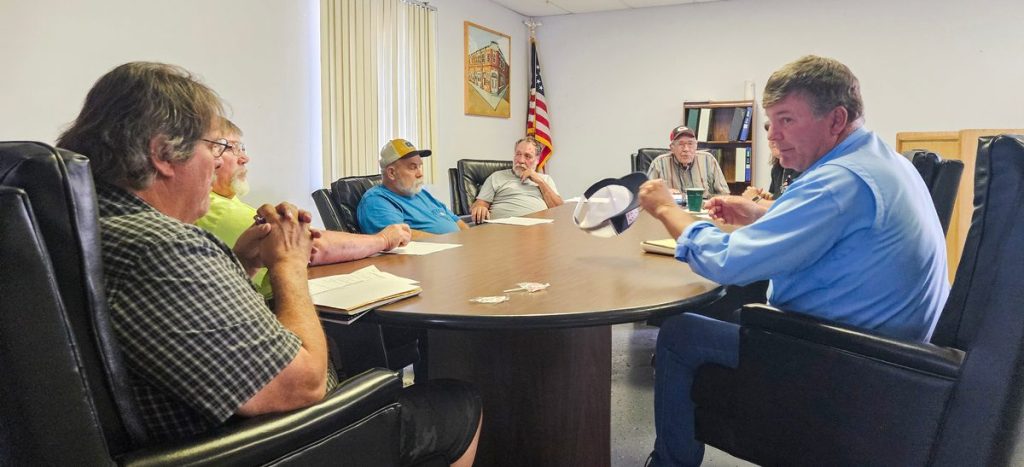
Brock Pfost, right, with White Cloud Engineering gives an update about the work being done at the city lagoon during Monday’s Burlington Junction Board of Aldermen meeting.
BURLINGTON JCT., Mo. — At a Monday meeting, the Burlington Junction Board of Aldermen heard an update on the city’s ongoing lagoon expansion project and held a public hearing regarding a needs assessment for its application for grant funds to help city streets. The board then scheduled a special city meeting for regular business at 6 p.m. tonight, June 12.
Kirk Kopper, community planner for the Northwest Missouri Regional Council of Governments, introduced himself to the board and community members present, and discussed the city’s needs in order to fill out a form that will be used to apply for a $500,000 grant to help repair city streets.
He said that the city maintains approximately 33,077 feet, or 6.26 miles, of streets. The city received a preliminary engineering report from Snyder and Associates identifying that 62,083 square yards of streets and parking areas are in need of improvement, with 16,062 square yards of those streets having a severe need for repair.
Board members worked with Kopper to complete a list of questions which found five areas of city facilities that are in poor condition, including streets, sidewalks, infant/day care, single-family housing and economic development.
While the form doesn’t necessarily mean any one of these areas is in poor condition, Kopper explained, it can mean that the number of available services doesn’t meet the need of the community.
Kopper said that he will use the information to complete the form identifying the community’s top needs and describing how the city’s proposed project would relate to them.
“It’s a little bit like strategic planning in terms of agreeing on … the (things in town) we have the most problems with specific problems,” he said. This will help the city focus its time, money and efforts on those specific needs, he noted.
Community member Martha Greeley asked where the the current CDBG grant cycle stands.
Kopper said he didn’t think they were very far into this cycle, but that this needs assessment is likely good for up to a year should the city need to reapply.
He explained that if the grant window closes, it’s possible it will reopen within that year, if there are remaining funds that could fund a project.
He was going to check with Jerri Dearmont, executive director of the regional council, about how long the needs assessment will be good and whether winning grant funds for the project would preclude the city from applying for other statewide grants.
Lagoon
Working alongside engineering firm Lamp Rynearson, Brock Pfost, with White Cloud Engineering, of Maryville, told board members that the city’s lagoon project is moving along well with 90 percent of the earthwork complete and all the grades and back slopes pretty much done.
He said what’s left is mostly some replacing of fencing, a couple gates and seeding, which the company won’t fully do until September. Pfost said the plan is to seed a cover crop to help with any erosion up until that time.
“I fully expect if the gates come in when they’re supposed to … by early fall we should have everything completely done and seeded and cleaned up out there,” he said.
Pfost said the project will “significantly increase” the amount of space for storing wastewater from the city. The project will add between 28 and 30 inches to what the lagoons once had. He said the lagoons had about 18-20 inches of sludge in Cell 2, so likely even more in Cell 1, he said. None of that sludge was removed.
“The extra capacity was done by raising the dikes,” Pfost said, which he said was cheaper than dredging and land application.
He also noted that work is proceeding on some of the other equipment that’s still incoming, including shear gates, which won’t arrive until September. He said it’s not necessary to have them now, that they’re already beginning to refill the lagoon cells.
The city is also waiting on some ultrasonic flow meters and some stainless steel baffle plates that will help city staff measure the flow and view digitally whether pumps are on or off.
Pfost said that the building where the disinfection feeding equipment will be located is likely to be delivered in a couple weeks and will be hooked up at that time. He said Gary Coenen, owner of Coenen Electric, suggested a change to the project to run a separate electrical line and box from the pump station down to the chlorine building. This will save the city a considerable amount of money, even adding a new service line, since it removes around 2,000 feet of heavy copper wire that had originally been planned.
SKYE POURNAZARI/THE FORUM
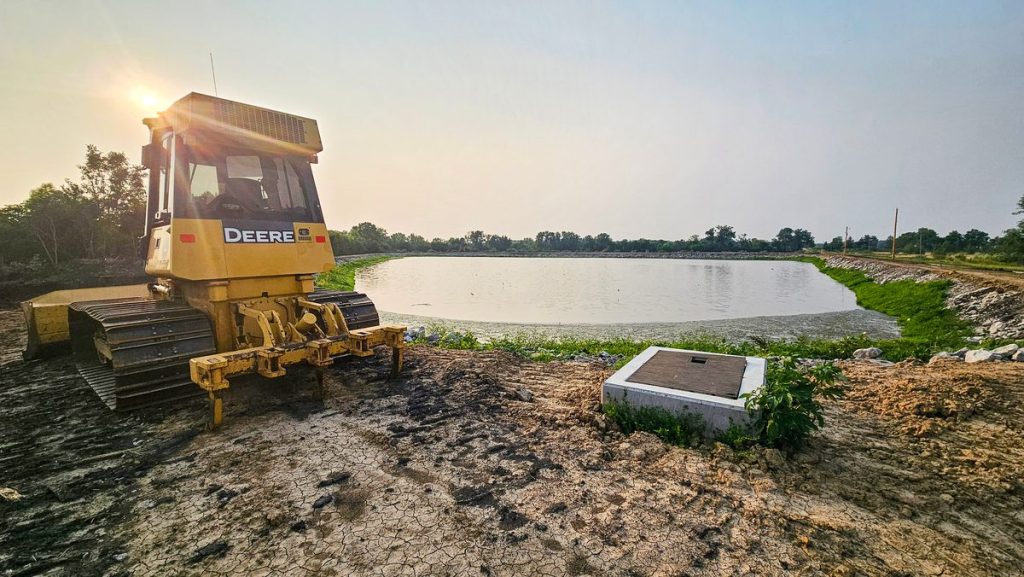
The Burlington Junction lagoon is shown Monday evening on Danube Road west of town. The dikes have been raised considerably to allow more storage of wastewater from the city. Brock Pfost with White Cloud Engineering said this project cost considerably less than dredging the lagoon and paying for land application.