Methodist Episcopal Church division in Nodaway County
NODAWAY COUNTY HISTORICAL SOCIETY
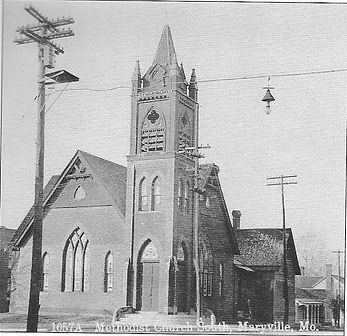
The Methodist Episcopal Church, South was built in 1890 on the corner of Second and Buchanan in Maryville.
MARYVILLE, Mo. — The history of the Methodist Episcopal Church in Nodaway County showed that while this community could be a place of violence, hatred and tension, this community could also be a place of compassion and friendship.
Twenty years before the American Civil War, the Methodist Episcopal Church split nationally over slavery. Likewise, Nodaway County was divided over slavery as Missouri was a border state. Despite the violence of the mid-19th century, the Methodist churches in Nodaway County resided in general peace until their reunion in 1939.
The Methodist Episcopal Church was established in the United States with an anti-slavery platform. As Methodism spread throughout the 19th century, the church took a more neutral stance on slavery to appease Southern members. These appeasement measures enraged abolitionist members of the North. In turn, the abolitionist activism of Northerners angered members from the South. Due to these rising tensions, the pro-slavery, Methodist Episcopal Church, South was formed in 1844.
Methodism made its way to Nodaway County in the 1840s. Early services were small and conducted within homes. The first Methodist Episcopal Church building was constructed in Maryville and opened in 1867. There also was a branch of the Methodist Episcopal Church, South organized in Nodaway County in 1846. During the Civil War, their church services were suspended for three years due to Confederate sympathizers fleeing Nodaway County or serving in the war.
Nodaway County faced unrest during the Civil War. This unrest spread to the Methodist Episcopal community. An anti-slavery preacher in northern Andrew County, William Sellers, was tarred and feathered by a pro-slavery mob in 1854. Another preacher, D.W. David, was forced to hide in a tree stump to escape a pro-slavery group. In 1857, Methodist Episcopal preacher John Chivington threatened pro-slavery churchgoers with a gun in Pickering.
Despite these acts of violence leading up to the Civil War, there was not much evidence of there being violent incidents directly involving members of the Methodist Episcopal churches after the Civil War. That is not to say that incidents did not happen, nor is that to say that members of these churches were not involved in documented acts of violence in the decades since the Civil War. But the archival record shows that the churches were relatively friendly with each other. For example, the Methodist churches hosted guest preachers from different churches. Later during World War II, the Methodist Church, the African Methodist Episcopal Church and other churches in Maryville joined together to support the Red Cross.
On May 10, 1939, the Methodist Episcopal Church and Methodist Episcopal Church, South reunited to form the Methodist Church. A week later, the measure was adopted in Maryville. The Methodist Episcopal Church, South on Buchanan Street was sold, and the Methodist Church on Main Street was designated as the primary Methodist Church. On June 11, 1939, a service and dinner were held to celebrate the reunion.
A church reflects the community it resides in. This reflection can show the best and the worst aspects of that community. This can be observed through the history of the Methodist Episcopal Church in Nodaway County.
To learn more about the religious history of Nodaway County, visit the new displays on the second floor of the NCHS museum. The museum is located at 110 N. Walnut Street in Maryville and is open March to December on Tuesdays to Fridays from 1-4 p.m. and on the second Saturday of each month from 9-11 a.m.
Upcoming events include a program about suffrage and voting rights in the county, as well as a special exhibit about the recently acquired Alma Nash collection, on Saturday, May 10, at 11 a.m. This program is part of the Smithsonian Museum on Main Street exhibit, sponsored by the Missouri Humanities, which will be on display at The Rose Theatre. There also will be a genealogy program on Saturday, June 14, at 11 a.m.
Learn more about the museum’s work at nodawaycountymuseum.com. You can contact us at [email protected] or at 660-582-8176.
NODAWAY COUNTY HISTORICAL SOCIETY
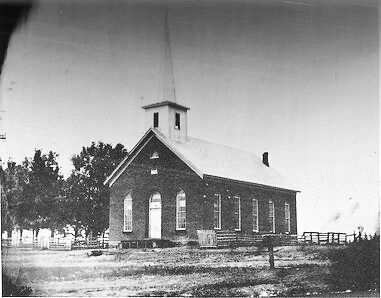
The first Methodist Episcopal Church in Maryville opened in 1867 on the southeast corner of First and Main. This was the first Protestant church in Maryville.