MIDC didn’t contact neighbors before manufactured home delivery
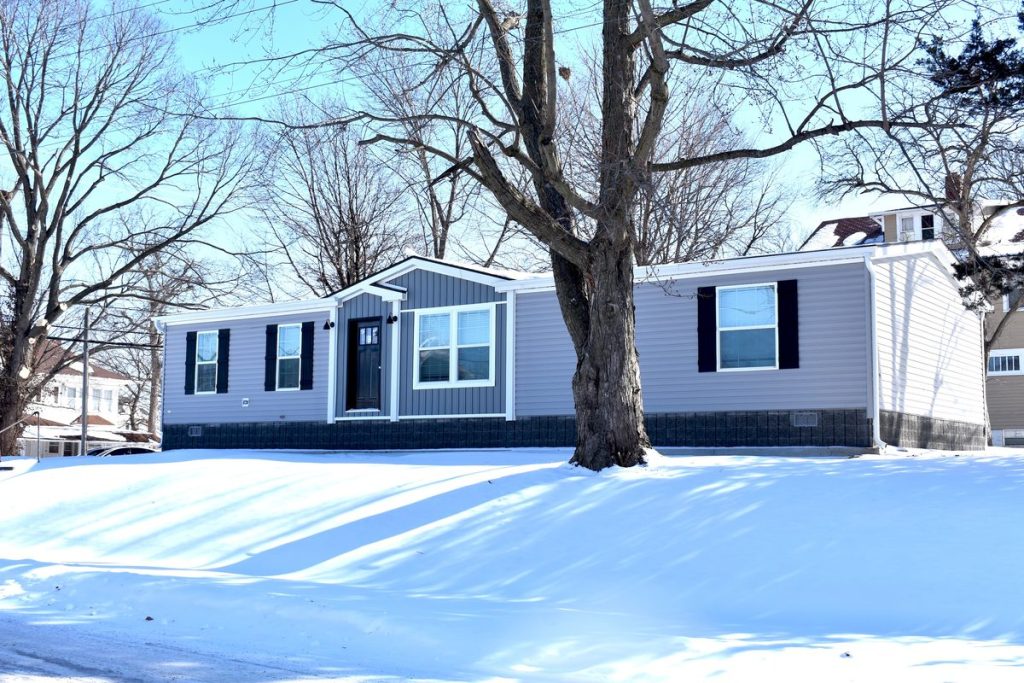
GEOFFREY WOEHLK/THE FORUM
The Maryville Industrial Development Corporation did not contact most of the neighborhood as requested by the city before installing a manufactured home on Buchanan Street. Since it was installed in December, MIDC has continued to work on the home, pouring a concrete skirt around it and clearing trees from the site.
MARYVILLE, Mo. — The Maryville Industrial Development Corporation did not contact most of the neighborhood around a manufactured home prior to installing it on Buchanan Street despite a request from the city to do so, the MIDC president told The Forum.
The manufactured home on Buchanan Street is part of an MIDC affordable housing pilot program aimed at manufacturing employees in the area, but the appearance of the home has angered several in the neighborhood. According to the U.S. Department of Housing and Urban Development, manufactured homes — formerly referred to as “mobile homes” prior to a 1976 overhaul of HUD codes — typically have metal frames and are built to national HUD standards.
One of those neighbors is Billie Mackey, who told the Maryville City Council during its regular meeting last week that while the plan was made “probably with good intention,” ultimately it was “misguided.”
Mackey also said that city officials had not upheld the part of the city’s comprehensive plan that says “we need to maintain zoning and land use policies that protect the integrity of the neighborhood” by helping MIDC put the manufactured home on the property without any policies in place to zone or restrict such homes.
“I don’t know how this came about. I know it’s MIDC’s problem, but it was also facilitated by the city,” Mackey said. “So I’m hoping that when this next ordinance is drawn up, you will take what I’m saying tonight into consideration.”
In January, the council announced a four-month moratorium on any new manufactured homes while city staff work on language for an ordinance to address factory-built homes.
Without such language, there was no requirement for MIDC to brief neighbors on the plan beforehand and receive feedback, as would be the case for something like a special use permit.
But city officials had said publicly that they wanted MIDC to do so anyway, Mackey pointed out, something that the organization did not do.
“I know that in July, (City Council member Tye) Parsons asked that MIDC — who is the owner of the home — contact the neighbors,” Mackey told the council last week. “And it was not done. It should have been done. Now it’s too little, too late.”
At the July 22 regular City Council meeting, the council agreed to waive more than $18,000 in liens on the property with the knowledge that MIDC, which had just acquired the property, would use it for its affordable housing program. In a phone conversation with The Forum on Tuesday, MIDC President Brock Pfost called waiving the liens “enormous,” and said the program could not have moved forward without it.
During that meeting, council member Tye Parsons said he would’ve liked to have seen a public hearing on MIDC’s plan so that neighbors could give feedback, even though there was no ordinance in place to require it.
“I don’t know that we have the power to do that, but I’d like to see at least notification of surrounding property owners, if not a public hearing, as the project moves forward,” Parsons said at the time.
City Manager Greg McDanel said at the time that the city would recommend to MIDC to “reach out to the neighbors” once it had a block plan in place for the property. Kim Mildward, project manager at the Nodaway County Economic Development corporation, which runs MIDC, was present at the meeting.
Pfost confirmed to The Forum on Tuesday that MIDC did not notify all surrounding property owners, but said that Josh McKim, NCED executive director, spoke in person with “two or three” immediate neighbors prior to the home’s delivery in December.
In an email to The Forum on Tuesday, McDanel acknowledged that MIDC was under no obligation to share a site plan or development intentions with the surrounding neighborhood.
“However, it was assumed that MIDC in exchange for the lien waiver, and NCED who was serving as the lead for this project under the City’s $60,000 annual contract for economic development services, would have taken the appropriate steps as organizational partners to create the requested neighborhood engagement,” he said.
Project progress
Although the project has raised the ire of neighbors over property values, Pfost said he and the MIDC board are excited about the progress the two pilot homes — one on Buchanan Street in Maryville and one in Hopkins — are making.
He said that work has already been done on the Maryville home to help make it look more appealing, including clearing trees and completing a concrete skirt. Before it’s finished, MIDC also plans to build a deck behind the home and will do grading and seeding on the site in the spring. Pfost said he’s hopeful the home can be sold to the family of an industry employee by sometime in March.
Though some, including City Council member John McBride, have raised questions about the $200,000 target price tag of the home, Pfost reiterated that was the price point that human resources directors from industry companies in Nodaway County said was the ceiling of what their typical employees would be able to afford.
“We are excited that these two are finally coming to fruition and we are able to do what we’ve been telling industry — even in a small manner with just two homes — for the last 30 years we’re gonna work on: industrial starter homes,” Pfost said. “And we’re very pleased that, no matter the bumps in the road, this is gonna be a good thing for industry and for the community when we get done with it.”