Voters to decide on water treatment plant bond Feb. 4
SKYE POURNAZARI/THE FORUM
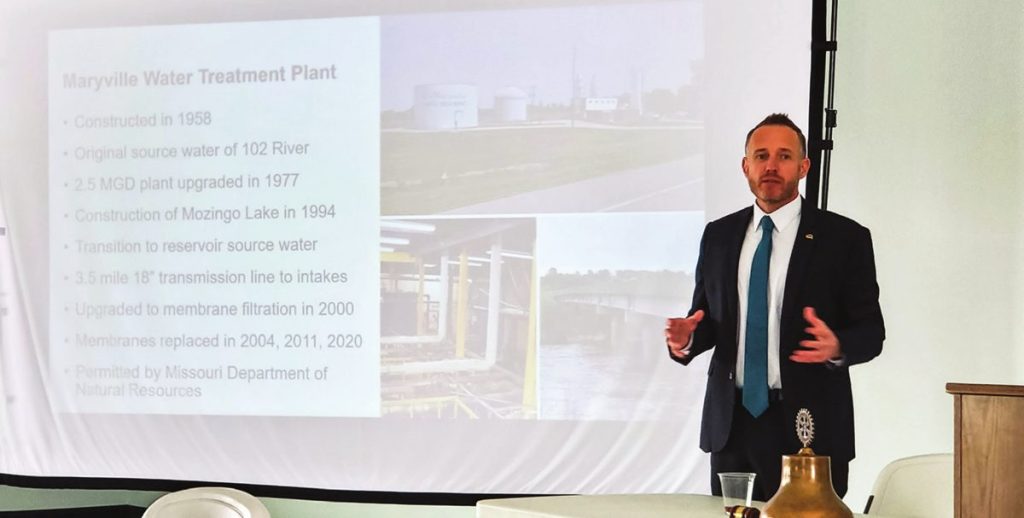
Maryville City Manager Greg McDanel speaks last week to the Rotary Club of Maryville about the details regarding the upcoming vote to secure bonding for a new water treatment plant. He asked the group to spread the word about the special election set for Tuesday, Feb. 4 and be a part of the process.
MARYVILLE, Mo. — Maryville voters will go to the polls for a special election on Feb. 4 to decide whether to authorize $50 million in bonds to pay for a new water treatment facility.
In June of last year, the city announced an ambitious plan to construct a new, state-of-the-art water treatment facility by August 2027. The relatively short timeline was necessary, city officials said, to ensure the project is completed before water filtration membranes at the current facility need to be replaced, which could cost around $10 million on its own.
FAQ
Can the existing plant be rehabilitated?
The Maryville Water Treatment Plant, originally constructed in 1958, was designed to treat water from the 102 River. In 1994, Mozingo Lake became the community’s primary water source, prompting significant updates to the plant, including the installation of a 3.5-mile transmission line connecting the lake intakes. Despite these upgrades, many of the plant’s mechanical and treatment components remain original to its 1958 construction. Because of the mounting maintenance costs added to the costs of stopgap measures to address taste and odor issues, a 2020 study conducted by HDR Engineering recommended building a new water treatment plant directly at the water source, Mozingo Lake.
If passed, will there be a tax increase?
No. This is not a tax, it is an authorization for the city to borrow the money to make these improvements. The state requires voter approval before borrowing from the funds they make available to municipalities through Missouri’s Clean Water State Revolving Fund.
If passed, what happens to user rates? If the project uses the full $50 million in authorized bonds, in-city water rates are projected to increase 10.7-13.5 percent in FY 2027 and 11.7-14.5 percent in FY 2028. According to a city analysis, this would mean the typical Maryville customer would see a water and sewer bill of a little more than $82 per month starting in FY 2028, which would begin in October 2027. Currently the typical Maryville customer’s water and sewer bill is $71.29.
What happens if bonds are not approved?
If the bonds are not approved, the City will explore other tax-exempt financing options that do not require voter approval. However, these alternatives typically carry interest rates nearly twice as high as those available through Missouri’s Clean Water State Revolving Fund, increasing the overall cost to the community.
Without the ability to construct a new water treatment plant, the City will face significant expenses to maintain the existing facility. Replacement of filtration membranes in 2027 is projected to cost between $7 million and $10 million, and the carbon media for the GAC Adsorber will need to be replaced every two years at an estimated cost of $400,000. Additionally, ongoing repairs and improvements will be necessary for the current plant, which was originally built in 1958.
SOURCE: CITY OF MARYVILLE AT MARYVILLE.ORG/WTP
Approval of the bond issue will keep the timeline for August 2027 intact at the lowest loan cost, city officials have said. The special election is necessary for that plan because it would allow the city to submit an application to the Missouri Department of Natural Resources’ State Revolving Fund in time to meet a March deadline, which a regular April election wouldn’t.
“The Missouri Clean Water State Revolving Fund (SRF) offers flexible, low-interest financing to support the replacement of Maryville’s aging water treatment plant, originally built in 1958,” said City Manager Greg McDanel. “… If the ballot measure is not approved, the City of Maryville will need to explore alternative funding options, which will likely come with higher interest rates, to replace the plant and address critical water system needs.”
As part of the application process, the city must demonstrate it has the full bonding capacity required to pay for the project, which is estimated at around $50 million. City officials have said they see that as a maximum that the city would have to pay and are working to bring down the actual cost through grants and other funding opportunities.
In informational materials, the city has estimated that the typical Maryville water user would see their water and sewer bill rise from a little more than $71 in 2025 to a little over $82 by October 2027 to pay for the low-interest bonds.
City officials have said that not passing the bond on Feb. 4 would not scuttle plans for the water plant, but would mean more costs shouldered by taxpayers and water customers.
The new water treatment plant has been a top priority for city officials since taste and odor issues with drinking water bubbled up in 2020. The planned new facility would be built at Mozingo Lake and replace the aging plant that was first constructed in 1958 to process river water from the One Hundred and Two River. City officials have consistently stressed the need for a new facility because of the increasing challenges of such an old facility not designed to address the new treatment challenges.
The plant would also be the first in Missouri to use ozone and biological active filtration, which uses microorganisms to filter raw water. According to the city, a pilot study conducted for 9 months in 2023 showed that the method removed more than 99 percent of the primary taste-and-odor-causing substances, like geosmin, from the raw water. The current plant can’t get close to those numbers, and uses an external granular activated carbon filter that requires clearouts every 2-3 years at a cost of about $400,000, city documents stated. The new method will ensure “a long-term solution to taste and odor concerns while delivering high-quality drinking water for generations to come,” McDanel said.
More information about the plant and the bond issue is available at maryville.org/wtp.