City charts new course for airport board
FORUM FILE PHOTO
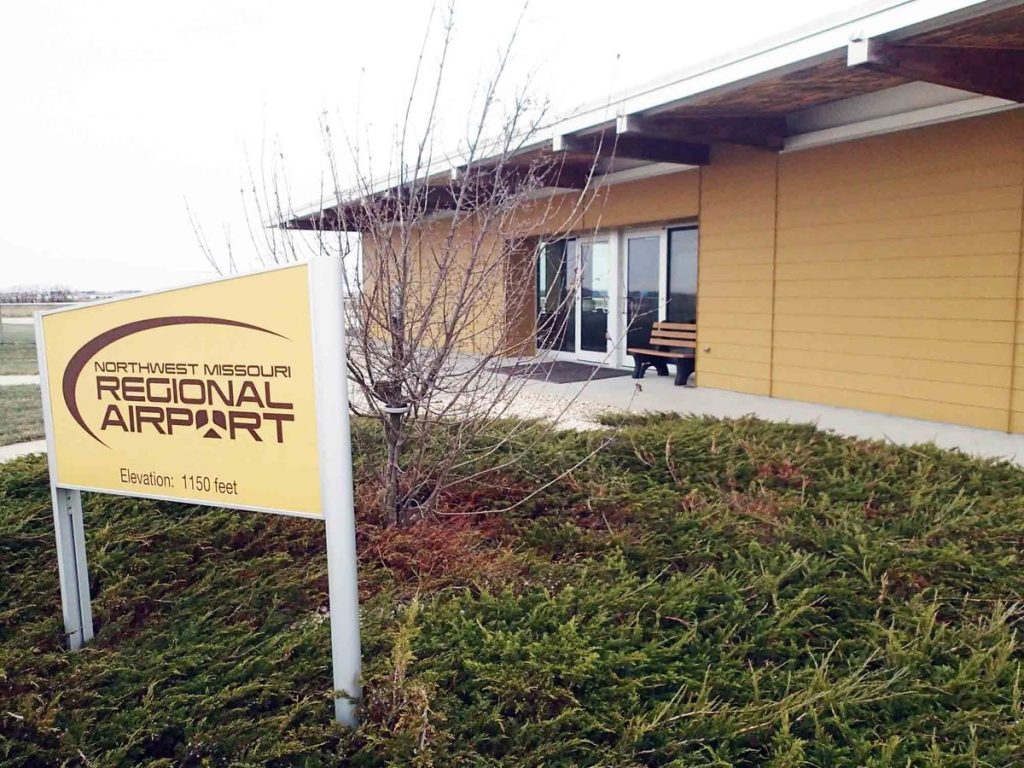
Northwest Missouri Regional Airport
MARYVILLE, Mo. — The Maryville City Council last month passed an ordinance that will overhaul the airport board after years without a quorum and amid friction with pilots.
The measure approved during the council’s Dec. 23 meeting changes city code to diversify the airport board, update language to match the current model of operations at the airport and emphasizes the board’s advisory role.
Prior to the change, city code had outlined a seven-member airport board with four members living inside city limits while the remaining three could have lived outside the city but within Nodaway County.
The new measure reduces the size of the board to “no less than five” — which would allow council members to increase the size in the future if they so choose — and requires that members represent interests in general aviation, tourism, industry/business and education, with at least one member required to have a background in each. One member may count toward multiple areas if qualified. One member may be from outside Maryville city limits but within Nodaway County.
Turbulent relationship
Since the city took over direct operation of Northwest Missouri Regional Airport in 2013, friction has steadily increased between the pilots who use the facility most frequently and the city administrators who are in charge of it. Prior to that point, Kevin Rankin had been in charge of operations as the airport’s fixed-base operator. An airport’s FBO acts as a for-profit contractor, providing services at the airport like fueling and maintenance and keeping the revenues.
When Rankin and the city parted ways that year, no other bidders emerged, and the city began running the airport much as it did any other city department. The city currently employs one full-time airport attendant.
With an FBO, the airport board at the time had a more defined role, providing feedback to the FBO and acting as a conduit between the FBO and the city. Rankin, like the members of the airport board, was also an aviation junkie.
That’s not true of Assistant City Manager Ryan Heiland and City Manager Greg McDanel, who after 2013 were thrust into the role of making direct decisions for the airport.
Much of the friction seemed to stem from the culture clash between the pilots and city administrators who weren’t aviation enthusiasts. Further diminishing the board’s role was the city’s hiring of Jviation as consultants since 2012. Since then, Jviation has largely served as the aviation experts for the city, providing input on planning and engineering on every airport project.
And the relationship didn’t get better as the airport board’s role appeared to shrink, and finally, disappear completely.
By 2019, there were only three members of the seven-member board left — not enough to complete any business even if the board had any. In 2020, city staff recommended to the City Council that the board be dissolved while they worked to come up with a new model.
One of the major problems with the board, city officials said at the time and several times since then, was that it was dominated by pilots who leased hangar space. That turned the board’s focus toward the day-to-day rather than long-term guidance, and toward issues that affected them personally — like services and maintenance for pilots who lease hangars — rather than what was best for the airport as a whole, city officials have said.
During a 2021 unofficial meeting of the remaining members of the airport board and a few other pilots, Dannen Merrill, then the City Council liaison to the airport board and now the mayor, cited that as the most significant factor in looking to overhaul the board’s structure.
“I think we’re gonna try to look at the composition and try to maybe add spots for non-pilots … I agree, we’ve gotta have some pilots on the board, because you know what’s going on,” Merrill told the group of pilots after the 2021 meeting. “But I think in order to get this board back off the ground, we’re gonna want to see an advisory board that is more encompassing and has some elements of industry, agriculture, education, that maybe (even) are pilots. But I think that that helps grow your market and your cause with people that are outside the piloting community.”
Bruce Twaddle, then the holdover president of the board, spoke for many pilots when he said he took issue with the characterization that having pilots who lease hangars on the board presented a kind of conflict of interest.
“It just doesn’t make sense that you would have a golf committee and not have any golfers because there’s a ‘conflict of interest,’” Twaddle said during the 2021 meeting.
Stalling out
More than three years later, nothing much had happened with the board as it took a backseat to a global pandemic, a water crisis and a once-in-a-generation infrastructure project, among other higher priority concerns.
And it was clear that wasn’t lost on some of the 17 or so pilots who attended a Dec. 17 stakeholder meeting to hear about the new airport board plan ahead of City Council consideration the following week.
That frustration, building for some time without much of a public outlet, boiled over at times, starting with the first tone-setting question of a question-and-answer session. One of the primary complaints remained that some of the pilots did not feel McDanel and Heiland were taking their concerns seriously and were not paying enough attention to the airport.
“Because I’m telling you, you don’t know crap about aviation,” Travis Ingram, a commercial airline pilot who has been flying since he was a teenager, told them during the Dec. 17 meeting. “… And why do you guys get to freaking run everything? It’s hard to battle with you guys when you guys make the rules.”
McDanel and Heiland didn’t disagree with the assessment of their relative knowledge level — McDanel later called it “apt,” telling the group “Ryan and I are not airport experts.” But Heiland said the reality is that the airport does not have access to enough money to add services, which were required by most of the suggestions made at the meeting by the pilots.
Like most city departments, the airport doesn’t have a dedicated funding source for operations. Instead, it’s funded out of the city’s general revenue, which also funds the other city departments, like police, fire and public works.
“And so the airport is competing with all of these different departments for resources when it comes to the operational budget,” Heiland said.
The airport’s operations budget typically runs between $400,000-$500,000 a year, Heiland said, with maybe about half offset by fuel sale and hangar lease revenues.
But what McDanel and Heiland have done, they said, is continue to adeptly leverage minimal local investment for millions in federal dollars in capital improvements at the airport.
One of the things the previous airport board did, back when it met regularly, was to assemble a 5-year rolling capital improvement plan. Federal funding is available each year for airport capital improvements, and the projects selected are based on a combination of priorities set by the Federal Aviation Administration and the Missouri Department of Transportation, which administers some of the federal funding to airport projects in the state.
That capital improvement plan has seen its top priorities steadily checked off over the past decade, with more than $5.5 million invested into the airport over that period in capital projects including clearing out tree obstructions in 2022 and extensive runway repairs and renovations in 2017.
In 2025, one of the larger remaining projects, an $835,000 community hangar that required only about 10 percent in local matching funds, is set to start construction in the spring with an eye toward fall completion.
During the Dec. 17 stakeholder meeting, McDanel and Heiland said that while they do have a few ideas, the city doesn’t have a set-in-stone plan for the new 80-by-80-foot hangar, but secured funding for it because it was the next highest priority on the capital improvement list.
New flight plan
Those are the types of issues, McDanel said, that the new airport advisory board would be key in tackling: establishing a long-term vision for how to best utilize what assets the airport does have access to in a way that’s best for the whole community. That’s why the new board will be modeled more on the Mozingo Advisory Board and Maryville Tourism Committee, both of which require members to come from certain areas, backgrounds or organizations in order to ensure a broad range of stakeholders are represented in decision-making, McDanel said.
Additionally, the new advisory board will have a voice during the city’s budget process, just like other departments, and will be able to better make a case to the City Council for non-capital projects — like, potentially, for adding more services and employees.
After the Dec. 17 meeting, Ingram, the commercial pilot who was most vocal in his criticism of how the city had run the airport, told The Forum he was especially frustrated that the city had essentially dissolved the airport board in 2020 when the City Council tabled discussion about formally dissolving it. After that, no further action was taken until now, and with little communication about what was happening in the meantime or what had actually happened in the first place to the board that was supposed to be a conduit for public feedback, he said.
During that time, it left people like Ingram, who have had flying in their blood since before they could drive, without a chance to feel heard and involved in their passion: aviation in Nodaway County.
McDanel said that the Dec.17 stakeholder meeting was the start of resetting how decisions at the airport are made.
“If our grievances are with previous decisions made at the airport, I think this is what this meeting is, is to restart that input process that helps get the airport to where the people who use it want it to be,” McDanel said during the meeting.
Later, McDanel told The Forum that due to the pandemic and then a slew of massive projects and emergencies, the airport board overhaul just hadn’t made it off the back burner for a few years.
“And that’s not a good excuse,” he said.
But, he said, the new advisory board will restore that opportunity for regular feedback and discussion, which he said hadn’t been available for too long.
“The most important part of creating that advisory board is that there will be regularly scheduled quarterly meetings,” McDanel said. “So every quarter you will have an opportunity — whether you are on that board or not — to show up in a public setting and talk about the airport.”
The City Council will begin accepting applications for the board this month. They will be available on the city’s website and from City Clerk Stacy Wood at City Hall.