City Council acts on complaints about manufactured home
GEOFFREY WOEHLK/THE FORUM
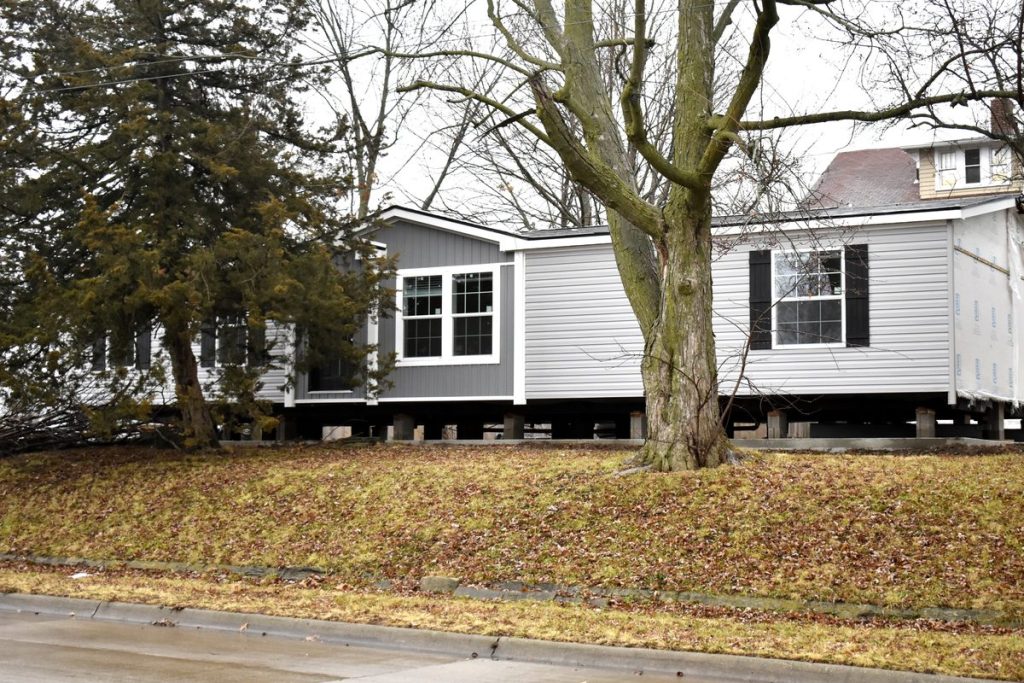
A manufactured home on Buchanan Street that is part of a Maryville Industrial Development Corporation affordable housing initiative sparked complaints from some neighbors, including about the appearance of the house, which currently is on cinderblocks. While the City Council will look at an ordinance to add more oversight over such homes, MIDC President Brock Pfost clarified that a concrete skirt will be poured around the house which will cover the cinderblocks.
MARYVILLE, Mo. — The Maryville City Council will look at options to increase oversight of manufactured homes like the one recently put up on Buchanan Street as part of an affordable housing initiative.
Maryville Industrial Development Corporation President Brock Pfost also alleviated concerns over the house sitting on cinderblocks by telling The Forum that a concrete skirt will be poured around the lower exterior of the home, covering up the space between the house and the concrete slab below it — along with the cinderblocks.
Earlier this year, the MIDC acquired land in Hopkins and Maryville to help facilitate a new pilot housing program, announcing its intention to put manufactured homes on the properties and then give manufacturing workers first crack at buying them.
For most of the MIDC’s 67-year history, its focus had been on acquiring property that it could help make more appealing for a company to use as an industrial site. But more recently, the biggest challenge facing industrial employers in the region is attracting and maintaining a workforce in the face of shrinking rural populations. In Nodaway County particularly there is a critical shortage of mid-range housing, according to a 2018 housing study commissioned by the city of Maryville, adding to that challenge.
The new pilot program is meant to essentially do what the MIDC does for factory locations, but applying the same principle to employees instead: acquiring land, building a house and then selling it to manufacturing workers at an affordable price.
“We got with all the HR directors and we started with the answer, and then went back to the question: What can line workers afford?” Pfost told The Forum on Monday.
That number was around the $200,000 mark, which is what the organization was targeting when it considered what homes to put on the properties.
“Now, as much as we’d like to go out to Ridgeline or Golden Acres or (Southdale) subdivision and buy a $50,000 lot and put up a 4,000-square-foot, four-bedroom home, you ain’t gonna get that for $200,000,” Pfost said.
The most cost-efficient option the organization could find, Pfost said, was to buy homes like the one on the lot on Buchanan Street, which is a manufactured home. Manufactured homes are constructed off-site and then brought to the property. According to the U.S. Department of Housing and Urban Development, manufactured homes — formerly referred to as “mobile homes” prior to a 1976 overhaul of HUD codes — typically have metal frames and are built to national HUD standards.
Currently, the house on the Maryville lot, which arrived in mid-December, is on cinderblocks, which elicited some strong complaints from neighbors. Pfost said the concrete skirt is one of several things left to do on the property before the home goes up for sale, like removing trees directly in front of the house.
“So there’s quite a bit of work yet to do, but we’re very optimistic and hopeful that it’s going to be a nice thing and awfully nice for the community and industry,” Pfost said.
To encourage the initiative, the Maryville City Council in July agreed to waive $18,277 of special tax liens on the property in Maryville from the previous owner.
During last week’s regular City Council meeting, council member Tye Parsons echoed neighbors’ concerns about the effect such a home might have on property values, and the council agreed to take a look at an ordinance to give area residents more input on future homes of the same type.
“It’s not a project, of course, that the city is driving — it’s NCED and MIDC — and we certainly want to support our partners, support workforce development, support workforce housing in our town and northwest Missouri,” Parsons said during the Dec. 23 meeting. “Is that the right way to go about it? I don’t know. I’ve been critical of the project before.
“What I’m not crazy about is how it’s come about.”
At Parsons’ suggestion, the council directed city staff to draw up language for an ordinance that would give the city more control over the appearance of new homes like the one in the MIDC pilot program. The city does not currently have any ordinances that deal specifically with manufactured homes. As is standard practice, while the ordinance language is being considered, the council placed a moratorium on any new such homes.
Assistant City Manager Ryan Heiland said that other communities typically deal with similar issues through either zoning out certain types of houses, or through a process like applying for a special use permit, which operates on more of a case-by-case basis and allows for input from neighbors before approval by the City Council. The latter option seemed to be favored by city staff and the council.
“It just gives the city another layer of, I think, protection and the ability to make sure that all surrounding property owners have a chance to communicate with the city and potential home builders and home purchasers — just making sure that we, again, head off some of these issues in the future,” Parsons said.
Council member John McBride said he wasn’t against the initiative, but he would like to see even more affordability.
“I know the market’s high, but with a manufactured home that’s gonna depreciate a lot quicker, a $200,000 home loan is a lot of money,” McBride said. “And I can tell you right now, entry level at a manufacturing facility, you’re gonna be struggling to make that payment — $200,000 is a lot of money. It might not be much to some people, but it’s a chunk of change. …
“I’d be 100 percent behind this project if, moving forward, we can find that happy medium where we can put a quality product up there that’s more cost-effective for the consumer.”
McDanel said he would work to get a draft of the ordinance before the council as soon as possible, likely in January.
Other City Council notes
- Council members approved a $4,439,417.69 agreement with VF Anderson Builders for construction of the Maryville-Northwest Stormwater Improvements Project, which will overhaul critical stormwater infrastructure on the Northwest Missouri State University campus and in the neighborhoods southeast of the university. The joint city-university project was awarded a $3.7 million grant through the Missouri Department of Natural Resources in 2022 funded through the state’s allocation of federal American Rescue Plan funds.
- The council approved the purchase of three ejector assemblies for use at the Maryville Water Treatment Plant from Veolia Water Technologies and Solutions for $16,064.52.
- Council members approved a 20-year land lease for 1,336.5 square feet of hangar space to Charles Harroun at Northwest Missouri Regional Airport at an annual rate of $294.03.
- The council approved a one-year, $10,415.05 contract with Coalition Insurance Solutions for cyber protection services.
CORRECTION: The original version of this story incorrectly classified the home on Buchanan Street. It is a manufactured home. Manufactured homes are constructed off-site and then brought to the property. According to the U.S. Department of Housing and Urban Development, manufactured homes — formerly referred to as “mobile homes” prior to a 1976 overhaul of HUD codes — typically have metal frames and are built to national HUD standards. Modular homes are built off-site in sections and then assembled on a permanent foundation, according to HUD. The Forum apologizes for the error.