Kelley receives legacy award
SKYE POURNAZARI/THE FORUM
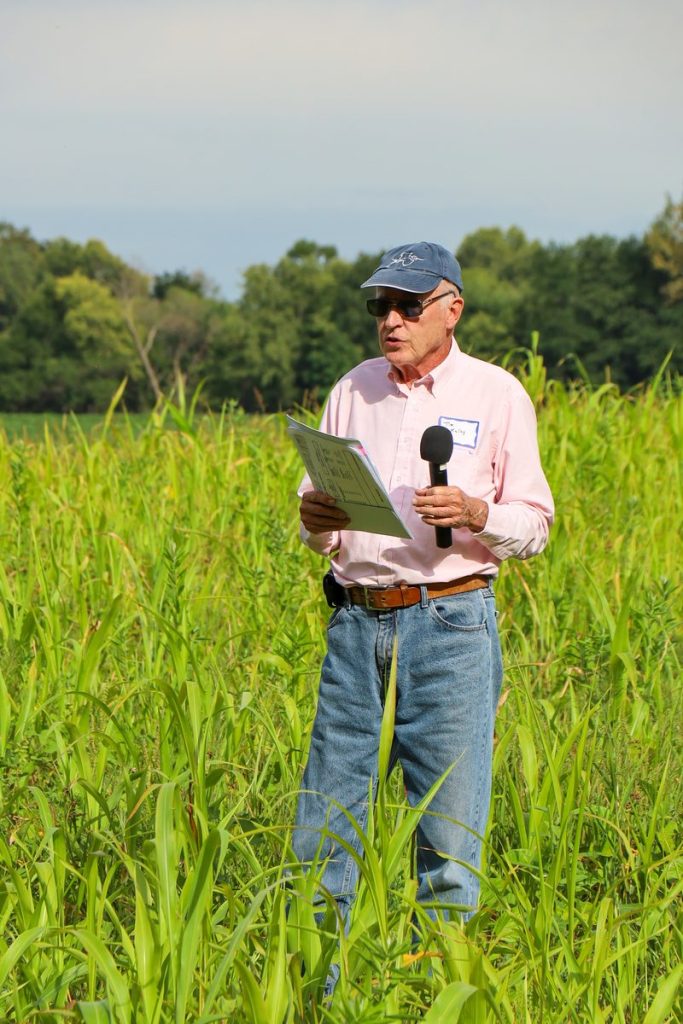
Tim Kelley, co-owner of around 800 acres in northwest Missouri near Elmo, is shown discussing the results of his use of multi-species cover crops at a Practical Farmers of Iowa Field Day held Sept. 13 on his land.
ELMO, Mo. — Surrounded by fields of soybeans and corn, Tim Kelley, of Elmo, was awarded a Practical Farmers of Iowa Farmland Owner Legacy Award on Sept. 13.
Kelley received the award during a Field Day held by the organization at the farm he owns with his sister, Margaret, near Elmo. The award is granted annually to landowners who help the next generation get started, advance land stewardship and promote long-term sustainability of farm businesses, environmental quality and rural communities.
With around 800 acres growing corn, soybeans, small grains, cover crops and restored cool-season and warm-season grass pastures that had cattle on them until 2022, the Kelleys have focused on long-term soil health with farm tenant Brent Nold.
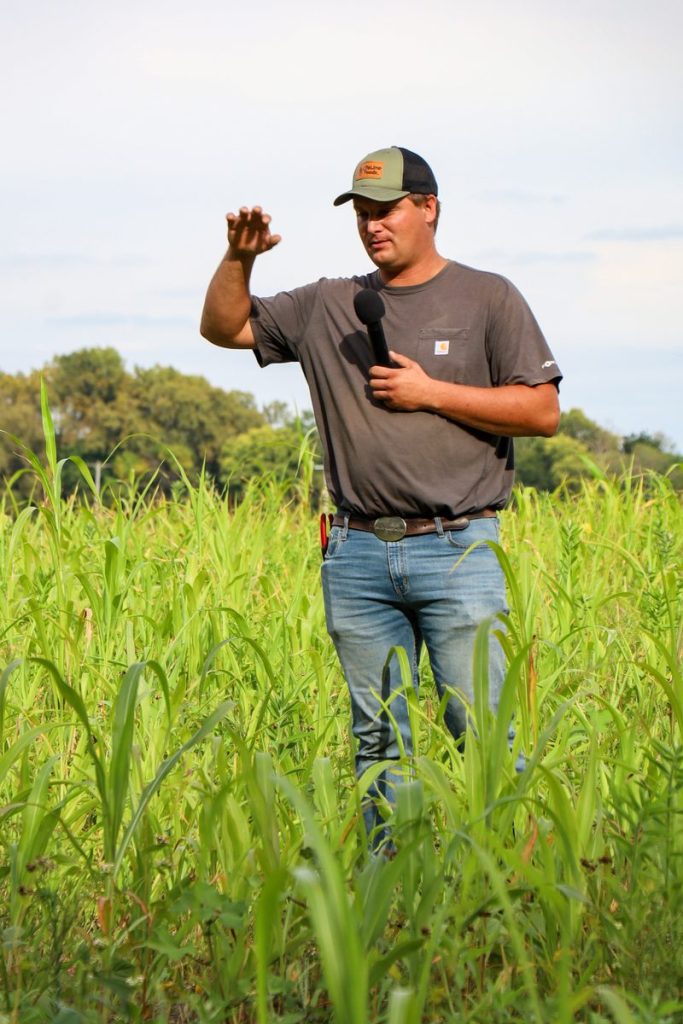
During the event, Kelley and Nold spoke at length about the results he was seeing on his land since adding a 13-plant mix of cover crops, restoring an oxbow wetland area. A portion of the Kelley farm is a Missouri Century Farm established by Tim’s grandfather in 1907.
Sally Worley, PFI’s executive director, told the farmers gathered that many farm owners take the path of least resistance when it comes to managing their land, but that it often leads to less conservation, more farm consolidation and less farmland access for beginning farmers.
“Or farmers can follow a more complex path in instilling conservation and diversity on their farmland, and paving the way for beginning farmers to get farmland access,” Worley said. “This path is neither simple, nor is it easy, but it is of the utmost importance for our farming future. Tim is one such farmland owner. He has not picked the easy path, but the important and complex path.”
During the Field Day, which took place located on a space where operator Nold had planted cover crop for the season. Kelley and Nold spoke about the choices they’ve made to help conserve the soil in various places.
“You can see the results of our efforts and our journey,” Tim told the group in the staging area. “… I think there’s 14 species planted and quite a bit of weed pressure too.”
He told the group that he’s working to reduce chemicals and fertilizer, but maintain the same yield. His goals include improving soil health by increasing soil organic matter, increasing fungi, diversity and protozoa. He’s definitely on the lookout for a cattle grazier interested in utilizing his land.
“As a grazier, I learned the benefit of increasing soil organic matter, and every increase in percent of organic matter increased the yield of pastures, which increased the carrying capacity of the land,” he said.
Noticing a difference in soil test results from year to year, Kelley said whether it was row crops or cattle grazing, the organic matter always tested lower after a row crop.
In 2023, he started working with Nold to incorporate small grains with multispecies covers, following small grains as well as preceding and following the corn and soy rotations. He spoke about bacteria, fungi, phospholipids and rhizobia, explaining the findings from his testing. They’re also adding poultry litter and other organic material to increase the soil health.
“Hopefully we can add livestock, and I think we’re on a much better track to getting where we want,” Kelley said. “That’s one good thing about working with Brent. I think we share the vision …. You have to make a profit, but the land comes first.”
He said that as it turned out, the cool- and warm-season grass and cool- and warm-season legumes are the best thing for soil health.
“By adaptive grazing and high-density grazing, I took the organic matter up to 7 percent, which they say is pre-settlement organic matter in this area,” Kelley said.
In the meantime, Kelley and Nold are exploring alternative crops and markets, but finding difficulty in the markets that don’t seem to be there for the crops they want to grow.
Nold explained some of the equipment that he uses on the property, including a 9430 No-Till Drill, a Phillips Harrow with an air-seeder on it for planting cover crops.
“I can get over a lot of ground in a hurry,” he said. “The struggle that I have with the cover crops is getting over the ground and getting harvest over with. Cooperating with rains and things like that. … Then once I got it planted, it didn’t rain for about a month. … But like we said, that’s farming.”
Nold said they’ve definitely tried several new things on the property. Last year they did some inter-seeding on some of the corn.
“We kind of swore off of anhydrous on the corn, so we’re going to try to do the liquid nitrogen,” he said. “I’m trying to get my nitrogen use rate down to 0.5 pounds per bushel. I’m at 0.7 right now, but in the future I can get there. I’m sure I can. Nutrient cycling, things like that, that’s the key. That’s the main mindset with all of these cover crops, those chicken litters. … I can fail at about anything it seems, but I can definitely learn as I’m going down.”
He shifted to talking about visiting with legislators in Washington, D.C., last year during a visit with FCS Financial and talking with his congressional leaders about the farm bill.
“That’s one of my biggest hiccups being a young farmer without a lot of generational wealth behind me, I guess,” Nold said. “I still use an operating note. A bank won’t loan you money against something that doesn’t have a board of trade, market, if that makes sense.”
He said that it would be good for newer farmers and the regenerative space they’re working in if Congress would open up crop insurance a bit more to the alternative markets.
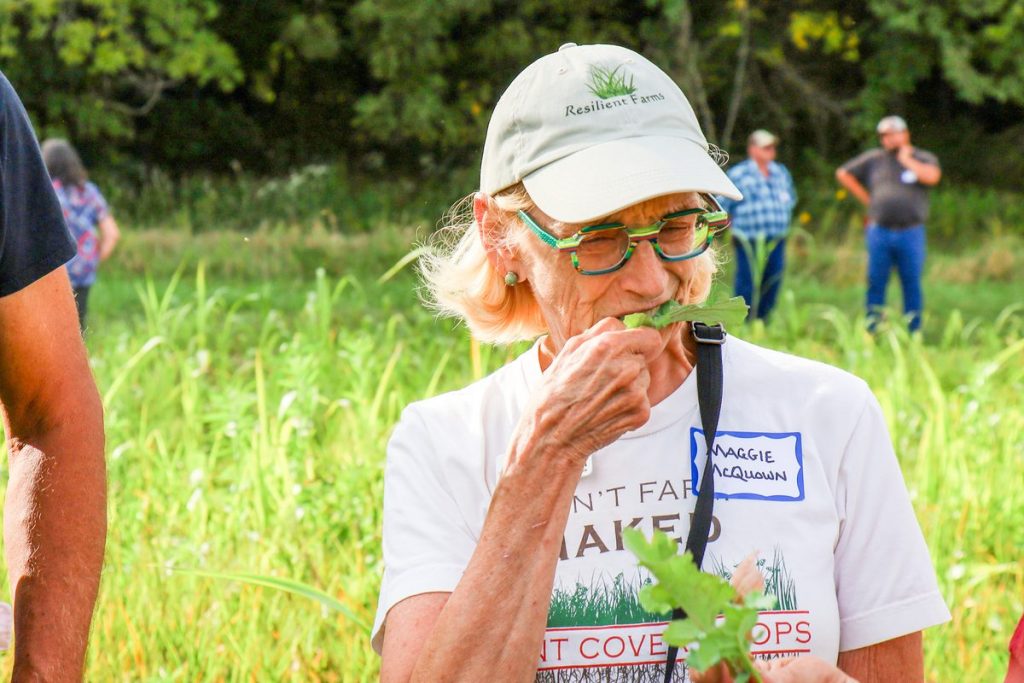
Following the presentation, attendees walked into the area seeded with cover crop mix and began to pull them, smell them and even taste them.
Colten Catterton, with Cover Crop Partners, of Indiana, told one attendee that rabe is more bitter than kale, and that’s one way they can be told apart.
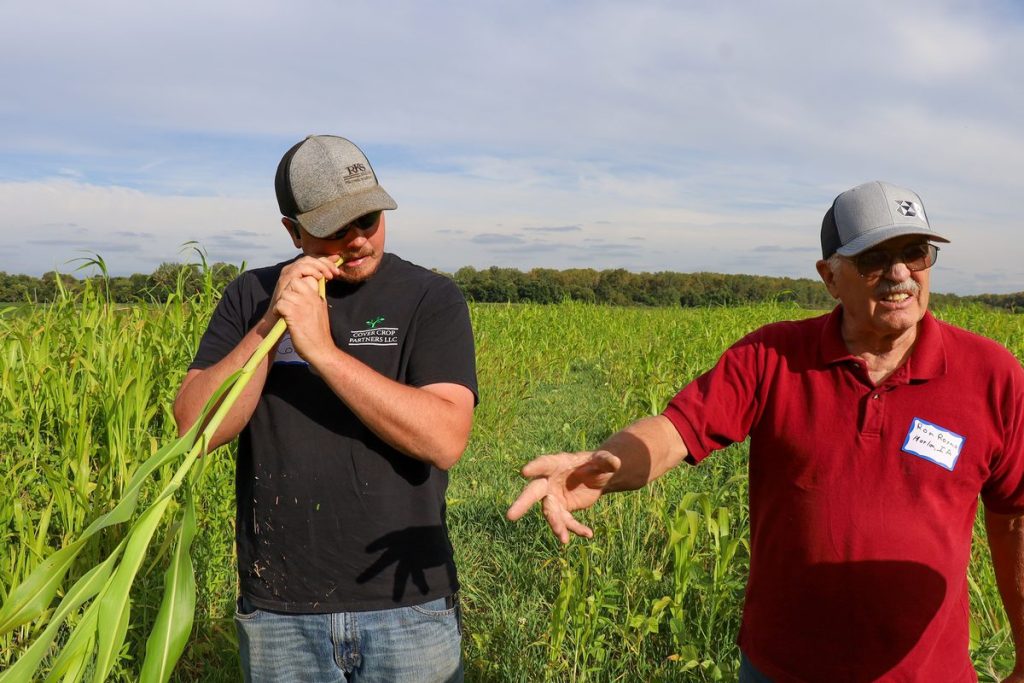
He picked a young cornstalk and began to chew on the center of the main stalk.
“It’s sweet,” he said.
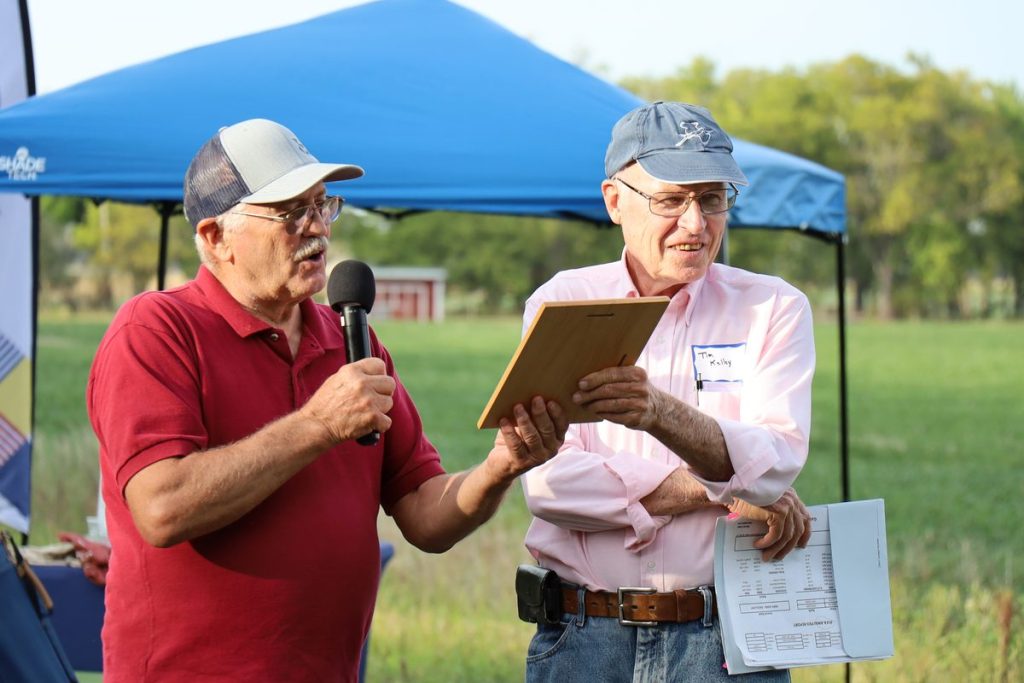
Following a meal of brisket and chicken catered by Dad’s Place, longtime member and former board member of Practical Farmers of Iowa Ron Rosmann presented Kelley with the organization’s annual Farmland Owner Legacy Award.
“This is what we’re looking for across America,” Rosmann said. “Here they’re working on soil quality, soil erosion, decreasing CO2 by planting cover crops. … All of these things mean resiliency to what our future holds, with our changing climate and ecological diversity. We’re losing that. We’re certainly losing our soil and our soil quality. I think one of the keys is getting livestock back on the land, like we used to have, diversified crop and livestock farms. It’s still the best way to farm and it always will be.”
Kelley told The Forum that he’s glad to have received the award, if only to help other farmers begin paying attention to these important topics.
SKYE POURNAZARI/THE FORUM
Maggie McQuown tastes a plant grown at Tim Kelley’s property as part of a 13-species mix of cover crops sown this summer. The plant was kale, not raab.
SKYE POURNAZARI/THE FORUM
Surrounded by cover crop growth from a 13-species mix, Brent Nold, Tim Kelley’s land tenant, speaks about the addition and results of multi-species cover crops on Sept. 13 at a Practical Farmers of Iowa Field Day held on the Kelley land in Elmo.
SKYE POURNAZARI/THE FORUM
Colten Catterton, with Cover Crop Partners LLC, of Indiana, is shown tasting a young cornstalk on Sept. 13 at Tim and Margaret Kelley’s land.
SKYE POURNAZARI/THE FORUM
Ron Rosmann, longtime member of Practical Farmers of Iowa, presents Elmo farmer Tim Kelley with an annual Farmland Owner Legacy Award on Sept. 13 at his farm.