The Depot and the history of Barnard
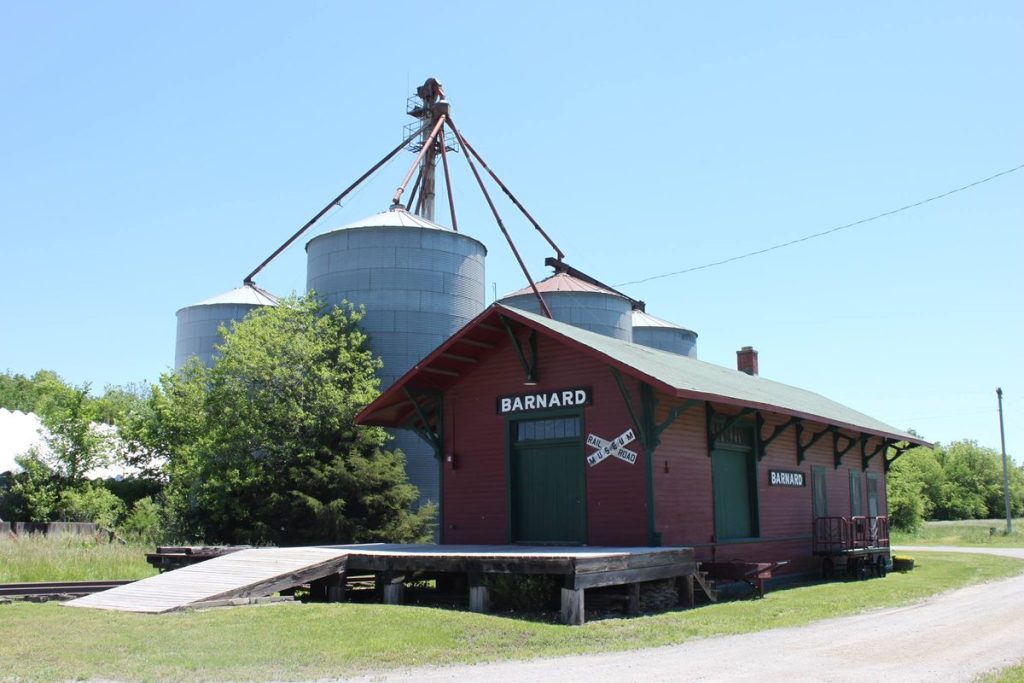
BARNARD COMMUNITY HISTORICAL SOCIETY DEPOT MUSEUM
Barnard Depot
The oldest building in Barnard is the Depot. It was built in 1870 by the Missouri Valley Railroad as that railroad made its way from St. Joseph up the 102 River Valley. John Fiske Barnard was the superintendent of construction and was given the job of getting the railroad built.
The Barnard Centennial Book, written in 1970, describes the process as “muscular men, and sweating mules, and shovels and plows, and temporary tented camps, and practical bridge-building crews and a gang of track-laying Irishers, all in one fast but tangled and rough and worrisome pattern. The decade-old settlement of Prairie Park, 2¼ miles north of the (Nodaway/ Andrew) County line, was skirted. But a mile further north Mr. Barnard found, late in 1869, a handsomely forested hillside, at whose feet a water powered grist-mill had been erected by Mr. James C. McCandless. And here the engineer envisioned a town-site. The rolling prairie nearby had been kept largely treeless by forest fires, and the wood had much value to the pioneers both as building material and as fuel.”
The Barnard City Company quickly came into existence and Mr. Barnard and some St. Joseph investors hired William Brady, a local surveyor, to measure and lay off the area into blocks and lots for a town close to the new railroad. By 1870 the depot and stockyards were built, and a bridge would soon be built over the 102 River. Located in the southern part of Nodaway County, the town was ready for business. Lots were sold for about $50 and soon buildings, shops and homes were being constructed. Within a year the post office had moved from Prairie Park to the new town, now renamed Barnard.
By 1880 the town had 424 residents. The Business Directory of 1881 includes three blacksmiths, two grocery stores, two livery stables, a shoemaker, a milliner, a harness maker, a grain merchant, two carpenters, a wagon shop, a stock buyer, four general stores, two hardware stores, a lumberyard, two meat markets, a farm equipment shop, a hotel, restaurant, two doctors, two drug stores, three saloons and a marshal, mayor and justice of the peace. There was also a school and two churches.
A story told about the old days of Barnard says that a young drunken man got on the train at St. Joe, handed the ticket taker some money, was asked where he wanted to go and he said, “I want to go to hell” and got on the train. So, the crew pitched him off at Barnard.
The Barnard Bulletin newspaper on July 24, 1924, had an article about the Barnard Picnic, which became the town’s most famous and popular yearly attraction. It said the first Barnard Picnic was held in 1893 because the town band wanted to buy new uniforms, so, with the help of the local businessmen, they put together a three-day picnic and celebration as a fundraiser. They cleared the brush next to the river and held the Picnic there from then on, and that area is still called The Picnic Grounds. The Maryville Daily Forum reported that 10,000 people came to the Picnic in 1923 and 20,000 attended in 1975. The Picnic had a run of about 90 years, missing only a few years because of wars or floods.
Over the years, politicians, office seekers and officeholders from city and county officials to governors, senators and representatives, along with judges and preachers, came to the Picnic to speak to the multitudes. Bands played and people sang and danced and put on plays. There were carnival rides and games of chance and food stands. The Bulletin said in 1924, “The amusements for the Picnic have been of a varied line and of course at times the attractions hired have not come up to expectations but in most cases have been worthy of their hire. A great many can well remember the first balloon ascension and parachute leap and we sometimes hear someone telling of a certain lady screaming as the parachute was cut loose and saying, ‘oh, My God he has fallen out.’” The newspaper told of a nighttime balloonist with a trapeze beneath holding a man with magnesium flares and fireworks that he set off in the air. One time this balloonist accidentally landed in the river, to the amusement and amazement of the crowd.
The 1924 article ended with this: “Picnic in the early days suggested market baskets filled with fried chicken, homemade pickles, bean salad, potato salad, sandwiches on homemade bread, ice cream and cake, and we are not forgetting those apple and cherry pies with ‘stuffing’ an inch and a half thick inside. All this was spread out on one of Mother’s red and blue tablecloths on the ground, beginning at the corners and finally filling up the middle with dozens of nick-nacks such as only Grandma could make. Then the wild scramble by the children, the jam-smeared faces, and the laughing and visiting while everyone enjoyed themselves and ate to their heart’s content. Then for a flop on the matted blue-grass, while women-folk cleaned up the mess and packed their baskets and dishes back into the buggies, wagons or carriages. Ah, me. But today it is different. The coming of the automobile, the merry-go-round, the ferris wheel, and then the numerous concessions and other rides, not to mention the lunch stands and lemonade jars, turned the appearance of the celebration into that which we see today.”
To learn more about Barnard, visit the Depot located on the road into town. The Depot is a museum today, and you can find pictures and information on their Facebook page at Barnard Community Historical Society Museum. You might even be able to catch a glimpse of the Picnic grounds!
To learn about other parts of the county, visit the NCHS Museum at 110 N. Walnut St. in Maryville. The museum is open March to December on Tuesdays to Fridays from 1 to 4 p.m. and on the second Saturday of each month from 9 to 11 a.m. We also host monthly programs which are free to the public.
Our next events are an author program with Jason Offutt on Saturday, June 8, at 1 p.m. He will be discussing his new book and paranormal activity in the region.
On Sunday, June 9, the historic Caleb Burns House will be open for a special open house from 12-4 p.m.
Stay tuned into these many programs and events by becoming a museum member, following our Facebook page and checking out our website.