Looking back at smallpox scares in Nodaway Co.
SUBMITTED BY NCHS
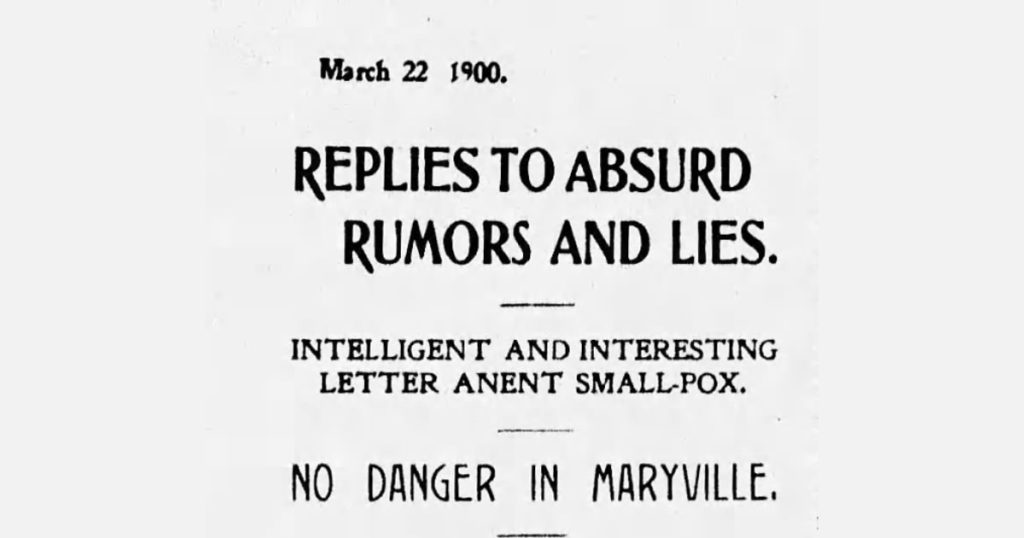
This headline was published in the March 22, 1900 edition of The Maryville Tribune.
You wake up one morning feeling off. You might have a headache, sniffles, or feel the need to take your temperature. The next questions that might pop into your head are “what do I have?” and “is it serious?” These two questions are loosely related to two key aspects of medicine that have a long history: diagnosis (identifying a disorder) and prognosis (imaging what the course of illness will look like). Answering either question incorrectly can have serious consequences. At the turn of the 20th century, uncertain diagnoses caused a bit of a stir in Nodaway County. The disease in question — smallpox.
Prior to its global eradication in 1980, smallpox was a common and dangerous infectious disease. With a mortality rate of around 10 percent, the prospect of a smallpox outbreak was justifiably frightening to the people of Nodaway County. Nineteenth-century vaccinations provided immunity which reduced the severity of the disease and in many cases prevented it altogether. Despite these facts, readers of Maryville newspapers worried about the possibility of the ailment.
They were also confused. Were rumors of fevers and rashes the result of smallpox or its less dangerous cousin, chickenpox? In either case, how was the community expected to respond?
Newspapers in the county actively tracked outbreaks, interviewed physicians and simultaneously attempted to quell panic and promote caution.
By the 1890s, vaccination for smallpox was well-known and widespread. Deaths from the disease were most likely among the unvaccinated, including children. In the wake of various smallpox scares between 1890 and 1910, local newspapers reprinted recommendations from physicians as well as the state quarantine guidelines. Many of the recommendations sound familiar to us now. For example, vaccination as soon as possible and avoidance of infected or exposed individuals.
Others appear more unusual such as the establishment of temporary hospitals or burning of bedding and clothes of the ill once recovered.
Physicians were also contacted to explain the illness. One confirmed outbreak here in 1895 arguably started because of a misidentified cause of death. Abraham Hull of Maryville died of smallpox in Hot Springs, Arkansas, where he had been on vacation to treat a chronic illness. The doctor at the spa diagnosed him with “blood poisoning” and shipped Hull’s body — and the virus — home to Missouri. Unlike many other diseases, the smallpox pathogen can persist on objects — especially fabric — and infect individuals without direct human-to human-contact. Six Nodaway County physicians signed a statement connecting Hull’s funeral to a small outbreak that infected six individuals by March 7.
Beyond the official recommendations, residents of Nodaway County had additional information to sort through in 1895. For example, what to do if someone in your family fell ill?
The Nodaway Democrat included home remedies from a Mrs. J.W. Carnagey that are outright strange. In one of her recipes, she claimed that a home cure of zinc, foxglove and sugar would cure either smallpox or scarlet fever (completely unrelated illnesses) in less than 12 hours.
With so much contradictory information, it’s not surprising that many ordinary people found themselves flummoxed by the disease and news reports.
While the 1895 outbreak appeared small and well-understood based on news reports, suspicion five years later indicated far more uncertainty and possible panic. Only two months into the new century, Maryville residents picked up their copies of the Nodaway Democrat with the headline “Relative to Smallpox: Was it Smallpox or Not in Maryville?” in response to an outbreak of … something. General consensus traced the rashy fever to Illinois, where physicians apparently claimed that chickenpox, not smallpox, ran through communities.
The paper concluded that with either disease caution was warranted. Smallpox scares continued to pepper county papers for the next few years, showing the persistence of disease as an important topic of conversation, as it is now.
Visit the NCHS Museum at 110 N. Walnut Street to learn more about the history of Nodaway County, including daily life during the late 19th century when diseases like smallpox frightened the local community.
The museum is open March to December on Tuesdays to Fridays from 1 to 4 p.m. and on the second Saturday of each month from 9 to 11a.m. We also host monthly programs and are free to the public.
The museum also maintains the historic Hickory Grove one-room schoolhouse from 1883 and the Caleb Burns House, one of the oldest still-standing homes in the entire Platte Purchase area. To preserve this history, the NCHS Museum relies on monetary donations and offers legacy giving plans to donors. Learn more about the museum’s work on our website. You can contact us at [email protected] or at 660-582-8176.