Maryville, Nodaway County’s railroad legacy, Part II
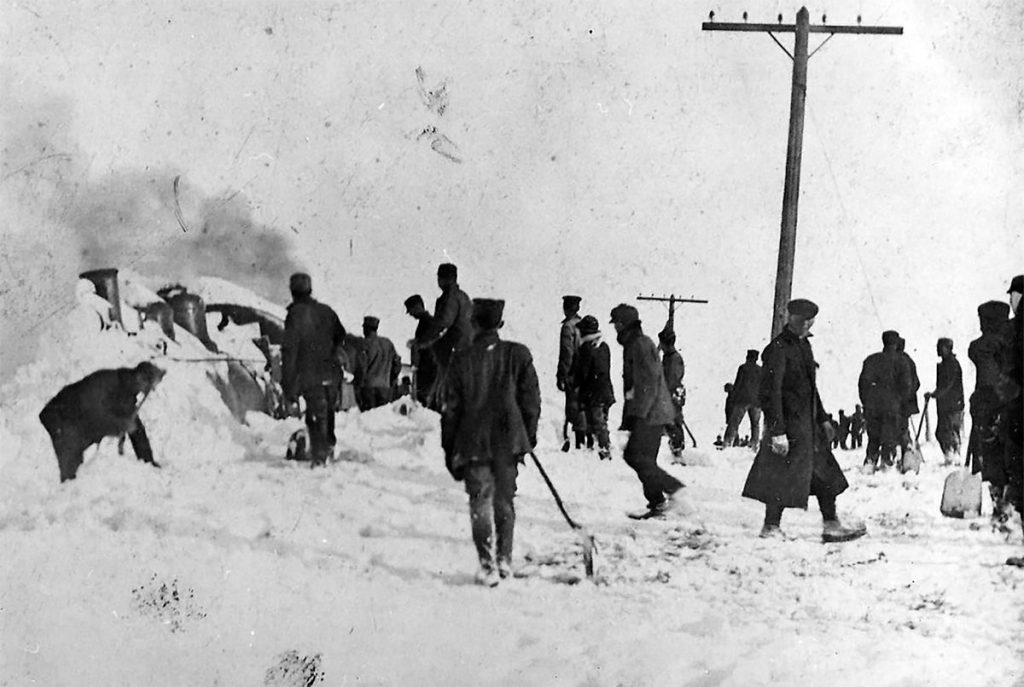
NCHS MUSEUM PHOTO
Railroad workers attempt to free a “snowed in” train, almost hidden by the bank behind them, on a local winter day.
Depot Street in Maryville is more than a name, it’s a living memory of the railroads that once defined our town. Today, the tracks are gone, but their stories echo through our streets. The Wabash Line depot near Northwest Missouri State University stands as a poignant reminder of this era, now overshadowed by new structures yet still resonant with history.
As the mid-20th century unfolded, the iron horses that once thundered across northwest Missouri began their slow retreat. Instead of the railroad acting as the center of commerce, relying on small communities to serve engines with water, sand, and passengers, the communities began to rely on rail to remain economically viable. The economic boom of the 1950s, ironically, heralded the beginning of the end for our regional railroads. The rise of automobiles and changing agricultural markets directed our area away from its rail-focused past. Rail lines, once vital arteries of commerce, struggled under the weight of high maintenance costs and diminishing returns. Consolidated rail companies, driven by bottom lines, reshaped our region yet again.
Some still recall riding the Dome Car along the Burlington Line from Maryville to St. Joseph in the early 1950s. These innovations briefly captured interest, but the struggle to maintain them was evident. In response, rail companies introduced smaller, more economical trains. The “Doodlebug” engine, a gasoline-powered and more limited version of its predecessors, represented a valiant effort to keep the essential services of mail, passenger transport and small deliveries alive. These engines continued to serve the community, stopping wherever signaled along the tracks, but their presence highlighted the financial constraints of rural communities.
The concept of “trainspace,” as coined by Julie Cidell, captures the enduring influence of railroads. It reflects the physical and cultural landscapes shaped by rail lines. Our region’s “trainspace” is visible in the layout of our towns, the old railroad beds and the stories that remain an integral part of our community fabric.
The decline of railroads left deep marks on places like Burlington Junction, Barnard, Pickering, Skidmore and the storied Wabash Line depot. These sites, once vibrant with locomotive energy, now stand as quiet guardians of a rich railroad heritage. They remind us of a time when the lifeblood of our communities pulsed with the rhythm of trains.
Reflecting on Maryville and Nodaway County’s railroad legacy, it’s imperative to preserve these echoes of the iron horse. Our “trainspace” is a testament to our adaptability and resilience. In valuing and preserving this legacy, we honor our past and guide future generations to understand the transformative journey of our region, a journey that continues to shape the identity and spirit of Maryville and its surroundings.
Visit the NCHS Museum at 110 N. Walnut St. to learn more about the history of Nodaway County, including the region’s railroad history. We also have a children’s room with an antique train racing the tracks overhead, so be sure to head upstairs to check it out! The museum is open March to December from 1 to 4 p.m. on Tuesdays through Fridays and year-round from 9 to 11 a.m. on the second Saturday of each month. We host monthly programs that are free to the public.
The museum also maintains the historic Hickory Grove one-room schoolhouse from 1883 and the Caleb Burns House, one of the oldest still-standing homes in the entire Platte Purchase area. To preserve this history, the NCHS Museum relies on monetary donations and offers legacy giving plans to donors. Learn more about the museum’s work on our website. You can contact us at [email protected] or 660-582-8176.
The museum is now closed for the winter season and will be reopening the first week of March. Our Second Saturday coffee hours from 9 to 11 a.m. will be continuing in January and February, so you are welcome to stop by on those days for coffee and to explore the museum!