Maryville, Nodaway County’s railroad legacy
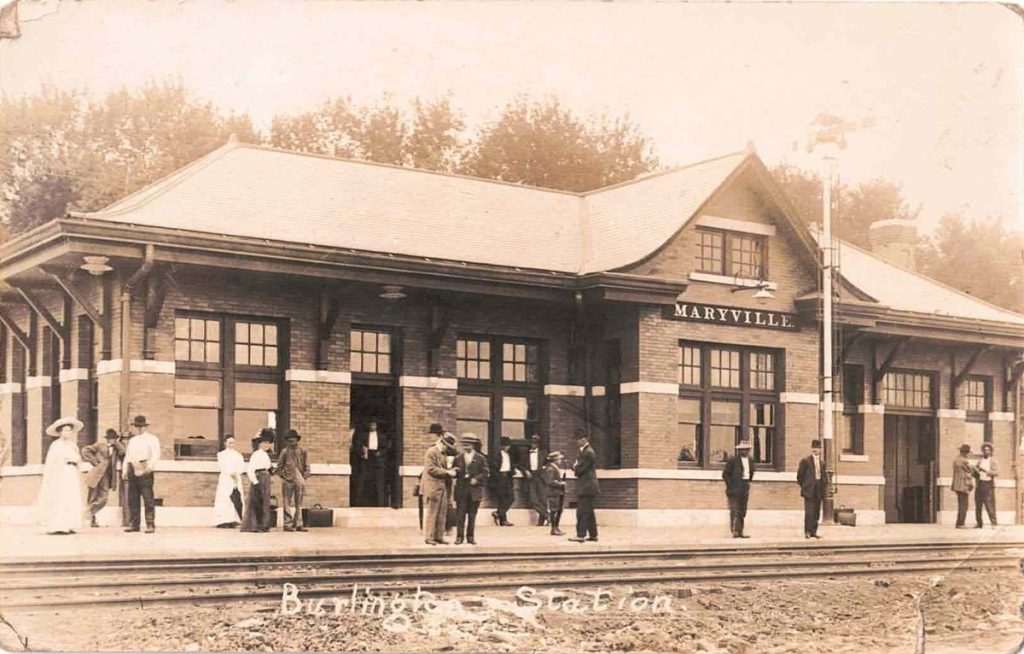
NCHS MUSEUM PHOTO
The Burlington Station, a Maryville Depot, is shown in this photograph.
The echoes of railroads that once crisscrossed Maryville still linger in its streets and landmarks. You can see it in the old trestle foundations along Main Street, the Wabash Line depot standing tall near Northwest Missouri State University, and even in the name of Depot Street. These aren’t just relics; they tell the story of when railroads were the heartbeat of Nodaway County, bringing growth and hope to Maryville.
Back in the 19th century, as railroads were stitching the Midwest together, Maryville and its surrounding county underwent a big change. The Wabash Railroad’s arrival didn’t just break the quiet of the countryside, it opened doors to new opportunities.
Before the trains, Maryville was just a small county seat, its pace of life dictated by how far a horse could travel in a day. But when the railroad tracks were laid — interestingly, over a mile east of the county courthouse — it sparked talk of “Two Maryvilles.” The suggestion was that the railroad was just too far from the city center and might need a second city.
This was a sign of just how much the railroads would change the city’s layout and its future.
The railroads transformed Maryville’s economy more than the city founders could have imagined, but also not as much as others envisioned. The first trains brought a surge in trade, linking local farms and businesses to markets far and wide. Later, the Chicago, Burlington and Quincy Railroad’s arrival spurred even more growth and urban development, reshaping the city into a bustling hub. But neither railroad was a trunk line that could have signaled major growth, they were just branch lines with a smaller purpose.
The impact of the railroads went beyond Maryville. In the countryside, the need for infrastructure like water towers, sanding towers and depots every six miles or so led to the birth of new towns — Arkoe, Barnard, Pickering, Wilcox and Burlington Junction are just a few examples in Nodaway County. These towns sprang up around railroad facilities, thriving as vital stops along the rail lines. Unfortunately, not all these towns stood the test of time. Several smaller communities, born out of railroad needs, have since been lost to history, their stories echoing the transient nature of progress and development.
It wasn’t just goods that the trains brought in, they also brought people. New faces, new ideas and new cultures started flowing into Maryville. The once quiet and predictable streets became lively and diverse, buzzing with new businesses and the promise of a brighter future.
Today, as you drive down Depot Street or pause to look at the old depot, you’re retracing the steps of Maryville’s history. Sure, railroads might not be the key players in our progress anymore, but their impact is still all around us. They remind us of a time when Maryville rode the rails into an era of growth, when our farms, for the first time, could send grain and produce far beyond our borders and when new goods and ideas came chugging in from distant places, changing our little corner of Missouri forever.
In the second installment of this series, we will investigate the decline of railroads and what that also meant for rural communities like Maryville.
Visit the NCHS Museum at 110 N. Walnut Street to learn more about the history of Nodaway County, including the region’s railroad history.
The museum is open March to December on Tuesdays to Fridays from 1-4 p.m. and year-round on the second Saturday of each month from 9-11 a.m. We host monthly programs that are free to the public.
The museum also maintains the historic Hickory Grove one-room schoolhouse from 1883 and the Caleb Burns House, one of the oldest still-standing homes in the entire Platte Purchase area.
To preserve this history, the NCHS Museum relies on monetary donations and offers legacy giving plans to donors. Learn more about the museum’s work on our website. You can contact us at [email protected] or 660-582-8176. The museum is now closed for the winter season and will be reopening the first week of March. Our second Saturday coffee hours from 9-11 a.m. will be continuing in January and February, so you are welcome to stop by on those days. We would like to say a huge thank you to the community for supporting the museum and helping to preserve Nodaway County’s history. We could not do it without you!