
Community celebrates completion of South Main Phase I
SKYE POURNAZARI/THE FORUM
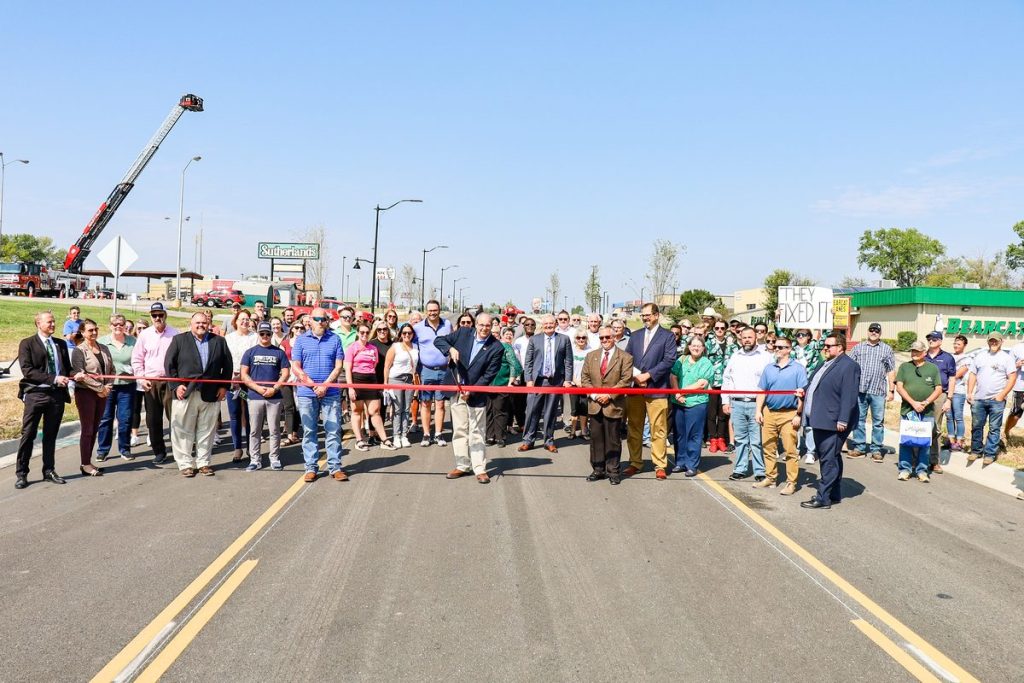
Surrounded by members of the Maryville community, Mayor Tye Parsons prepares to cut a ribbon Monday celebrating the Phase I completion of the South Main Street project.
MARYVILLE, Mo. — The mood was triumphant and jubilant on Monday as the city of Maryville celebrated the completion of Phase I of the South Main Corridor Improvement Project, the most significant public works project in the city’s history.
“In no uncertain terms, we have completed the single most important transportation and economic development project in the history of our community,” said Mayor Tye Parsons in a speech to kick off Monday’s celebration and ribbon-cutting. “Transportation planners at the state and federal levels call this type of development a ‘complete street.’ Much more than a strip of asphalt that connects two places together, a complete street addresses safety, access, motorized and non-motorized transportation, functionality, infrastructure and aesthetics.
“A complete street, like South Main, makes a transportation corridor work, and work better, for everyone — citizens, businesses, visitors, pedestrians and drivers — in a way that enhances not only the immediate area but the region as a whole.”
What’s New on South Main
- Proper storm drainage
- New water line
- New traffic signals, including at Walmart intersection
- New turn lanes, reduction of unsafe and conflicting turn movements
- Appropriately sized and located access points
- Utilities moved underground
- Decorative streetlights
- Pedestrian amenities
- Other aesthetic enhancements including trees, sod and more
Phase I, the long-gestating overhaul of South Main Street from the intersection with South Avenue to the intersection with State Highway V, made a host of functional and aesthetic improvements designed to make the corridor safer, more accessible for pedestrians and more of a welcoming sight for visitors driving down Maryville’s most significant economic artery.
“As we stand here and celebrate this momentous occasion, cutting the ribbon to signify the completion of Phase I, it’s hard to put into words the immense sense of accomplishment this community should feel right now,” said City Manager Greg McDanel.
Parsons pointed out that the majority of sales taxes collected in Nodaway County come from businesses along South Main, and the approximately $13 million Phase I overhaul is a major economic development investment that has already begun to pay dividends.
“Since the South Main project was announced, millions of dollars in private investments have come to the area, not only in new businesses such as Starbucks and Marshalls, but remodels of existing businesses, including the multimillion-dollar remodel of Walmart. And that’s just the tip of the iceberg,” Parsons said, adding that the city is in talks with more businesses about remodels and new locations in Maryville.
Beyond the obvious benefits, speakers during Monday’s ceremony marveled at the fact that Maryville had been successful in pulling off such a colossal infrastructure project that began a decade ago — December 2012 — with a goal in the city’s comprehensive plan.
By 2015, the city had a traffic study in hand that outlined the problems on the clogged corridor, and prescribed fixes. The estimated price tag? Between $12 and $15 million.
To pay for it, city voters endorsed an extension of the capital improvement sales tax in 2017, setting the city on its path toward a plan of at least a decade of construction to complete the improvements — all on the dime of local taxpayers.
But in late summer 2018, the city worked feverishly with the Northwest Missouri Regional Council of Governments to complete an application package for a federal Better Utilizing Investments to Leverage Development (BUILD) grant. City and NWMRCOG staff worked around the clock in a 45-day sprint to submit the materials, and sent in the application with “minutes to spare,” according to McDanel.
“Amy Dowis, Kim Mildward, Jerri Dearmont from the Northwest Missouri Regional Council of Governments, our community is in debt to your assistance in that process in working (with us), providing us the courage to demystify and work through complex federal grant requests, and the insight in working with grants.gov — thank you for preventing me from throwing my laptop on more than one occasion,” McDanel said Monday.
Even after the application had been submitted, the project still faced long odds: the BUILD program had $1.5 billion of funding to allocate for 851 potential projects requesting more than $11 billion of aid from across the country.
In the end, the $10.48 million BUILD grant awarded to Maryville, one of only four in Missouri that year, would prove to be a turning point for the city’s confidence in its grant process and ability to secure federal and state funding.
It also meant a much quicker timeline of only a few years, and a local match of only a few million.
South Main Project Timeline
Dec. 2012: Master plan cites South Main as No. 1 priority
Aug. 2015: Traffic corridor study outlines problems, solutions
April 2017: Capital improvement sales tax extended, providing funding for a decade-long construction plan
Dec. 2018: $10.48 million BUILD grant awarded for project
Dec. 2019: Full corridor design completed
April 2021: Project split into two phases after bids come in over budget
Oct. 2021: Phase I begins construction
Aug. 2022: $5.9 million awarded for Phase II
Aug. 2023: Phase II bids come in over budget
Sept. 2023: Phase I completed
The key to the grant application’s success, McDanel would say later, was the widespread support from local leaders and businesses: nearly every property owner along South Main provided a letter of support, driving home how important the project was to the community.
“We aren’t OK with just being OK,” said Nate Blackford, president of Mosaic Medical Center – Maryville which is one of the property owners along the corridor that provided a letter of support. “The easiest thing for Greg and the city of Maryville to do was just to kind of live with the way things were — it was a highly disruptive project. … But despite that, Greg and team committed to the project. They were committed to getting it done, getting it done right, getting it done within budget, and we thank you very much for that, because it’s not always easy to challenge the status quo, it’s not always easy to do tough things — and this was a tough thing.”
But just before the project was ready to get into full swing, the COVID-19 pandemic struck, throwing a wrench into the well-laid plans.
Delay after delay at the federal level pushed the process back into 2021, when the city finally received the first construction bids for the project that had been gestating since 2012 — and they were way over budget.
Driven up by pandemic-related issues affecting global supply chains, what had been estimated as a $12-13 million project in 2018 was, by March 2021, now estimated to be closer to $16 million. And that number would only go up.
The solution drawn up by city staff and contractor SK Design was to split the project into two parts that are now known as Phase I and Phase II, with Phase I running from the intersection with South Avenue to the intersection with State Route V, and Phase II running from there to the intersection with U.S. Highway 71.
On Monday, the city marked the end of Phase I, 705 days after it officially began. For only three days of those 705, McDanel said, was the roadway closed.
The speakers at Monday’s event — Parsons, Kevin Ward of the Federal Highway Administration, Blackford and McDanel — all played variations on the same theme, harping on what a historic achievement it was for Maryville to be celebrating success on such a massive, transformative infrastructure project.
In particular, McDanel was singled out with praise again and again for his leadership during the decade-long project and all the work that went into keeping it on track despite obstacle after obstacle.
“Those of us who work with Greg know how hard he works, how important his leadership is to not just this community but to all of us within the organization,” said Assistant City Manager Ryan Heiland. “And this was an incredible project that he really put all of his time and effort into. The results are amazing.”
McDanel emphasized the importance of a long list of elected local officials who never wavered from supporting the project over that time.
City Council support
Since 2012 when South Main was made the city’s No. 1 priority on the comprehensive plan, numerous city leaders have come and gone off the City Council, but have all helped to advance the project.
“The South Main project is a case study in how community success requires not just determination of current elected officials, but the consistency and commitment from those who served before them,” City Manager Greg McDanel said during Monday’s ceremony. He listed the following City Council members who contributed to the project through their leadership over the past decade:
- Glenn Jonagan
- Ron Moss
- Jim Fall
- Jeff Funston
- Renee Riedel
- Jerry Riggs
- Tim Shipley
- Jason McDowell
- Matt Johnson
- Rachael Martin
“They each embraced this project every step of the way, and at any point a new group of elected officials could have steered the ship in a different direction, established new priorities, but they remained committed and steadfast to our adopted plan,” McDanel said.
“Each time there was an opportunity to move this project forward, they did not hesitate,” McDanel said. “… These individuals decide to run for office, volunteer and serve, and take significant time out of their personal and professional lives to advance civic interests and just hopefully, incrementally, move this community forward, one step at a time.”
McDanel also said he is confident that the city will find ways to make up the funding gap for Phase II, the lone bid for the construction of which came in significantly over budget last month, forcing city staff to look at alternatives to the $5.9 million Rebuilding American Infrastructure with Sustainability and Equity (RAISE) grant the city received through the U.S. Department of Transportation’s successor to the BUILD program.
“The ribbon-cutting on Phase I is not the end, but it is rather a significant milestone in the community’s journey to enhance, enrich and empower the lives of those who reside in Maryville and those who visit the area,” McDanel said. “We remain committed to the construction of Phase II and for improving Maryville for generations to come.”
During his speech Monday, Mayor Parsons agreed that Maryville would find a way to get it done — and move on to the next big projects that await the city.
“What’s next? South Main Phase II,” Parsons said. “What’s next? A new multimillion-dollar water treatment plant that will serve this community and the county for the next 50 years. What’s next? A complete street for South Avenue and First Street through town, and a whole lot more.
“So to conclude, I’d say the No. 1 thing that I heard over the past two years of construction was, ‘well, it’ll be nice when it’s done.’ So to the citizens of Maryville, I’d like to say thank you. Thank you for your patience, thank you for your support as we work our way through the South Main corridor project. I hope you’ll agree that it’s nice now that it’s done.”




