Housing crisis: Officials, employers meet to hear housing pitch
SNYDER & ASSOCIATES RENDERING
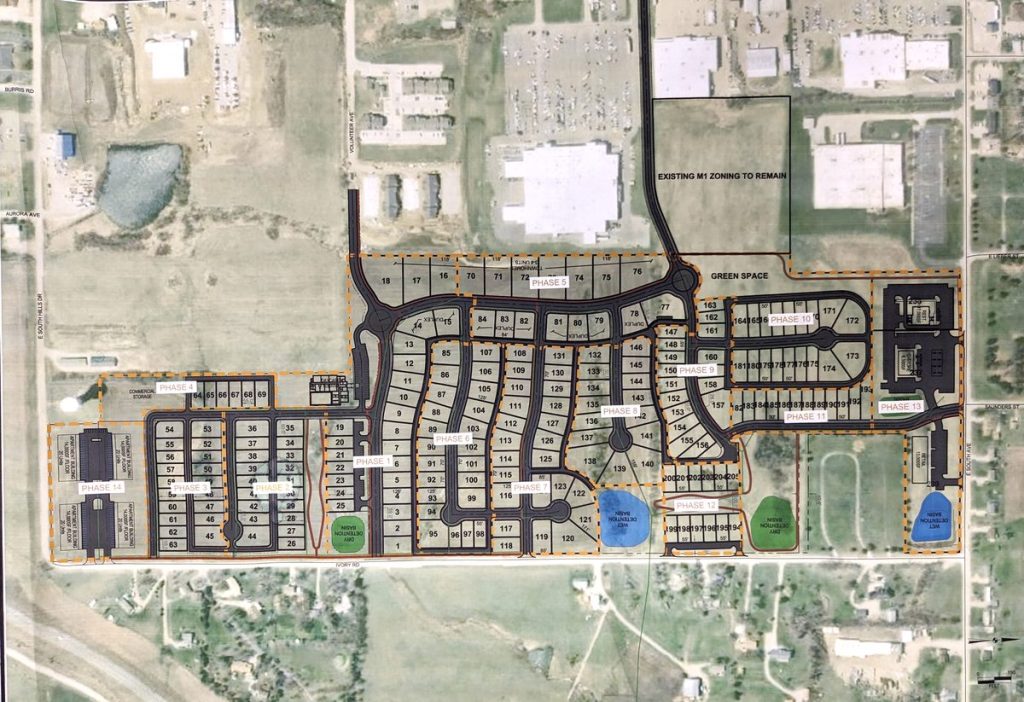
A phasing plan prepared by Snyder & Associates for a proposed 66-acre housing development that Mary Beth and Gary Shipps intend to build behind Walmart in Maryville.
MARYVILLE, Mo. — Local employers and government officials met last week to hear a proposal for a new housing development in Maryville intended to address the ongoing critical shortage of affordable housing in the area.
Mary Beth and Gary Shipps, a husband-and-wife team, presented a very early draft of a plan to develop a 66-acre area east of Walmart that the couple owns during a meeting facilitated by Nodaway County Economic Development on Aug. 31. Around two dozen representatives from some of the county’s largest employers and from the city and county governments gathered in the Nodaway County Administration Center to hear the pitch and give feedback.
“It is our vision to bring more housing to Maryville, to bring some affordable housing,” said Mary Beth Shipps, who headed the presentation to the group. “… We’re looking at starter homes, or maybe a transitional second home so that it frees up that first home for someone else to come in and purchase.”
A critical shortage of housing, especially within Maryville city limits, has been an issue for years in attracting candidates for open positions, often among the top obstacles listed by employers during past public meetings, alongside child care.
A 2018 study commissioned by the city of Maryville cited a “severe” lack of housing in the $125,000-$200,000 range, hampering young families looking to purchase their first home in Maryville. Consequently, the same report estimated that 63 percent of people who work in Maryville live someplace else.
“We need more housing,” said Josh McKim, NCED executive director. “And it’s all levels, it’s not just workforce, it’s all levels.”
That problem hasn’t gotten any better over the past five years as the cost to build and purchase homes continues to rise.
Eric Couts, owner of Premier Homes of Northwest Missouri, worked with the Shippses on the designs for their planned neighborhood. The base models for homeowners in the proposal would be 1,500 square feet with three bedrooms, two bathrooms and a garage. Couts, citing up-to-date numbers, said each home would come in at a value of around $280,000, with little fat in the budget to trim — demonstrating the problem that has plagued Maryville’s housing market.
Couts said that the costs of labor and materials have risen sharply, making it especially difficult to build more affordable housing.
“You know, it’s no different thing than anybody else is having issues with,” he said. “Concrete’s gone up from $114 a yard to $190. It’s just cost prohibitive to have what we all envision as a starter home of $159,000 — it just can’t happen. It’s a challenge that we all are facing. … I’d love to say you could build a house for $150 or $120 per square foot. But I don’t know how you cut $75,000 out of that house.”
Employers who spoke up during the meeting generally agreed that their employees would not be able to afford the down payment on homes like the ones proposed, and even if they could, mortgage costs would likely eat up much of their income.
“Not everybody’s got an appetite for that kind of living on the edge,” said Steve Klotz, assistant superintendent at the Maryville R-II School District. Starting teachers at the district make $38,000.
MARYVILLE HOUSING SNAPSHOT
| 2017-2021 | 2012-2016 | |
| Renter-occupied housing rate | 57.2% | 62.3% |
| Homeowner vacancy rate | 2.3% | 1.8% |
| Median owner-occupied home value | $132,700 | $137,800 |
| Median rent | $693/mo. | $626/mo. |
Source: American Community Survey 5-year data estimates
Mary Beth Shipps said some rentals would be mixed in through duplex and townhome options, but with restrictions to ensure they were for single families, not repurposed for multiple college students. The 2018 study cited an emphasis on rentals to college students as another barrier to affordable homeownership for young families. Couts said some combination of rent-to-buy opportunities could also potentially be offered.
Another hope, Mary Beth Shipps said, is that families already in Maryville could upgrade to one of the new houses, opening their old homes for an influx of first-time home buyers. However, the Shippses said they understood that in order to be successful, they would still need to find a way to bridge the gap between the homes they can build and the price points prospective new employees could afford.
Last week’s meeting, ultimately, was to acknowledge the problem and invite employers and government officials to participate in the process and begin thinking about creative solutions, McKim said.
As examples, McKim said employers could consider things like signing bonuses to assist with down payments, or more direct solutions like offering matching funds — much like a 401(k) — to help employees move into a new home.
The proposed development is in its early stages, though, and subject to significant change. Additionally, the Shippses said they would like assistance from the city in building out infrastructure — like roads and water and sewer connections — before proceeding.
Employers were encouraged to give feedback to NCED in the near future to help guide the project through its next steps.