MMC-M awarded for efforts to improve rural stroke care
SUBMITTED BY MOSAIC MEDICAL CENTER – MARYVILLE
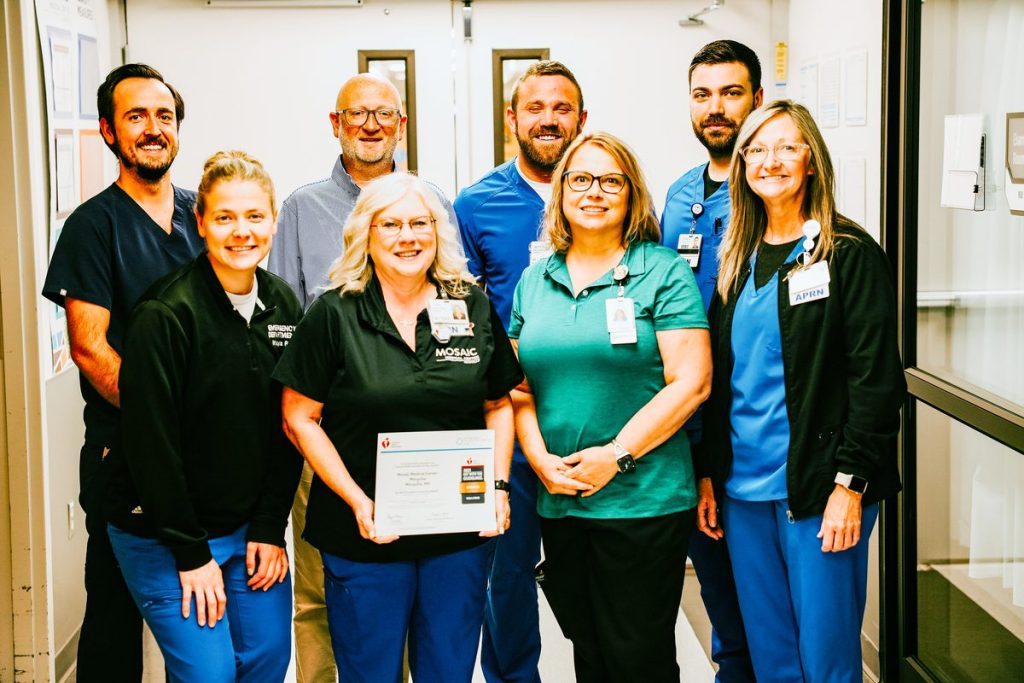
Shown in the front row, from left: Mikayla Bendig, RN; Lori Force, RN and stroke coordinator; Sally Bomar, MD; Paula Goodridge, APRN; back row: Jared Norman, DO; Nate Blackford, president of Mosaic Medical Center – Maryville; Jeff Lloyd, RN; Ethan Miller, RN.
MARYVILLE, Mo. — According to the American Heart Association, people who live in rural communities live an average of three years fewer than their urban counterparts, have a 40 percent higher likelihood of developing heart disease and face a 30 percent increased risk for stroke mortality — gaps that have grown for the past two decades.
According to a news release, Mosaic Medical Center – Maryville is committed to changing that.
For its efforts to optimize stroke care and eliminate rural health care outcome differences, MMC-M recently received the American Heart Association/American Stroke Association’s Get With The Guidelines – Stroke Rural Recognition Bronze award.
“Patients in our rural communities deserve to have the best possible outcomes when faced with life-altering health conditions,” Lori Force, RN and stroke coordinator at MMC-M, said in a statement. “Meeting these key quality measures demonstrates our team’s commitment to our patients. We strive to deliver care that is exceptional. Our patients can depend on us to recognize stroke-like symptoms and initiate appropriate treatment in a timely manner.”
The American Heart Association, the world’s leading nonprofit organization focused on heart and brain health for all, recognizes the importance of health care services provided to people living in rural areas by rural hospitals that play a vital role in the initiation of timely, evidence-based care. For that reason, all rural hospitals participating in Get With The Guidelines – Stroke are eligible to receive award recognition based on a unique methodology focused on early acute stroke performance metrics.
The award recognizes hospitals for their efforts toward acute stroke care excellence demonstrated by composite score compliance to guideline-directed care for intravenous thrombolytic therapy, timely hospital inter-facility transfer, dysphagia screening, symptom timeline and deficit assessment documentation, emergency medical services communication, brain imaging and stroke expert consultation.