MDC restoring wildlife-friendly native grassland habitat at the Bilby Ranch
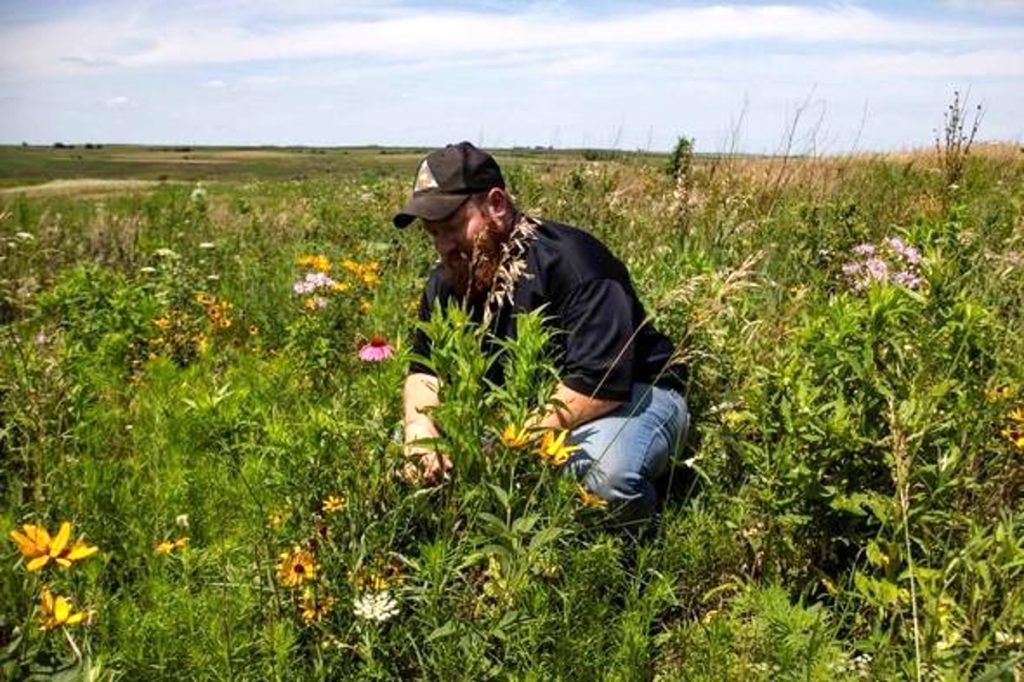
BILL GRAHAM/MDC PHOTO
Phil Boyer, MDC wildlife biologist, leads the Bilby Ranch native grassland restoration and monitors the prairie plants. In year two, they are growing, and some are blooming, but more growth years and management such as prescribed burns are required for the prairie plants to dominate and crowd out non-natives that linger.
MARYVILLE, Mo. — It’s early according to nature’s timetable, only the second growing season since the seeds went into the soil. But already prairie grasses and wildflowers are reclaiming sod on 600 acres of the Bilby Ranch Conservation Area in Nodaway County.
According to a news release, the Missouri Department of Conservation is restoring a tract on the area into the type of natural wildlife habitat that once covered most of northwest Missouri.
“Our goal is to restore a tallgrass prairie ecosystem, something that we don’t have a lot of acres,” said Phil Boyer, MDC wildlife biologist. “We want a contiguous grassland, uninterrupted. We’re trying to make it look like it might have been in the early 1800s.”
Purple coneflowers and yellow ox-eye sunflowers are blooming this summer on hills in the restoration tract.
Warm-season grasses such as big bluestem, Indiangrass and side oats grama are emerging. It will take years for the deep-rooted prairie plants to fully express their growth potential. But already they are providing overhead cover, insect hosts, and bare-ground openings at the base of plants that help ground-nesting birds like bobwhite quail.
That change has already boosted the spring and fall quail counts at Bilby Ranch.
Prairie grasses and wildflowers in vast open grasslands were dominant in the region prior to the 1800s. They were interspersed in places with smaller open savannas and woodlands that were also friendly to grassland wildlife. The tallgrass prairie ecosystem created rich soils that now support the region’s predominate corn and soybean agricultural economy. Today, less than one-tenth of one percent of Missouri’s historic prairies remain unplowed. Unplowed prairie remnants are especially scarce in the state’s deep-soil northwest region.
One remnant, MDC’s Little Tarkio Prairie in Holt County, is being used as the species model for the Bilby Ranch project. Restoring native grasslands provides a haven for wildlife and a destination for birders, wildlife watchers, and hunters.
The 5,110-acre Bilby Ranch property had a lake and several ponds when MDC acquired it 1987, but the rolling hills were mostly managed as crop fields with some acres in non-native brome grass pasture. Since then, MDC has managed more acres for wildlife habitat. Wildlife such as deer, turkey and bobwhite quail need a habitat that sustains them through the seasons and rearing young. Creatures such as songbirds and pollinators like wild bees and butterflies need the same. They evolved in a tallgrass prairie ecosystem.
Restoring native plant diversity that resembles an original tallgrass prairie, however, is challenging.
Starting in 2020, MDC began contracting with an area resident to remove trees that had encroached in fields and drainages. Historically, fire had kept trees from the prairies. An area farmer received a contract for haying brome fields that were to be converted to prairie plants.
Local contractors were hired to spray herbicide to control unwanted, non-native cool season grasses in the prairie restoration target area.
In the autumn of 2021, Boyer and the MDC work team planted 30 different species of prairie forbs and four species of native warm-season grass into the treated acres south and west of Bilby Lake. Seedlings began growing in the 2022 growing season. Prairie plantings can take a few years to become established and dominant. Also, establishing diverse prairie species is more difficult and requires more management than simply establishing three or four prairie grasses for livestock forage.
“These are species that commonly show within a year,” Boyer said. “It shows we did well at getting our seed drilled at a good depth in the soil for germination.”
Visitors will pass by the prairie restoration area on the ridge road that leads to Bilby Lake off Missouri 46 highway, west of Maryville.