Boehs build 108 Family, bring real-world experience into education
TRINITY COBB/THE FORUM
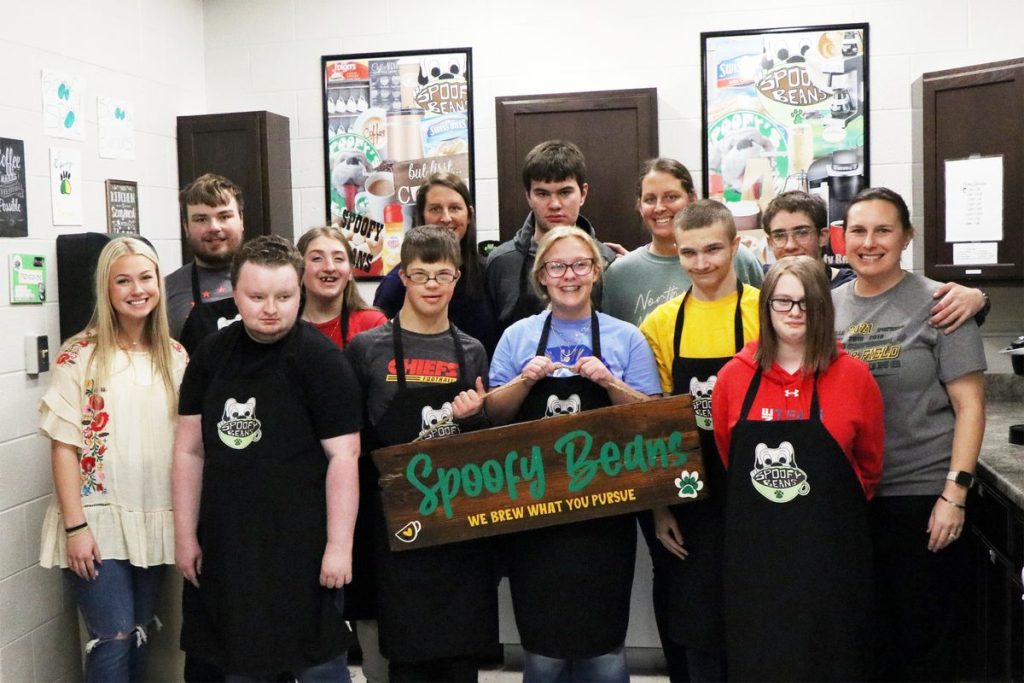
The Boeh sisters stand with their 108 family.
MARYVILLE, Mo. — When Alexis and Candace Boeh first became special services teachers eight years ago, Maryville High School’s life skills program was lacking.
“When we got to Maryville, the life skills program was probably two to three kids, and they were just in the classes that everybody else (was in). … There wasn’t like a program. Like (our) room was like desks and computers. It was just like a regular classroom,” Candace said. “What we kind of found out was that, when we got here, that there were a lot of kids that needed life skills, that needed these transition skills, these soft skills. … The first couple years we had like eight, but pretty consistently, I would say we have a group of anywhere from 10 to 14 students.”
The Boehs grew up in various places across the United States, including Arkansas, Ohio, Kansas and Pennsylvania. They came to Maryville for college when Gene Steinmeyer recruited the two to play basketball for Northwest Missouri State University.
At Northwest, the two studied K-12 special education and 1-6 elementary education. They went on to receive their masters’ degrees in K-12 leadership.
“We always knew that we wanted to do something in the realm of special education,” Alexis said. “We didn’t know initially if that looked like education or other organizations.”
Because their childhood best friend has a brother with Down syndrome, the two developed an interest in special needs at an early age. In middle school, they had a mentoring buddy who also had Down syndrome. In high school, they became teacher’s assistants for an adaptive physical education class.
Now that the Boehs have become teachers, they provide a similar opportunity for MHS students.
“There are peer mentors every hour, so that was another thing that was set up,” Candace said. “Typical, developing kids (their grade-level peers) apply to be a peer mentor, and so we have about three to four each hour. So the goal is that not only are the kids learning from us, but they’re learning from their peers.”
During their time at MHS, the Boehs have turned the life skills program into the 108 family, which consists of them, their students, peer mentors and Kristi Beu, an MHS paraprofessional.
“I don’t know if I could even have kids because I feel like I have 14 already,” Candace said with a laugh, noting that the classroom has become a community.
Everything the Boehs teach is centered on helping students transition to life after high school.
“The main thing that we do is the Spoofy Beans coffee shop. So, it first started where we were just serving to the high school … now the kids are actually going in and businesses are actually having us cater for their employees. And we’ve done, I think, up to 80 people at an event, and we do it multiple times a week. So the kids are getting an integrated, real-world experience,” Candace said.
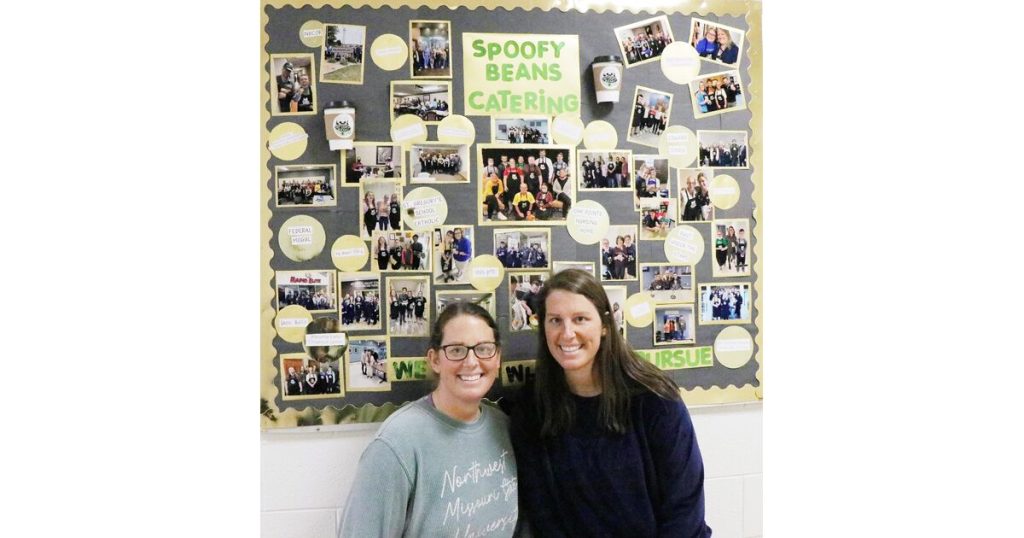
Businesses reach out to the Boehs and specifically request Spoofy Beans. A bulletin board outside their classroom displays all the businesses Spoofy Beans has catered to.
“It’s great getting to do it together, and I just want to overemphasize that the community has been really crucial,” Alexis said.
On catering days, the class prepares for the event as if they were at work. They clock in, put on work uniforms, practice hygiene, do an inventory check, make products and package supplies.
Each catering event is around a couple hours, but the work does not end there.
“Every time we go out and cater, when we get back here, the first thing we do is we have a team meeting, so we assess how that event went. What are some things that we felt like went well, and what areas do we still need to grow in,” Alexis said, adding that students receive supervisor and peer feedback on how accurate they were at creating the correct coffee orders and communicating with their customers.
After discussing feedback, the class comes up with one goal they want to work on for the next week.
While the Spoofy Beans business is better known, the students also work for Spoofy Spot.
“The other business is called Spoofy Spot, and so we do pop-up and vendor sales, where the kids make and sell the product,” Candace said. “And so they have to come up with the inventory. We talk about profit and loss, and so they are then having to — it’s a little bit different — they kind of have to practice communication a little bit more and sales pitch to get people to buy some of those, so definitely different jobs for some of those.”
While the education format is nontraditional, the students are gaining real-world experience.
“We don’t have classes called like ‘math’ or ‘English,’ everything is integrated, and the skills are obviously what they need, but also tied to the (Spoofy Beans) business,” Candace said.
At the end of every week, the Boehs’ students have to calculate how many hours they worked. They are paid hourly in Spoofy cash, which they can redeem at the end of the week for pop and prizes. They then fill out a deposit slip and turn it in to the Boehs for Spoofy cash. The students also fill out a check register to keep track of what they have spent.
“We really say to ourselves, ‘we could never teach anywhere else’ because the support, but also like the freedom and flexibility with the kids’ families and our administration,” Candace said.
This flexibility allows the Boehs to help their students attain job coaching and job exploration, as well as maintain healthy habits, such as exercising and dieting.
“Every kiddo has what would be considered a transition plan. And we focus on what are their goals for employment, education and training — so that could look like on-the-job training or (going to the) tech school — and then independent living. Do they see themselves in a group home? Do they see themselves with a roommate? Do they see themselves with their parents?” Alexis said.
Not only do the Boehs focus on the importance of being an active member of society, they emphasize the social and emotional impact of having a purpose.
“One of the things that we really focus on is employment (and) working. So when they work after high school … yes, it’s great to have a paycheck, and you need that to support yourself,” Alexis said. “But it’s all about the friendships that you make, the connections that you have, the pride and confidence that you gain from employment.”
Editor’s Note
March marks Women’s History Month and The Forum is celebrating historic women past and present in each issue. In each issue this month, The Forum will profile women making history today in different ways, as nominated by readers and staff. To nominate a woman making history today in Nodaway County, send your suggestion to [email protected] for consideration next year. All Women’s History Month profiles are available at maryvilleforum.com/features/whm.
TRINITY COBB/THE FORUM
Candace, left, and Alexis Boeh, Maryville High School special services teachers, stand in front of a display that shows all the locations their students have catered Spoofy Beans.