
Council considers plans to spread out water/sewer increase
By GEOFFREY WOEHLK The Forum
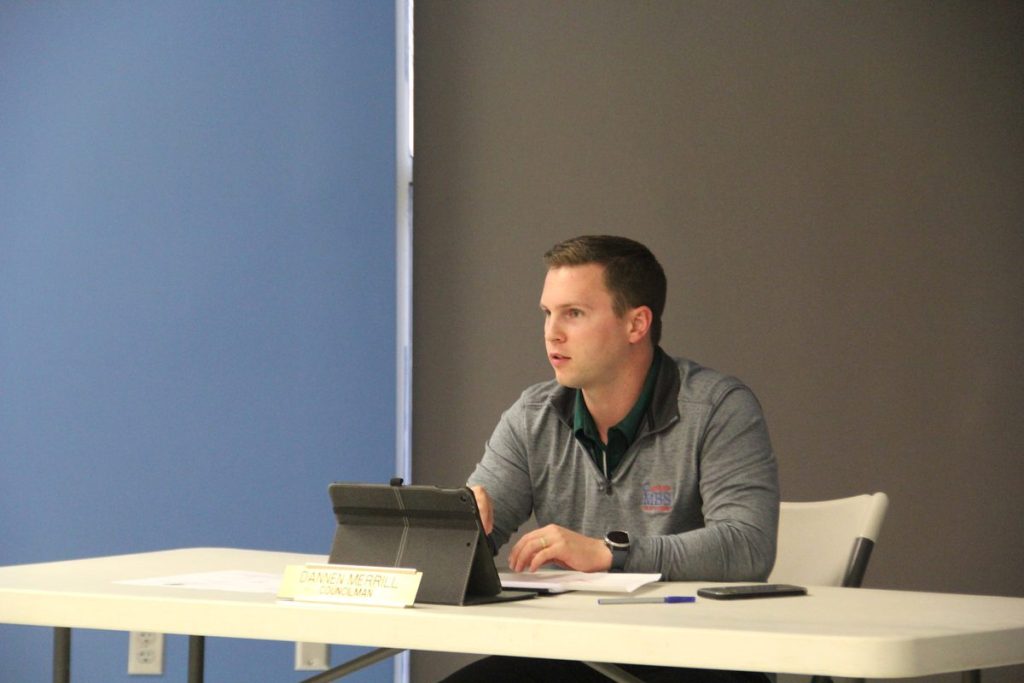
Maryville City Council member Dannen Merrill discusses alternate proposals for water and sewer rate increases at Monday’s council meeting at the Maryville Community Center. The proposals presented spread out the initial sharp increase recommended by NewGen Strategies & Solutions over two and three years instead of one large jump starting Jan. 1.
MARYVILLE, Mo. — Maryville City Council members on Monday looked at alternate plans that would phase in potential water and sewer rate increases over time to help spread out the impact on customers.
Last month, a study by consulting firm NewGen Strategies & Solutions showed that without significant and immediate increases, the water/sewer fund would be unable to keep up with expenses as soon as the end of the next fiscal year in October 2022.
To address the urgent need, NewGen recommended an increase of 25 percent to water rates and 50 percent to sewer rates to take effect on Jan. 1, followed by three percent increases each thereafter for five years. Other recommended rate adjustments were also recommended as part of more comprehensive overhaul of the rate system.
Currently, the typical residential customer inside Maryville city limits sees a monthly water and sewer bill of $46.08. Under the recommended plan from NewGen, the same customer’s bill would rise to $63.03 next year — an increase of about $17.
The immediate hike with smaller increases afterward had the lowest overall impact on customers while still keeping revenues above the city’s minimum reserve fund policy level, a consultant for NewGen told the council last week.
On Monday, the council reviewed two additional models requested from NewGen that would spread the initial rate increases out over two and three years. Under those models, the largest increases at the front end are more gradual, but are also higher overall to compensate for revenue that would have compounded beginning in the first year of the recommended model.
With the biggest increase spread out over the first two years, the typical residential customer inside Maryville city limits would see their water and sewer bill go up to $54.96 next year, about $8 cheaper than under NewGen’s initial recommendation.
However, in FY 2023, to make up for the smaller increase in the first year, the same customer would see a bill of $67.21, or a little over $2 more than under NewGen’s initial recommendation.
Projected Monthly Water/Sewer Bills
For a typical, residential Maryville customer
| FY 2021 | FY 2022 | FY 2023 | |
| Recommended rate | $46.08 | $63.03 | $64.92 |
| Two-year spread | $46.08 | $54.96 | $67.21 |
| FY 2024 | FY 2025 | FY 2026 | |
| Recommended rate | $66.87 | $68.87 | $70.94 |
| Two-year spread | $69.23 | $71.30 | $73.44 |
Source: NewGen Strategies & Solutions
Spreading the increase over three years would mean a bill only about $6 higher in the first year, followed by slightly larger jumps in years two and three to help make up the ground against the other models.
“I think when we put it in a dollar figure, that’s a lot more manageable over even a two- or three-year span for the consumer, especially when looking at their monthly budget,” said council member Dannen Merrill.
In general, council members were supportive across the board of a more gradual increase than the 50 percent jump that had been recommended by NewGen.
Council member Rachael Martin suggested the two-year spread would be her preference, and said that although she supported the gradual approach, getting back to a break-even point as soon as possible would be the most fiscally responsible move — the proposed increases do not include any extra spending, only regular operations, maintenance and capital improvement costs.
Those expenses have only been going up as the city has moved to address taste and odor issues with the water, both at its source in Mozingo Lake and through the water treatment plant. Since 2017, the city has spent more than $1 million on such projects, City Manager Greg McDanel said, which does not include half of a $1.2 million GAC adsorber being installed in partnership with Public Water Supply District No. 1, or the ongoing costs for algicide treatments to the lake approximately every three months for the past year or so.
Regional Water/Sewer Rate Comparison
| City | Monthly Rate (current total) |
| Excelsior Springs | $99.21 |
| St. Joseph | $87.66 |
| Moberly | $71.30 |
| Smithville | $66.85 |
| Marshall | $62.34 |
| Kirksville | $61.42 |
| Grain Valley | $58.36 |
| Mexico | $55.40 |
| Kearney | $52.64 |
| Maryville | $46.08 |
| Clarinda, Iowa | $44.87 |
| Chillicothe | $44.42 |
Source: NewGen Strategies & Solutions
Until revenues start to outpace expenses again, not only are those needed costs unaccounted for, but other necessary improvements, like a $450,000 water line replacement on South Market Street, stay on hold.
The models reviewed Monday also did not include longer term projections that incorporated the cost of a potential, new water treatment plant that could run about $20 million. NewGen’s study recommended additional three percent increases to water and sewer rates in FY 2027, a 30 percent jump for water rates in FY 2028 along with a three percent increase to sewer, and another three years of annual three percent increases to each after that to finance such a project.
If the council decides to pursue the construction of a new plant, those rate increases could also be spread out over multiple years, including in years earlier than those recommended by NewGen, to similarly help make the rise more gradual.
However, the current council has very little practical control over how dollars spent in the future. Council member Tye Parsons pointed out that any future council can decide to spend its money how it wants, and set rates however it wants, regardless of the plan laid out now.
Council members took no action on the rates at Monday’s meeting, and will review additional data between now and the next meeting on Oct. 25. McDanel said he expects the council will be ready to vote on a rate ordinance during that meeting or the next one on Nov. 8.
If the council does approve a new rate schedule by that first November meeting, McDanel said, that would give enough time to allow for the rate increase to begin in January. Under that scenario, the first bills with the increased rates would go out to customers in late February for usage incurred starting Jan. 1.
Other City Council notes
- The council approved a contract of up to $31,500 with Jacobi Carbons for the purchase of powder activated carbon, a substance used to help combat taste and odor issues, for the water treatment plant. McDanel said he hopes it’s the last bulk purchase of PAC that will be needed, as the granular activated carbon adsorber, which is still on schedule to go online Nov. 1, should greatly mitigate the need for PAC.




