
City OKs water rate study, first step toward pricing treatment plant
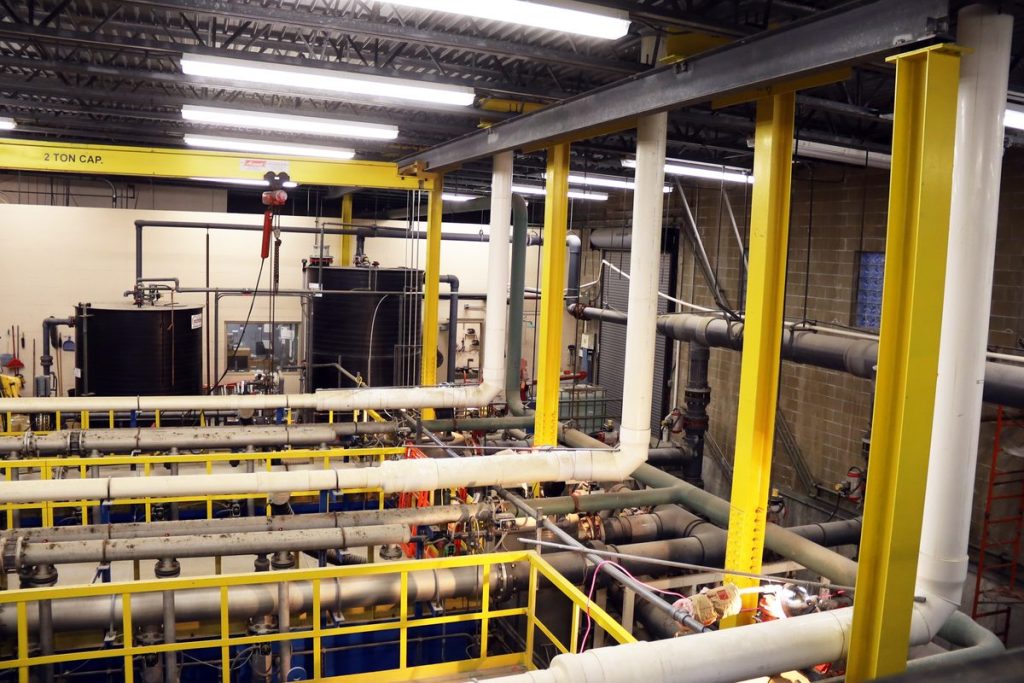
FORUM FILE
Maryville City Council members approved an agreement with Newgen Solutions and Strategies on Monday for a comprehensive water and sewer rate study. The study will help determine the possible cost of a new water treatment facility, which would replace the existing plant, seen here during a tour last year, that was originally constructed in 1956.
MARYVILLE, Mo. — The Maryville City Council on Monday approved a proposal to perform a comprehensive water and sewer rate study, the first step toward determining how much rates may need to increase if the council opts to go with a plan to build a new water treatment facility.
The council accepted a bid from NewGen Strategies and Solutions for up to $49,640 to perform the study, which will analyze the existing rate schedules and provide recommendations for the next five years for rate increases that would address possible infrastructure improvements like a new water treatment plant. More broadly, the study will also provide a guide for the next 20 years for the city to use when determining rate adjustments. It will be the first comprehensive rate study since 2005, when the city began the process of looking into building a new wastewater treatment plant that was completed in 2015.
Since that time, said city Finance Director Denise Town, the city has been working off the same 2005 base with incremental increases to keep up with cost requirements. But with the possibility of building a new facility that could cost anywhere between $18-38 million over the next decade, city staff said a new study would be needed to determine just how much rates would need to increase, and in what ways. Additionally, any applicable grants would require a rate study to qualify.
NewGen was the second-highest of seven bids received by the city, which ranged from a little under $23,000 to $55,000. But a three-person committee assembled to score the bids recommended NewGen because of its thoroughness and commitment to building a rate schedule that would make practical sense to consumers, not just make financial sense. City staff in particular praised the firm for its attitude toward transparency with the public.
“I think one of the key things that I liked about (NewGen’s) cover letter was the emphasis on public education to really help the end users — the ones who are really going to be paying for it through the user fees — as to what all’s involved in operating a water/sewer system, how the costs are allocated, what is coming down the road that needs to be paid for eventually, and how to best allocate that,” Town, who was on the committee, said Monday.
According to bid documents, NewGen aims to have a final report completed 14 weeks after the project kicks off. Once that is presented, the council will have projections in hand to see how much different water treatment plant options would cost ratepayers.
The council unanimously approved the agreement 3-0, with council members Tye Parsons and Dannen Merrill absent.
More water
In the meantime, the city continues to implement new strategies to mitigate recurring taste and odor issues.
During Monday’s meeting, the council also approved an agreement with Estate Management Services of Missouri for up to $53,350 to purchase and apply EarthTec, an algicide, to Mozingo Lake as necessary. The contract follows the first application of the product to the lake earlier this month, which City Manager Greg McDanel said was highly successful.
The city continues to receive testing results from the lake twice per week to determine the levels of algae blooms present that can cause taste and odor issues. Consultant HDR Engineering has recommended that the algicide be applied when levels start to rise significantly.
McDanel said that in late April, counts of cyanobacteria, also known as blue-green algae, were at 10,800 cells per milliliter. By May 6, the number had risen to nearly 100,000 cells per milliliter. On May 10-13, following a recommendation from HDR after consultation, Estate Management Services applied EarthTec across about 500 acres of the lake. The samples taken on the last day of application, May 13, showed cyanobacteria levels had dipped to 40 cells per milliliter.
The $53,350 cost is for one application of the treatment.
McDanel said the treatments will likely need to continue even after a new granular activated carbon adsorber is completed later this year because although the adsorber will help remove much of the taste and odor issues in drinking water, the buildup of algae in the lake could affect recreational activities.
“I think the source water protection efforts are probably something that’s here to stay, and probably should have been in place since day one,” McDanel said of the man-made lake built in 1994. “But we’re obviously learning as the lake (ages) what’s going to make the best impact.”
Telecom tax
The council also approved a non-disclosure agreement with Verizon as part of an audit process to determine if the company has been underpaying municipal telecommunications license fees.
State law allows for a five percent municipal fee to be charged to telecom companies that operate within a city’s limits. Last summer, Maryville began an audit process to determine whether Verizon, AT&T Mobility and AT&T had been underpaying the fee. Large and frequent acquisitions by the companies over the past two decades have complicated what companies are responsible for what fees, and technological changes have also complicated what constitutes telecommunications operations.
Earlier this year, telecom giant Charter was ordered to pay $39 million in underpaid taxes to several Missouri municipalities in a case that centered around voice-over-internet protocol services, and a case filed by the cities of Columbia and Joplin against Spectra Communications Group (CenturyLink) was filed in 2014 and continues.
The non-disclosure agreement approved by Maryville’s council is standard practice for Verizon’s cooperation in such audits. Under the terms of the agreement, Verizon will release revenue data requested by the city’s outside law firm, Cunningham, Vogel and Rost, which specializes in these cases. In return, the city agrees not to share any of the data that Verizon considers to be confidential unless ordered to do so by a judge or the attorney general’s office.
Other City Council notes
- The council approved the intention of Alex Rice to beautify Freedom Rock at Franklin Park as his Eagle Scout project contingent upon approval of his plan by the Maryville Parks and Recreation board.
- Jared Lane asked the council to assist in getting Evergy to evaluate the safety of a power line near his property on Thompson Street that he says is leaning and dangerously entangled with a tree. He said he has contacted the utility multiple times over the past year but hasn’t heard back. McDanel said after hearing about the issue this weekend, he reached out to Evergy but hasn’t received a response yet.
- Lane also asked the council to consider extending a drainage ditch on Thompson Street. McDanel said he and Public Works Director C.E. Goodall will set up a time to discuss options with him this week.
- Council members approved the appointment of Phillip Kenkel to the Housing Authority Board to serve a four-year term. Kenkel will fill the seat formerly held by Loretta Kissinger, who passed away. She had served on the board since 1989.
- The council amended the city code for possession of marijuana to allow for the legal possession of medicinal marijuana, aligning with state law.
- Assistant City Manager Ryan Heiland said city crews will begin grading for the expansion of Mozingo’s RV park on June 1, weather permitting. Bidding for the project will likely open sometime in July, he said.




