NCAD uses UV light to battle COVID-19
EA MEDICAL PHOTO
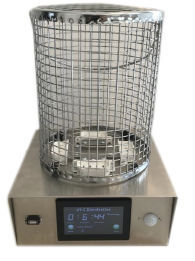
The Nodaway County Ambulance District purchased two EDU-435 UV-C Air and Surface Disinfection lights to help keep patients and crews safe during the COVID-19 pandemic. The district has received one of the lights and still awaits a second.
MARYVILLE, Mo. — Nodaway County Ambulance District personnel now have new ammunition in the fight against COVID-19: ultraviolet light.
In July, the district received a large light apparatus with four germicidal UV lightbulbs to help fend off infectious diseases including the new coronavirus.
Assistant Director of Operations Jared McQueen said ambulance district staff members use the portable light to disinfect each ambulance, both in the front and in the cab, every day and after every transport of a patient suspected of having COVID-19.
“We decided to do this after hearing that Buchanan County is using this to help control the (new) coronavirus that’s causing this pandemic” he said.
“There have also been (Nodaway County) sheriff vehicles that have used the system as well as rooms in the office building,” according to Bill Florea, director of operations, in the July Board of Director meeting minutes.
Sheriff Randy Strong told The Forum by email Tuesday afternoon that his office now has their own UV lights. Using CARES ACT funding, the office purchased a small one used in small office spaces and vehicle interiors as well as a larger one it just received.
“We have utilized the small one often and I’m sure we will have many uses for the large lights,” he wrote. “It is large enough to do the courtroom.”
Maryville Public Safety has also utlized the ambulance district’s UV light a couple of times to decontaminate vehicles after possible contamination with the COVID-19 virus, according to Acting Director Ron Christian.
“While our agency has been fortunate enough to not need to use it very many times, having access to the UV system is an invaluable resource as that system has been demonstrated to be highly effective at decontamination of viruses,” he wrote in an email to The Forum on Tuesday.
He explained that being able to use the light also helps the department put a vehicle back into service with confidence in a timely manner.
He said the department is evaluating its need for one and any available funding through the CARES Act before making any requests.
“I believe having one for our agency would help with keeping vehicle(s) decontaminated as well as allow us to ensure sanitary conditions in the public areas of our new facility,” he said.
Device research
The ambulance district researched the UV light before purchase and ordered it in March, however, it took some time to make it to Maryville. According to meeting minutes from June, the light hadn’t yet arrived, but Florea said he wanted to order another. The district used PPE funds from the county to do so.
The EDU-435 UV-C Air and Surface Disinfection light is a portable germicidal disinfection device to be used in unoccupied areas, according to the website of EMS equipment provider EA Medical, of Canton, Missouri. The one that arrived at the ambulance district in July was immediately put to use.
“We’ve done some research and found that it does kill it,” McQueen said. “We go ahead and use it on top of our disinfectant — our disinfectant sprays and our disinfectant wipes that we use — just for more safety for our providers and patients.”
Saying he doesn’t know exactly how it works, McQueen said that it just kills bacteria, germs and viruses, including COVID-19.
According to the EA Medical website, the lamp weighs about 14 pounds and is stainless steel and aluminum with a welded wire protective cage for rugged use. It has a 9,000-hour lamp life and an adjustable system delay timer to lower risk of exposure.
The site notes that the UV-C, “can cause temporary damage and discomfort to unprotected skin and eyes.”
According to a July 22 Kaiser Health News article, the technology that utilizes energetic waves of ultraviolet light is centuries old and research has shown it can effectively inactivate airborne microbes that transmit measles, tuberculosis and SARS-CoV-1, a close relative to COVID-19.
“Now, with concern mounting that the coronavirus that causes COVID-19 may be easily transmitted through microscopic floating particles known as aerosols, some researchers and physicians hope the technology can be recruited yet again to help disinfect high-risk indoor settings,” according to KHN.
McQueen said the UV light can kill the virus within 10 seconds, but only when it’s very close to the light.
“As the light gets farther away versus the larger area, you just do it a longer time,” he said.
A 2018 study by Do-Kyun Kim, Dong-Hyun Kang and published in the scientific journal Applied Environmental Microbiology, investigated the inactivation effect of aerosolized microorganisms, including viruses, bacteria and fungi with a UVC LED module.
“UVC LED array treatment effectively inactivated viral infectivity,” according to the study’s abstract available online at the National Library of Medicine.
Is UV a solution?
Just because it works doesn’t mean widespread adoption of UV systems is likely. And while some restaurants around the country have begun implementing the lights, it won’t work for everyone in every space.
The first barrier is cost.
Each device cost the ambulance district $4,045, according to NCAD Board of Directors treasurer Scott Walk who called Florea on Tuesday morning for verification.
Different devices will cost more or less based on size and type.
Availability is the second hurdle.
“Bill told us that he can get the machine, but getting replacement bulbs is a real challenge,” Walk said.
According to July meeting minutes, Florea ordered replacement bulbs, but they were still on backorder July 8.
Sheriff Strong said they had only just received their second device, but put the first one into use immediately.
It is likely the devices will be sought heavily for law enforcement and first responder use during the pandemic.
Safety is the third issue.
Low-dose germicidal UV can damage eyes and skin, according to a KHN story, however, with enough vertical space and air exchange, such as with ceiling fans, to move aerosols into the light’s path using “upper-room germicidal UV,” could position lights out of harms way.
Not every location will allow for the space and air exchange required to utilize the technology, however, it does provide local law enforcement officials, first responders and many others another weapon in the fight against COVID-19.