Community gathers to discuss suicide report
SKYE POURNAZARI/THE FORUM
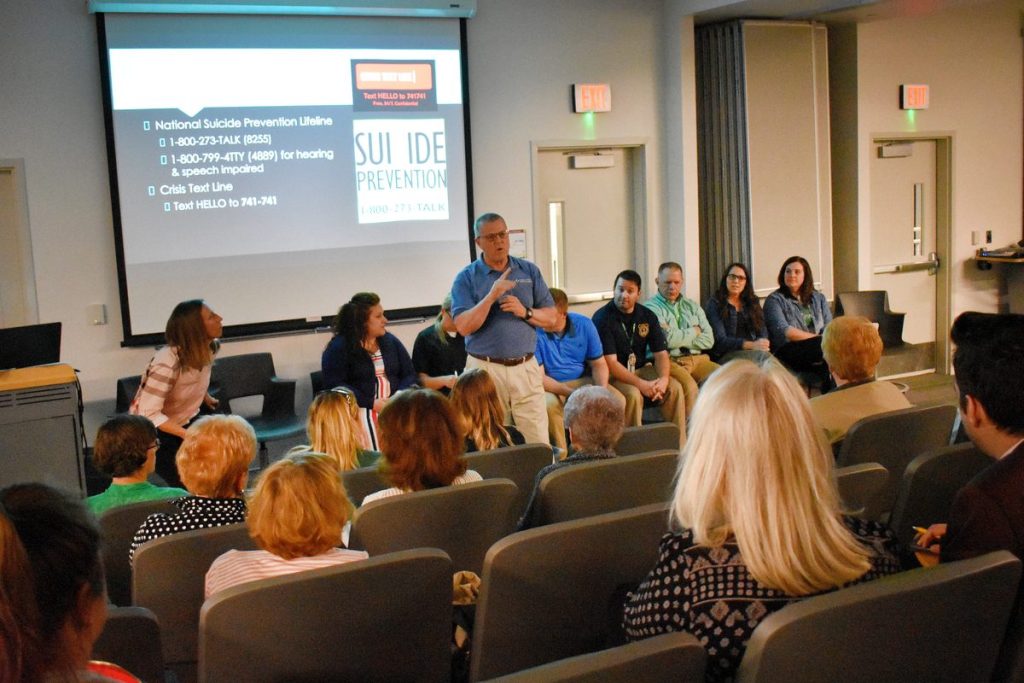
Dr. Gerald Wilmes takes part in a panel discussion held in April by P.E.O. Chapter KP at the Carl & Cheryl Hughes Fieldhouse on the Northwest Missouri State University campus. Community members gathered to discuss the new baseline numbers the Maryville R-II School District has seen reported this school year.
MARYVILLE, Mo. — During the 2018-2019 school year, the Maryville R-II school district began district-wide tracking of suicide screenings given to students by district personnel. From the beginning of school until April 11, the district counted 112 suicide screenings given to children and teens within the district.
Members of Maryville Chapter KP of P.E.O. Sisterhood heard the numbers and held a special community meeting at the Carl & Cheryl Hughes Fieldhouse on April 14 to raise awareness of the issue.
Karen Patterson said they hoped to make the information available to a broader audience and brought in a panel of experts both in the mental health field and from the R-II school district.
Maryville High School counselors Becky Houtchens and Ashlee James led the presentation.
“It is definitely a growing concern in our community,” said Houtchens.
She explained that 112 incidents occurred at buildings throughout the school district: 13 at the alternative school, 18 at Eugene Field Elementary School, 25 at Maryville High School and 56 at Maryville Middle School. Of those 112 screenings, 40 students were referred to outside mental health professionals or hospitalized.
Panel members included from MHS: James; Houtchens; Craig Borey, assistant principal; and Karie Ogle, nurse. Joining the panel from MMS were: counselors Heidi Webster and Mark Falke, and nurse Melissa Coffelt. Also on the panel were Sarah Pedersen, counselor at EFES; Ian Myers, school resource officer; and members of Northwest Missouri State University’s Wellness Services.
James compared deaths in children ages 10 to 14 per 100,000 population by suicide and from motor vehicle wrecks. Since 1999, with awareness and pushing for more children to wear seat belts and use appropriate car seats, the deaths of children in traffic crashes is slowly decreasing while death by suicide is increasing in this age group over the same period of time. James suggests it could be due to mental health being a somewhat “taboo subject.”
James, along with Houtchens, showed a suicide prevention and health coping skills presentation with tips on how to demystify the discussion topic and how to talk with children and teens about it.
One of those tips comes in the form of an acronym, ACT, which stands for Acknowledge, Care and Tell. When hearing someone talk about hurting themselves or others, these three steps will help that person and anyone else involved.
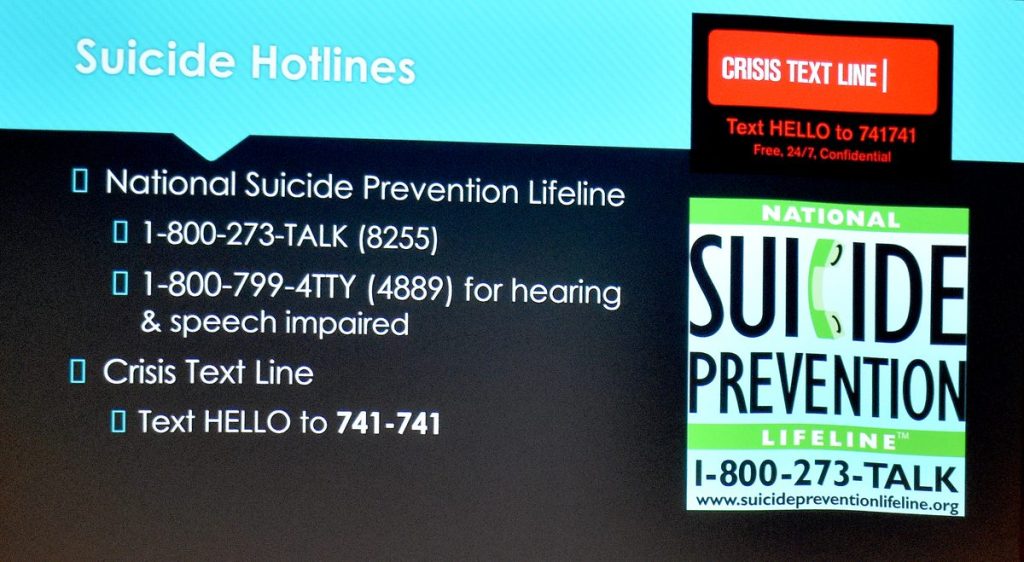
To end the presentation, the counselors offered phone numbers to call or text for anyone needing help. The national Suicide Prevention Lifeline can be reached at 1-800-273-TALK (8255) or 1-800-799-4TTY (4889) for the hearing and speech impaired. The crisis text line can be reached by texting HELLO to 741-741.
For two hours, about 30 community members took part in the informational meeting and discussed possible solutions and next steps.
Webster said of the 56 middle school students who have been given screenings, 20 are sixth-graders, 15 are seventh-graders and 11 of them are eighth-graders.
“It’s not the 15, 16, 17 (year olds) like I thought,” she said. “It’s your 11, 12-year-olds who are really struggling. … Those are the kids we need to get to immediately.”
Katie Neubauer, Director of Student Services for Maryville said in a later interview that it makes sense that the middle school population is seeing more of the screenings.
“That’s just an age group where they’re trying to reconcile their inner life with their outer life,” she said. “They might have a lot of feelings that they don’t know how to cope with. They’re changing so much and so fast at that age that their peer group might change from one day to another and that’s something they’re not used to.”
She said children have a lot to cope with integrating their social and emotional experiences.
“I think what has been a slippery slope is the access to social media piece,” she said. “But with social media in general it’s not well understood how significantly impactful that is to kids’ emotional health. Social relationships are so tricky anyway at this age, the middle school age and early high school age, I think it’s very easy to spiral. I do think that the influence of it (social media) goes much deeper and much broader than we as adults have understood.”
Toward the end of the meeting, community members discussed possible prevention efforts as being key such as the “Mind Up” program where students learn the biological reasons why they are experiencing emotional changes, or the “Bright Futures” program where community members enter the school district on a regular basis to have lunch with and focus attention on students.
Lynette Harbin with Big Brothers Big Sisters of Nodaway County was at the meeting and said her organization helps students in much the same way, serving to offer a mentor to children and teens in the county.
It also was noted that none of the students involved in the 112 screenings is a part of the BBBS program.
While prevention is an important part of the puzzle, the group agreed the community is in need of more resources.
“I could not agree more with the need to have resources, no doubt about that,” said Nate Blackford, president of Mosaic Medical Center – Maryville. “We could sit here and talk for hours about some of the barriers to access and such. It’s unfortunately not as easy of a fix as you might think. … From a health care perspective, these resources are difficult to acquire. But if you can acquire them in a prescribed way, in other words really hone in on what it is we need, we can go far with those resources.
“My guess is that this group now joins another group of about 100 other people in this town who understands just how big of an issue this is in the big picture,” he said. “I think when this community is aware of an issue it supports that issue.”
While the meeting is just the first of several likely to occur in the future, should anyone in the community be interested in attending, they may contact Patterson at [email protected] for more information.
SKYE POURNAZARI/THE FORUM
Suicide Hotline information is shown during a community panel discussion held in April by P.E.O. Chapter KP at the Carl & Cheryl Hughes Fieldhouse on the Northwest Missouri State University campus.