Lunch and Learn offers tips on skin cancer prevention
SKYE POURNAZARI/THE FORUM
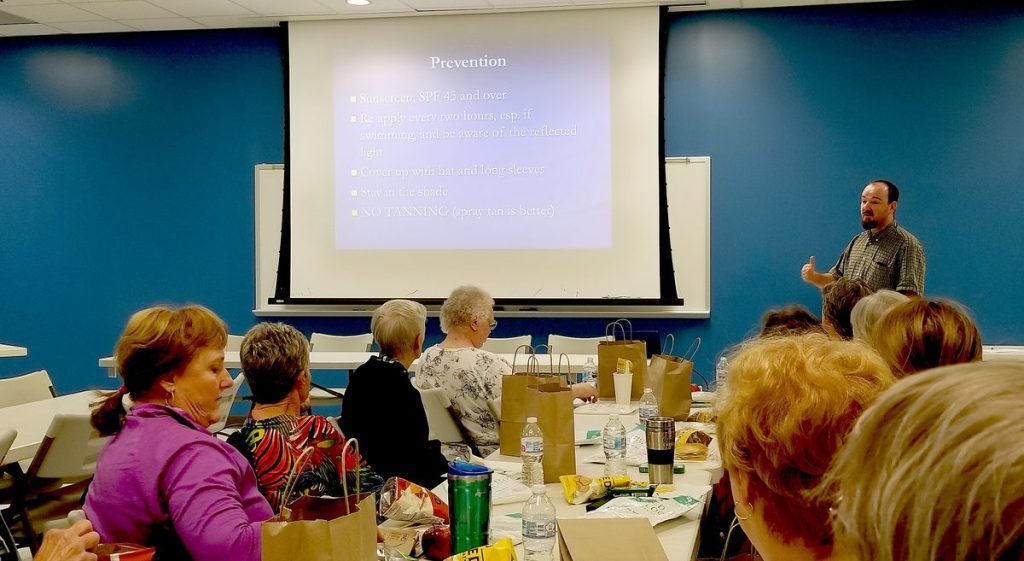
Charles Glass, PA-C, sub-investigator at Advanced Dermatology, discusses skin cancer prevention with community members at the monthly Lunch and Learn sponsored by Mosaic Medical Center – Maryville.
MARYVILLE, Mo. — While no tan is the best tan for preserving skin, summer fun in the sun can take a toll on the skin and even cause cancer.
“With summer upon us, it’s super important,” said Jackie Ross, community health liaison with Mosaic Medical Center – Maryville.
At last week’s Lunch and Learn event sponsored by Mosaic, Charles Glass, a physician’s assistant at Advanced Dermatology and Skin Cancer Center, talked to community members about skin cancer and some of the signs to watch out for.
He said the center has been open in Maryville for about two years now and the company is looking to open a facility in Clarinda, Iowa.
“Easily in the last month, we’ve found several dozens of skin cancers of all types, and we’ve also found hundreds of pre-cancers,” said Glass. He continued that if they’re found before becoming cancer, they’re a lot easier to treat.
The sun is a major player when it comes to causing skin cancer. While it is not the only thing that can cause it — continuous chemical contact and genetics also can cause it — the majority of skin cancer is caused by the sun, Glass said.
“The sun has ultraviolet radiation and ultraviolet radiation can actually cause a mutation to the DNA at a cellular level,” he said. “If you get enough of those mutations you can get a cancerous cell.”
Skin cancer signs
Glass said there are several signs a person can watch for on their own skin. Pre-cancers such as actinic keratoses or a “crusty spot” that won’t go away, is very common — the spots appear in 1 in 4 people over the age of 50. It can be treated easily by freezing, blue light or types of creams.
About 1 of every 5 cases can turn into squamous cell carcinoma if not treated.
Glass said people often live with them not knowing they’re cancerous, because they’re almost always painless. Usually on the face or hand, because both are in the sun, they typically just won’t heal. Only about 2 to 5 percent of the squamous cell carcinomas metastasize into cancer.
These are treated either surgically or with radiation and removed through burning.
“These can be mistaken for abscesses because it will grow kind of quickly, the difference is an abscess is almost always painful … these are almost always painless,” said Glass. “Oftentimes what brings them in is either that it’s gotten big enough they don’t like it, or it’s bleeding and they can’t stop the bleeding.”
He explained that as cancer grows, so do a lot of blood vessels, and once those start bleeding it can be difficult to get them to stop.
With basal cell carcinoma, the most common type of cancer in humans, there is a 1 in 5,000 chance of metastasis.
“It’s almost always due to sun exposure,” he said.
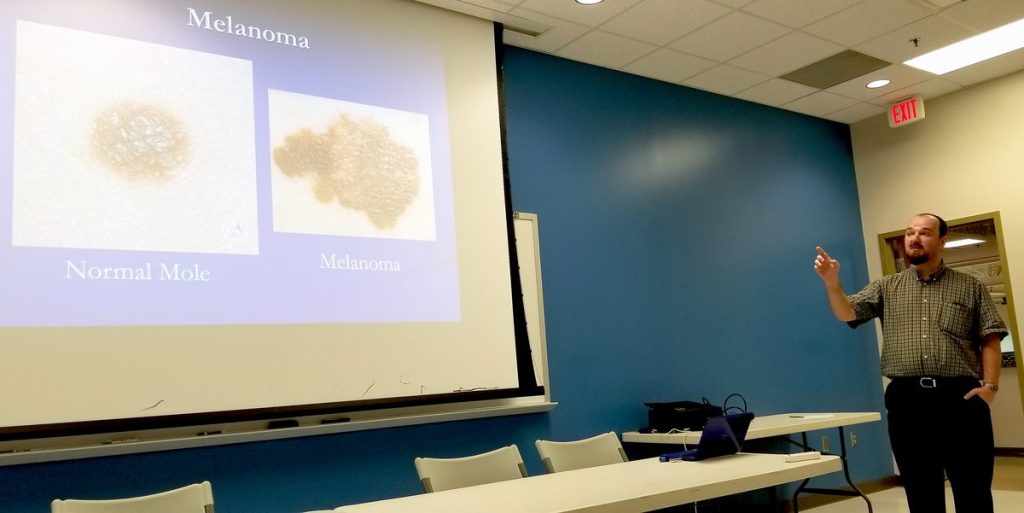
Melanoma can be diagnosed through usage of the A, B, C, D, E criteria. Asymmetry: If the spot is oddly shaped and not symmetrical, that can be a sign of melanoma. If the Border, is not smooth and rounded, that is another sign. If the Color is not even or changes over time, that is a sign. Another way to determine if it’s cancer or not, is if the Diameter of the spot is not equal all the way around. Finally, Evolution, or the way a spot evolves, is a way to determine if it is melanoma.
Glass said it is the deadliest of skin cancers and part of that is because it can look like nearly anything.
In general, if any new spot is not going away after a month, or it doesn’t heal in that time, he suggests getting it checked out by a physician.
Advanced Dermatology will hold a free spot check at 9 a.m. on Saturday, Aug. 3 at the Maryville location, 2617 Burris Road. If interested in an earlier check, the company also will off a free spot check at 8 a.m. on Saturday, June 8 at 1419 Village Drive in St. Joseph.
Prevention
In order to prevent cancer, Glass suggests wearing sunscreen, SPF 45 or more, anytime out in the sun. It is important to reapply every two hours, especially if swimming.
“The way that sunscreens work, is that the energy from the sun is actually absorbed by the sunscreen and those molecules break apart instead of your skin ripping apart,” he said. “You do have to reapply every couple of hours, otherwise that sunscreen is not able to absorb the light.”
Another basic suggestion for cancer prevention is to cover up with a hat and long sleeves or stay in the shade and be aware of reflected light, which also can cause sunburn.
Glass said that while there’s no such thing as a safe tan, a spray tan technically is better than sun tanning.
SKYE POURNAZARI/THE FORUM
The difference between a normal mole and a melanoma can be very obvious said Charles Glass, PA-C, sub-investigator at Advanced Dermatology. Located at 2617 Burris Road in Maryville, the facility will offer a free spot check at 9 a.m. on Saturday, Aug. 3. The company also will offer a free spot check at 8 a.m. on Saturday, June 8 at 1419 Village Drive in St. Joseph.