Lettuce Dream plants a seed with state’s Lt. Gov.
TONY BROWN/DAILY FORUM
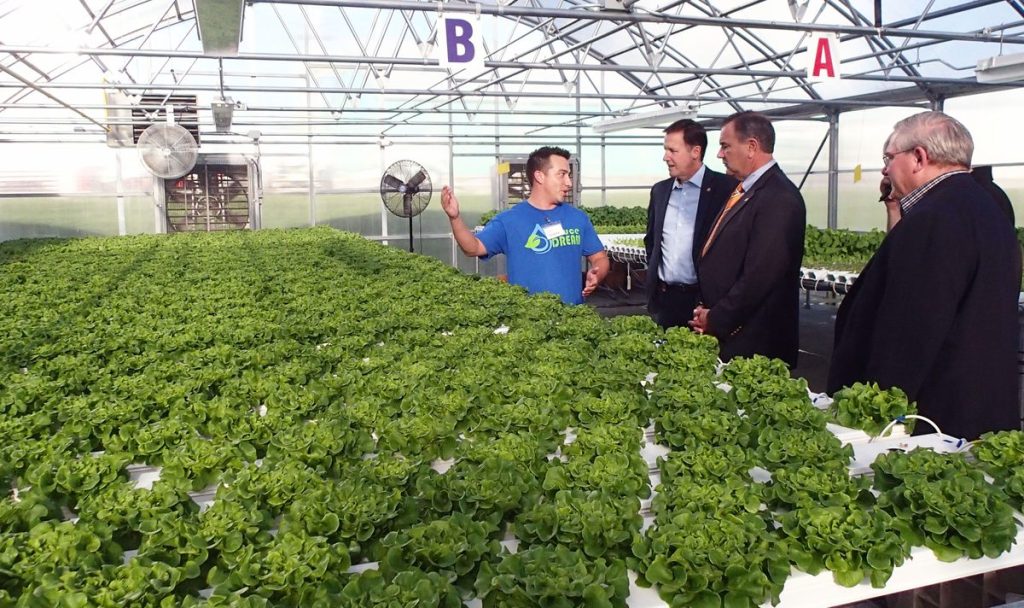
Lettuce Dream Executive Director Charlie Clodfelter, left, describes components of the nonprofit lettuce-growing and vocational training operation to, from left, state Rep. Allen Andrews, Missouri Lt. Gov. Mike Kehoe and state Sen. Dan Hegeman during Kehoe’s visit to Maryville on Thursday morning. Kehoe professed enthusiasm for Lettuce Dream, which provides post-secondary opportunities for people with cognitive and developmental disabilities, and said the greenhouse’s mission and business model should be replicated across the state.
MARYVILLE, Mo. — Lt. Gov. Mike Kehoe was in Maryville on Thursday, ostensibly to talk about Proposition D, a general election ballot measure that would increase Missouri’s pay-at-the-pump motor fuels tax for the first time in 22 years.
But the agenda changed during a morning visit to Lettuce Dream, a nonprofit hydroponic greenhouse operation whose mission is to provide post-high school job training to young adults with cognitive and developmental disabilities.
During a tour of the greenhouse led by Lettuce Dream Executive Director Charlie Clodfelter, and including state Rep. Allen Andrews and state Sen. Dan Hegeman, an increasingly enthusiastic Kehoe declared the operation “one of the best I’ve seen.”
He added that he planned to return to Jefferson City and spread the word about Lettuce Dream to top-level state officials with an eye toward replicating the Lettuce Dream model statewide.
Kehoe also voiced support for changing state bidding regulations in ways that would make it easier for such operations to successfully bid for state food service contracts with prisons, universities and other tax-supported institutions.
Clodfelter told the Lt. governor that Lettuce Dream is currently unable to compete for such contracts because of the costs associated with fulfilling its twin mission — growing produce and providing free post-secondary vocational training to clients, which Lettuce Dream calls interns.
Kehoe responded that bidding guidelines are sometimes unfair to non-profits like Lettuce Dream, which provide social services that, in the long run, save tax dollars.
“The state would probably end up supporting (Lettuce Dream interns) in some other way if they didn’t have this opportunity,” Kehoe said. “… This (program) absolutely has to be duplicated in our state. There is lots of opportunity.”
Lettuce Dream currently serves eight interns who participate in all facets of produce production, from planting and harvesting to sales and marketing. Over the past two years, it has trained five “graduates,” each of whom, Clodfelter said, have gone on to competitive, private-sector employment.
Kehoe said he said believed the opportunity for partnerships between Lettuce Dream-style programs and state universities was especially promising, and he appeared impressed when told students from Northwest Missouri State were volunteering at the greenhouse in order to pick up experience in fields of study ranging from agriculture and horticulture to business and special education.
“Doesn’t the University of Missouri have a pretty good agriculture school?” he quipped, implying that a Lettuce Dream-like operation and MU would be a good fit.
Kehoe also seemed enthusiastic about the way Lettuce Dream’s founders put together a nearly $1 million investment that included as U.S Department of Agriculture grant, state Neighborhood Assistance Program tax credits and thousands of dollars in private donations from foundations, businesses and individuals.
The Lt. governor said he saw possibilities for Lettuce Dream, and similar organizations, in providing produce to Department of Corrections facilities like the Maryville Treatment Center.
He pledged to organize a visit to the Maryville greenhouse by “a group of Jefferson City folks,” including DOC Director Anne L. Precythe.
“I’m going to get her here,” Kehoe said.
At the conclusion of the tour, while talking to his fellow politicians and a couple of reporters, the Lt. governor added, “I’m blown away. This is a fantastic model that needs to be replicated throughout the state. The community of Maryville can be proud of what’s going on.”
Following his Lettuce Dream visit, Kehoe took a few minutes to express support for Proposition D, a 10-cent fuels tax increase proposal that would be implemented over four years two and a half cents at a time.
Kehoe said the measure would have a significant impact on lettered blacktops, also known as farm-to-market roads, which he described as the least traveled in the state but the most important in terms of supporting agriculture, Missouri’s largest industry.
During the first five years after full implementation, Kehoe said, the tax increase would fund the repaving of 8,200 miles of lettered routes and, after 10 years, a total of 46,000 miles of hard-surface highways of all kinds.
Other improvements are to include 1,700 bridge decks in a state classed 47th out of 50 for the overall condition of its spans over rivers and creeks.
In arguing that a fuels tax increase is warranted, Kehoe cited a report rating the Missouri Department of Transportation as the ninth most efficient state transportation agency in the country.
On other fronts, Kehoe said that, in addition to Proposition D, the administration of Gov. Mike Parson was committed to improving state services and facilities for veterans, upgrading public infrastructure and boosting sales of Missouri products through the “Buy Missouri” campaign.
After leaving Lettuce Dream, Kehoe was to visit the Laclede Chain factory before traveling to Bethany for a meeting with northwest Missouri county commissioners and Sedalia for an economic development gathering.