County experiences Level 4 drought
NATIONAL INTEGRATED DROUGHT INFORMATION SYSTEM
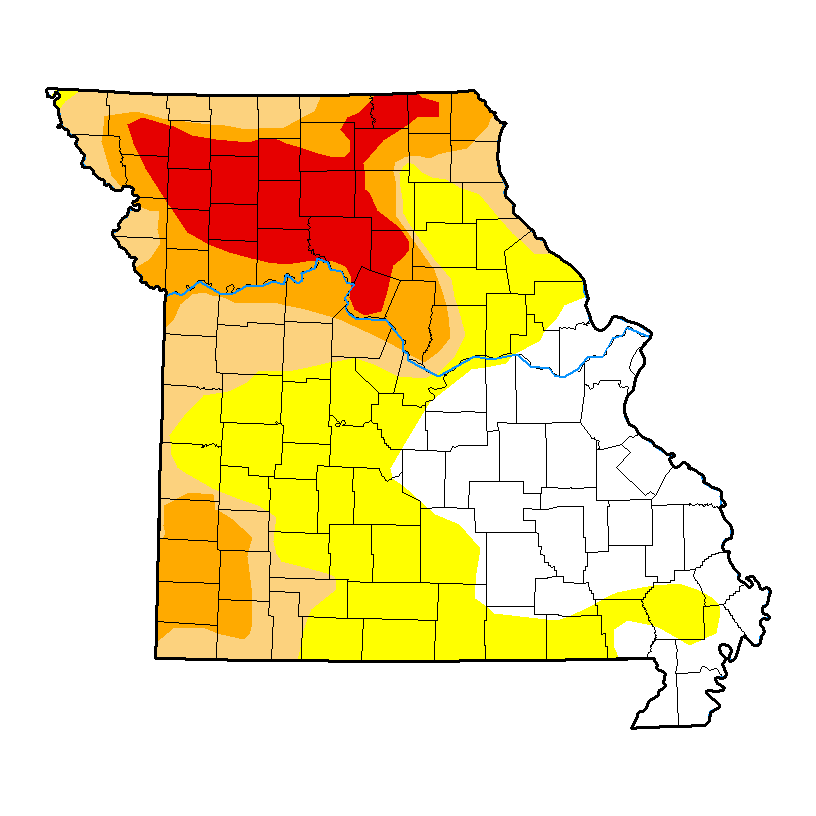
A map of Missouri counties shows the areas affected by this summer’s drought. Much of Nodaway County fell into a Level 4 drought, affecting crops and animals throughout farms in the county.
NODAWAY COUNTY, Mo. — This summer, the northwest region of Missouri has experienced high temperatures and low rainfall, something every farmer fears as they plant their crops in spring.
Harold Spire, manager of Consumer Oil in Maryville, says he has seen this weather affecting the farmers who come into his business in many ways.
“A lot of the pastures are needing supplements; people are weaning calves early,” Spire said. “There’s a lot of feeding going on, a lot of supplementing cows. We’re kind of short on hay, so people are kind of planning on this winter, ‘If we sell the cows now, will we have the hay later?’”
According to the National Integrated Drought Information System, Nodaway County is currently in a Level 3-4 drought throughout most of the area, with other areas in the northern section of the county falling into Level 1-2 and Level 2-4.
“The southern end of the county is worse than the north end of the county,” Spire said. “These guys out here are hurting worse than the north end.”
While there has been some rain lately, Spire says it’s not enough to get rid of the drought.
“Any time we get rain, it’s a good thing, it’s just we haven’t gotten enough to break the drought,” Spire said.
Within the past week, Maryville has only seen .71 inches of rain, while the average temperature remains above 85 degrees. Because of the heat, Spire expects harvest to begin a few weeks ahead of schedule for Nodaway County.
“It’s speeding up the maturity of these crops,” Spire said. “I think we will have an early harvest.”
While the crops and livestock are struggling, the businesses frequented by farmers also are hurt by the drought.
“If they don’t raise a normal crop, they don’t have that to sell,” Spire said. “In that term, that affects everybody in town. They don’t buy pickups, and they don’t buy this and they don’t buy that, tractors and combines.”
While this year may be rough for many farmers, Spire says he believes they will bounce back through the help of crop insurance and revenue insurance.
“They may not make money, but they’ll break even.”