Police: Life vests critical for Mozingo boaters
TONY BROWN/THE FORUM
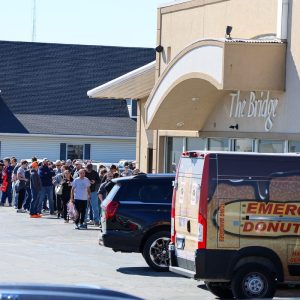
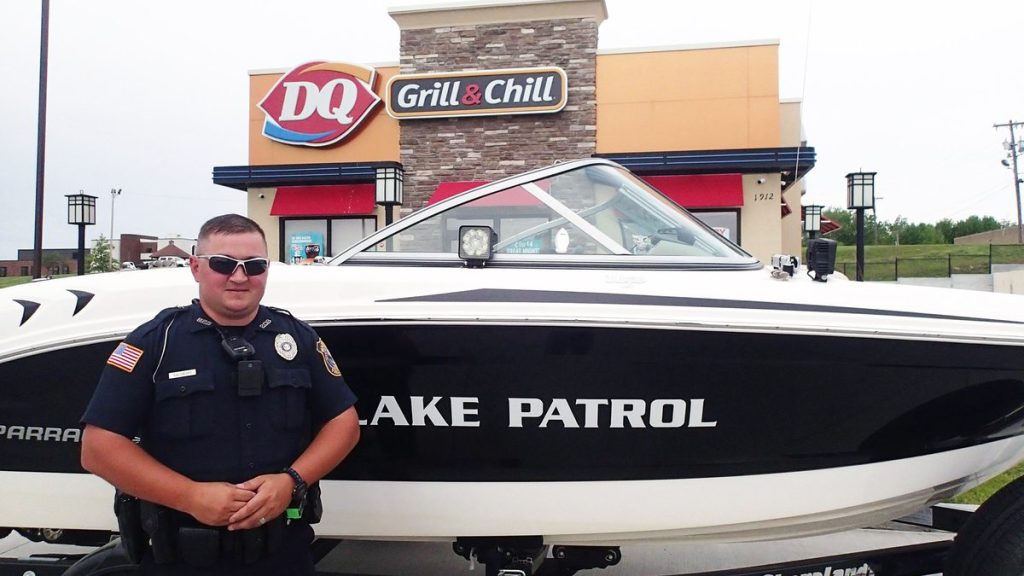
Maryville Public Safety Officer Tyler Salsbury stands beside the Maryville Public Safety patrol boat during an ice cream giveaway Saturday at the local Dairy Queen restaurant. The event was designed to create awareness about the importance of boating safety at Mozingo Lake just prior to the start of the post-Memorial Day vacation season.
MARYVILLE, Mo. — Memorial Day weekend — the widely recognized start of the summer vacation season — arrives at the end of this month, which means hundreds of boaters, fisherfolk and jet skiers intent on hitting the water will soon crowd much of Mozingo Lake’s 1,000 acres of surface area.
The annual search for fun and sun at the city-owned reservoir means “game on” for the three police officers who make up Maryville Public Safety’s Lake Patrol.
Officers Tyler Salsbury, Aaron Jones and Josh McMillen have already been on duty at the lake for the past couple of weeks, taking to the waves this year aboard a customized outboard patrol boat plus two new Jet Skis recently donated by the local Kawasaki Motors plant.
By way of kicking off the season, Salsbury spent much of Saturday in the Maryville Dairy Queen parking lot greeting parents and children during a promotion in which the fast-food eatery gave away free ice cream cones to any youngster who showed up with a life jacket.
The giveaway was in addition to a similar effort hosted by the local Sonic drive-in that provides officers with a large stack of free ice-cream coupons to hand to children at the lake who wear life jackets while boating with family members.
Both programs, Salsbury said, are intended to emphasize the importance of learning to boat safely, especially when it comes to wearing life jackets — more formally known as personal flotation devices or “PFDs.”
“They save lives,” said Salsbury, who noted that the handful of water-related fatalities at the lake over the past dozen years have occurred because people were not wearing buoyant vests.
Under Missouri law, all children under 7 years old must wear a U.S. Coast Guard-approved PFD at all times while on board any vessel, unless the child is confined in a totally enclosed area, such as the cabin of a houseboat or day cruiser. Such PFDs must be sized appropriately based on the child’s weight and chest size.
Municipal regulations applicable at Mozingo are even stricter and require PFDs for children age 12 and under who are swimming off a boat.
The Lake Patrol also enforces state PFD and other boating safety laws for adults, which require that vessels more than 16 feet long carry at least one wearable U.S. Coast Guard-approved life jacket for each person on board or being towed.
Boats under 16 feet in length must carry at least one wearable or one throwable PFD per person. Federal law, however, dictates wearable PFDs for each person on board regardless of vessel length.
Salsbury said, in his view, every boater and skier on the lake should wear at least a Type III PFD, a category that describes vests and full-sleeved jackets recommended for calm waters when a quick rescue is likely.
Such vests are not recommended for rough waters because they won’t turn most unconscious persons face up.
Other types of Coast Guard-approved vests include: Type I, PFDs geared for rough or remote waters where rescue is not immediately forthcoming; Type II “near-shore” vests; Type IV throwable devices; and Type V vests designed for specific activities, such as windsurfing, kayaking and water-skiing.
In addition to meeting life-vest requirements, Salsbury noted that all Missouri boaters born after Jan. 1, 1984 must successfully apply for a Missouri Boating Safety Certification Card, which requires satisfactory completion of an online boating-safety test administered by the National Association of State Boating Law Administrators at a cost of $24.50 plus a $17 state fee.
Salsbury added that the most common boating infractions at Mozingo include failure to display an orange “ski flag” when a skier is down in the water, careless driving and “bow-riding” or other behavior in which passengers place themselves at risk while aboard a moving vessel.
Other problems for the Lake Patrol are created by boaters who drive too fast or inattentively, causing wakes and near misses that endanger nearby craft.
More than a half-dozen miles long and, at its widest point, a half-mile wide, Salsbury said Mozingo Lake can nevertheless become dangerously crowded on summer weekends when 100 or more boats are often on the water at the same time.