Top Democrat says agenda will aid family farms
TONY BROWN/THE FORUM
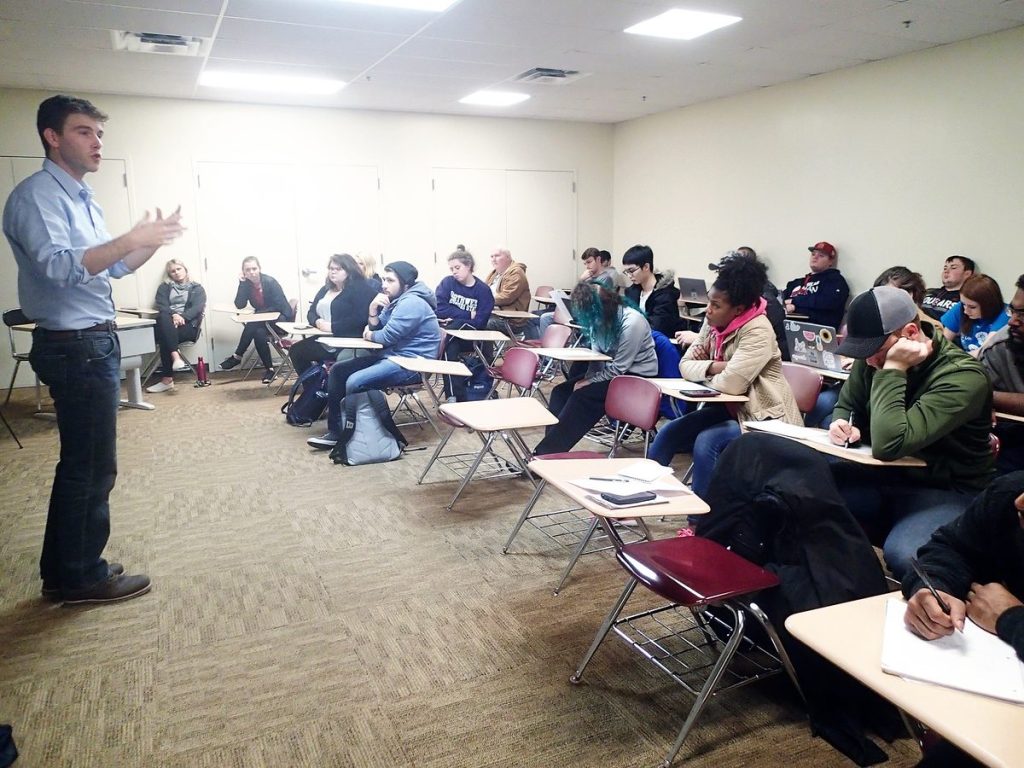
State Democratic Party Chairman Stephen Webber is shown last week speaking before a group of students at Northwest Missouri State University. Webber was in Maryville as part of a statewide tour designed to garner public support for a Farmer’s Bill of Rights. The legislative agenda, backed by Missouri’s Democratic leadership, seeks to boost family farms while curbing vertical integration, mergers, foreign land acquisitions and “monopolistic” practices by such agriculture giants Smithfield Foods Inc., a Chinese-controlled meat-processing company.
When Missouri Democratic Party Chairman Stephen Webber visited Maryville Dec. 5 as part of a statewide tour to introduce a Farmer’s Bill of Rights, he painted a troubling picture of obstacles faced by family farmers — unfair barriers, he said, created by GOP-driven policies favoring corporate profits over a “level playing field” for small producers.
“The status quo in rural Missouri is unacceptable,” Webber told an audience of about 30 Northwest Missouri State University agriculture and political science majors, most on hand to pick up extra credit as the fall semester drew to a close.
As reported earlier, the Democratic initiative, which is to take the form of bills to be introduced during the upcoming 2018 legislative session, has three overall goals cast as family-farmer “rights.”
These include the “right to fair and open markets,” the “right to local control of land” and the “right to rural opportunity,” defined as improved local health care resources and public schools along with enhanced opportunities for economic growth and a reduction in the rate of rural poverty.
Democratic legislation designed to further those aims, Webber said, will embrace such measures as the barring of foreign ownership of Missouri farmland and regulations requiring country-of-origin labeling for meat and other food products.
Additional proposals, he said, call for transparent agreements for pig and chicken producers raising animals under contract to such corporations as pork giant Smithfield Foods Inc., a meat-processing company wholly owned by the China’s WH Group.
Unfair contracts required by Smithfield and a handful of other “monopolies,” according to Webber, force many Missouri farmers into debt in order to keep pace with corporately dictated production standards.
Over the years, he said, allegedly exploitive contracts, often containing nondisclosure clauses, have helped reduce the number of independent hog producers statewide from around 10,000 to less than 600.
Citing Smithfield’s control by a Chinese conglomerate, Webber also called for restoration of a 1978 law, weakened by the legislature in 2013, that banned foreign acquisition of farmland. In the same vein, he urged a requirement that would force companies to report if they are more than 20 percent owned by non-U.S. investors or entities.
Webber said such moves would not lead to increased government control but simply restore fairness and competition to a system that rewards corporate shareholders while diverting profits from independent producers.
“We’re not saying that it shouldn’t be competitive,” he said. “We’re saying it can be fair.”
Webber continued he is convinced a current environment making it tough on family farms is the direct result of “conscious policy choices by government” driven by veto-proof Republican majorities in both the Missouri House and Senate.
Given the reality of GOP control, he admitted the chances of any portion of the Farmer’s Bill of Rights getting to Gov. Eric Greitens’ desk and being signed into law in 2018 are “zero.”
“But that’s just next year,” Webber said. “I believe this is a long-term fight.”
Beyond negatively affecting family farms, Webber said, existing laws and regulations — or the lack of thereof — are making a material contribution to endemic rural poverty.
“The poorest counties in the state are rural counties,” he said. “Rural areas are also where poverty is growing the fastest because wages are not keeping up with costs. We have school districts in rural areas that are going to four days a week because they lack revenue. When you lose family farms, when you lose agriculture, it’s hard to maintain that tax base.”
Webber said he sees a direct link between the vertical integration and consolidation practiced by large ag companies and the high jobless rates and relatively low standard of living afflicting many parts of outstate Missouri.
Before accepting the leadership post of the state Democratic organization, Webber served eight years in the House (2009-2016) representing central Missouri’s 46th District. Before entering politics, the 2001 Hickman (Columbia) High School graduate served two tours of duty in Iraq as a U.S. Marine.
He later earned a bachelor’s degree in economics from Saint Louis University before completing law school at the University of Missouri-Columbia in 2013.