Experts offer look into the history of local radio
SKYE POURNAZARI/DAILY FORUM
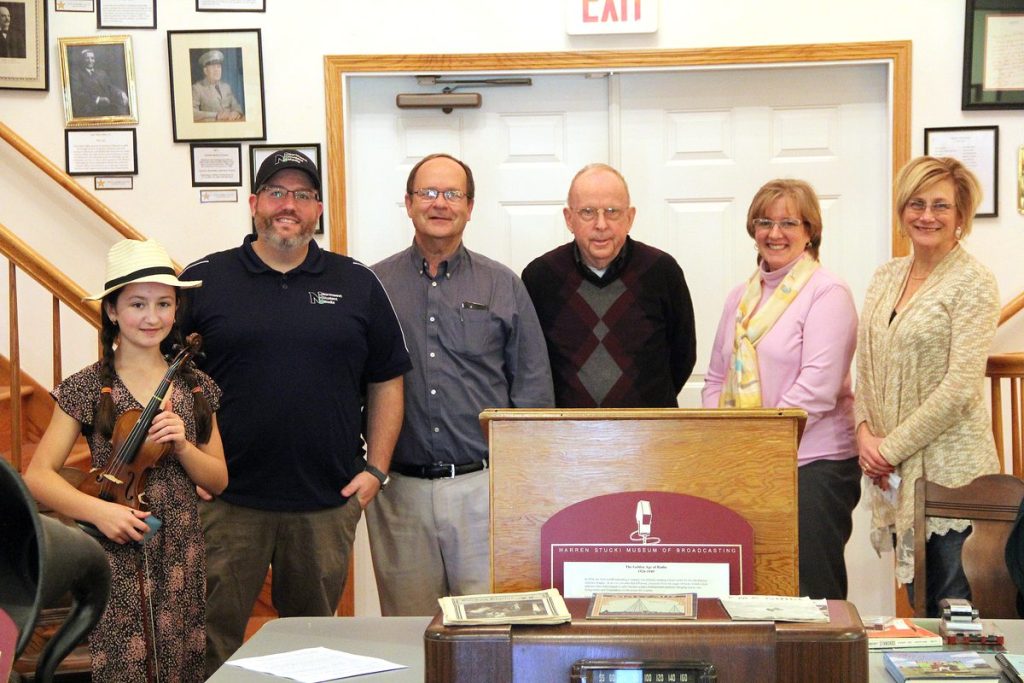
Shown Sunday, from left, are presenters of the Radio panel held at the Nodaway County Historical Society Museum: Hadley Cline, violinist and interlude performer; William Murphy, Northwest Missouri State University mass media engineer; Chuck Morris, former KMA radio personality, Bob Bohlken, Northwest professor emeritus; Patricia Holley, KXCV/KRNW, public radio personality; and Joyce Cronin, manager of KNIM-FM-AM Radio.
Several local radio experts brought the history of broadcast radio to life Sunday at the Nodaway County Historical Society’s program held at the museum.
Northwest Professor Emeritus Bob Bohlken chaired a panel of local experts, who also were his former mass communication students, to discuss radio from its beginning up to what is on the airwaves today.
Bohlken kicked off the event speaking about the history of radio in this area starting in 1912, when the U.S. Congress, through the Radio Act, was given the responsibility of licensing radio waves on the basis of frequency intensity and the call numbers.
The term “broadcasting,” came from the farmer reaching into a bag of seeds and strewing the seeds around him, he said.
“In 1922 there were 570 active commercial licensed stations,” Bohlken said. “Most of the stations intent was to promote the sale of radio receivers by RCA and General Electric.”
The government imposed a rule that no more than 12 minutes per hour could be used for advertising so, local entertainment was used in between the advertisements.
Bohlken introduced, Hadley Cline, local violinist, who played a Bluegrass song “Boil That Cabbage Down,” as a taste for the audience of the type of music played over the airwaves at the time.
In 1928, Bohlken continued, radio networks developed NBC, CBS, ABC and Mutual. In 1934, the FCC was given jurisdiction and judicial powers to regulate, “trustbusting violation, advertising restriction,” he said.
William Murphy, Northwest Missouri State University mass media engineer told the crowd about the technical side of radio beginnings using many items from the Warren Stucki Museum of Broadcasting located in Wells Hall.
He started with Samuel L. Morris and the telegraph in 1844 and how only 20 years later it was figured out how to do it without a wire.
“The first seed of this being possible comes about 1860,” Murphy said. “A gentleman named James Maxwell theorizes that there are electromagnetic waves looking at things like lightning strikes making your hair stand on end.”
Murphy said after another 20 years Heinrich Hertz proves electromagnetic waves exist and in 1896 Guillermo Marconi lends his expertise.
“He starts building these huge stations,” Murphy said. “There’s really no better way to talk about this, than just saying that these guys are crazy and crazy on a spectrum of crazy that now, they would put them in jail.”
The stations included ship masts with huge rings, and giant antennas the size of football fields. They replaced them when they were destroyed by weather, with 210-foot-tall wooden towers on either side of the Atlantic. One was in Nova Scotia, one in England and one was in Massachusetts.
“They start firing up these huge kerosene-powered 2,200 volt generators stepped up with a transformer to 25,000 volts,” Murphy said. “Deadly amounts of power at a time when they didn’t know how to handle normal amounts of power.”
He said they ended up flooding the ionosphere with a jolt of electricity that would bounce off the atmosphere and end up reflecting back down just to get that barely audibly perceptible sound, while also burning so much oxygen it would make it difficult to breathe where the switches were being flipped.
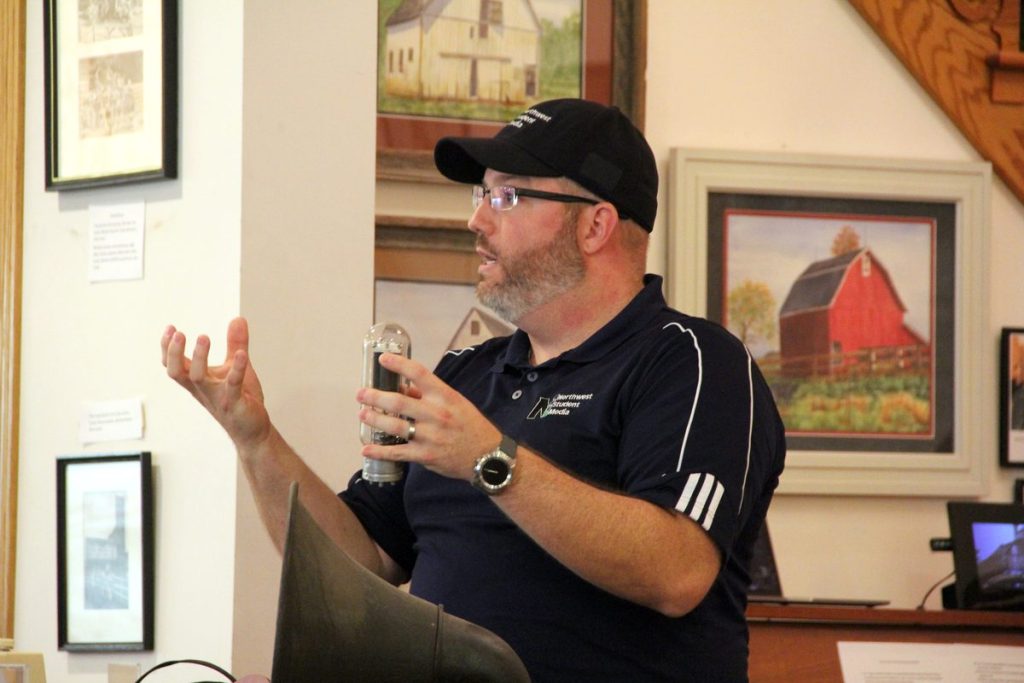
“But it worked,” Murphy said. “Just a few short years later, from the ability to transmit that dit or dot to the ability to transmit voice about 1906. … But even that didn’t really get us the radio we know today, until a guy named Lee DeForest, who happened to be born just up the road from here in Council Bluffs, Iowa. Lee DeForest developed something called … the audion tube.”
The quality of broadcast at the time was very poor, but he developed the tube in 1906.
“It’s known as the greatest invention of the first half of the 20th Century,” Murphy said. “It’s the basis for not only radio, but television broadcast, for radar, for the computer age. Until about 1947 when the transistor comes out, this was the coolest piece of technology that was out there.”
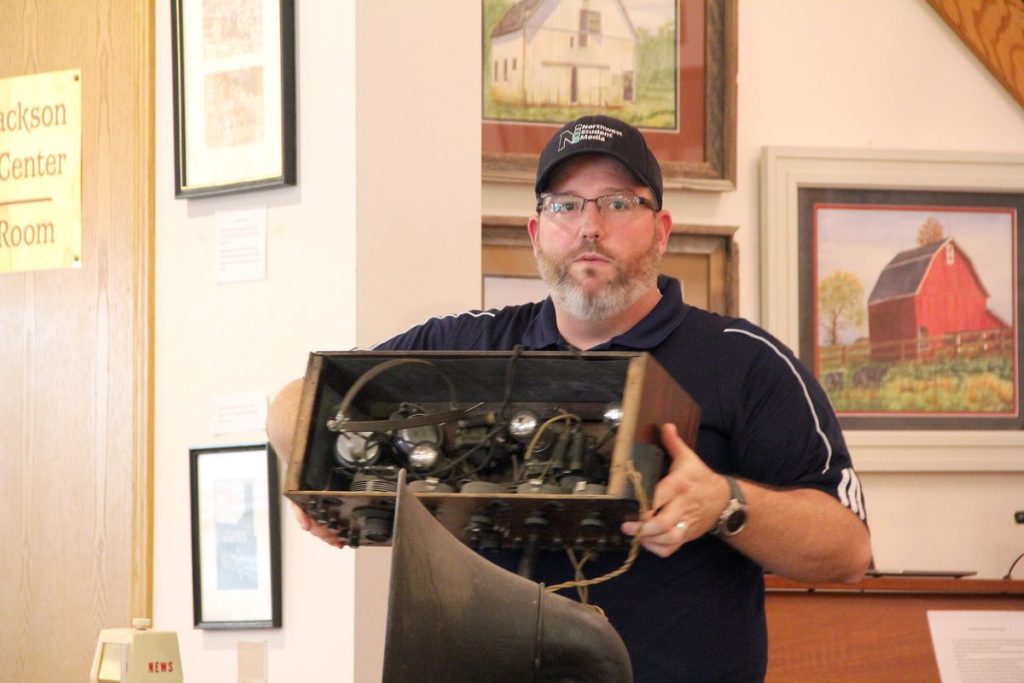
He showed the audience an original crystal radio set that was used to pick up radio stations, by connecting to a wire connected to say, a kitchen faucet, that runs down into the ground and an antenna.
By 1910, companies started putting together full radios. Those companies realized they had audiences, and began selling the sets and advertising for the sets, while producing content to get more listeners.
Williams explained AM/FM, short-band radios allowing more long-distance listening.
“It wasn’t just about being local anymore,” Murphy said. “We start to use radio for guidance.” He showed the audience a radio compass from an aircraft. “So, you could dial into something that you knew the frequency. It didn’t necessarily have to be songs or music. It could just be a beep repeater.”
Murphy went through more items on from the Warren Stucki Museum at Northwest and explained that much of how radio grew, was through the “chicken and the egg,” philosophy. Radio makers would advertise to sell radios, but then offered content that became so popular artists even traveled around to record for stations so people would listen, which required more upgrades and always bettering technology, including microphones etc.
Bohlken turned the topic local, told the crowd that the first radio stations in this area were KFNF and KMA and introduced Chuck Morris, former KMA personality.
Morris started at KMA in 1980 and gave a short history of the station and its owners.
KFNF was started in 1924 by Henry Fields, he had a seed nursery company and saw it as a way to promote his business. Earl May, who also had a seed nursery company, thought it was a good idea and put KMA on the air in August of 1925.
The two families became intertwined in various ways over the years. Frank Fields became a large personality on KMA for more than 30 years. Morris said, there were some intermarriages and some finance deals.
“I came to KMA in 1980,” Morris said. “A lot of what I learned there was maybe factual part of it was folklore. I came at the time when the Radio Homemakers was coming to an end. Radio Homemakers are really a rich part of the heritage of KMA and KFNF, in fact Evelyn Birkby … is still on the air at KMA. She just turned 90. We think she is the oldest living Homemaker and the longest running Homemaker in America.”
He told the crowd about KMA’s started its affiliation with ABC in early 60s and continues to use ABC as a network today.
Morris said both Earl May and Henry Fields, both understood that being local and connecting in the community was really going to be the key to their success. That local broadcasting between the advertisements came in the form of farm broadcasting, Homemakers and very astute weather people.
“Frank Fields he’s a legend by weather,” Morris said. “People still today who lived and listened to Frank Fields, will tell me they wouldn’t hang clothes up on the line if Frank said it was going to rain or it could possibly rain, because it would.”
The May family had a connection to Omaha, Nebraska. Morris said that was pretty important.
“They started KMTV in 1949 a CBS affiliate in Omaha,” Morris said. “They dabbled in television until about 1986. The two families that you hear so much about the Lankin family was intertwined with the May family. The Lankins and the Mays built this broadcast empire and this seed nursery empire. In 1986, the third generation decided they couldn’t really get along.”
Much was sold at that time, and split between the two families. Then everything was finally sold off in the early 90s.
“KMA is the only station that is still retained by the May family. Third generation Ed May Sr. took it from Earl and Ed May Jr. has taken it from his dad. Ed May Jr. lives in Omaha. He’s 64 years old.”
Morris left KMA in April and he’s not sure what the future of KMA will be, with May Jr., because none of his family, none of his children have any desire to run it.
“Right now, KMA is the longest-held license in America by the same family since they went on in 1925,” Morris said. “That’s kind of a cool thing.”
Morris recounted several opportunities he received from s being a part of KMA, covering two World Series, covering the 1988 Summer Olympic Games in Seoul, South Korea, interviewing seven Heisman Trophy winners, meeting presidents.
“I pinch myself,” he said. “It’s a magical time. It’s still magical, but certainly it’s changed. The one thing that doesn’t change is how you connect with people, where you connect. “Whether it’s on their iPod or crystal radio set. How can you communicate human being to human being and make a difference in somebody’s life.”
Bohlken introduced Joyce Cronin, KNIM advertising manager who spoke about the time when Maryville wanted a radio station, he said.
Cronin said back in the 1950s a Baptist minister called a business owner in Maryville saying it needed to broadcast the church’s services.
“So, Garden Williams … and a group of other men got together and started a radio station,” Cronin said. “So as TV came in, of course people thought radio would go away, but radio reinvented itself. Radio became more just playing music.”
She said KNIM (Kansas, Nebraska, Iowa and Missouri) was just an AM station back then, was sold at some point to George Powers. Who in turn sold it to Steve Mickelson, who met Cronin at the bank who in turn hired her for the station. After many years, he told Cronin it was about time for her to stop selling the station and be the station.
“So, long story short, my husband and I operate the station,” she said. “We’ve been here now for 22 years. There’ve been a lot of changes in radio, and a lot of changes in the business of radio stations.”
The station split it’s signal into AM and FM, having KNIM 1580 AM/FM and 97.1 “The Ville,” KVBO FM, which allowed for a format change. After much trial and error, finding several formats that either didn’t sell or people didn’t like, the station settled on classic rock from 1963 on, “When The Beatles came over,” she said. “Nothing before The Beatles. The station chose, “pick up” country for the AM station in the 90s when they were able to add more signal.
“The only church service we have on the air now, is Hope Lutheran Church,” Cronin said. “That’s on KNIM, that’s original.”
Cline was introduced again as a segue to the final speaker of the day, Patricia Holly.
Cline played on violin, Bach’s Gavotte in G Minor.
Holly spoke about the history of Public Radio at Northwest Missouri State University. She said Public Radio is celebrating its 50th anniversary this year. On Nov. 7, 1967, President Lyndon B. Johnson signed the Public Radio Act, which gave funding and support to public radio stations throughout the country. It also allowed those stations to sell underwriting.
She said the university’s station has a 100,000-megawatt tower, KXCV, reaching from Des Moines, Iowa, to Kansas City, Missouri. The addition of the 94,000-megawatt tower KRNW, the signal reaches from Peru, Nebraska to Kirksville, Missouri.
She said the university has that signal strength because of Dr. Robert Foster and Cathran Cushman, a speech teacher at the time went to Washington D.C. to ask for as much signal as they could possibly get.
“We had a group of students that were broadcasting out of a closet,” Holly said. “… I think it was a cable carried signal. It was a radio club that they had. Well Dr. Foster thought we needed more than that. We have a really large signal thanks to the foresight of Dr. Robert Foster and Mrs. Cushman.”
Rollie Stadlman was the president of that radio club and he signed the station on Jan. 14, 1971. Holly went on to talk about local programming as well as networks and affiliations the station holds such as NPR, PRI and APM.
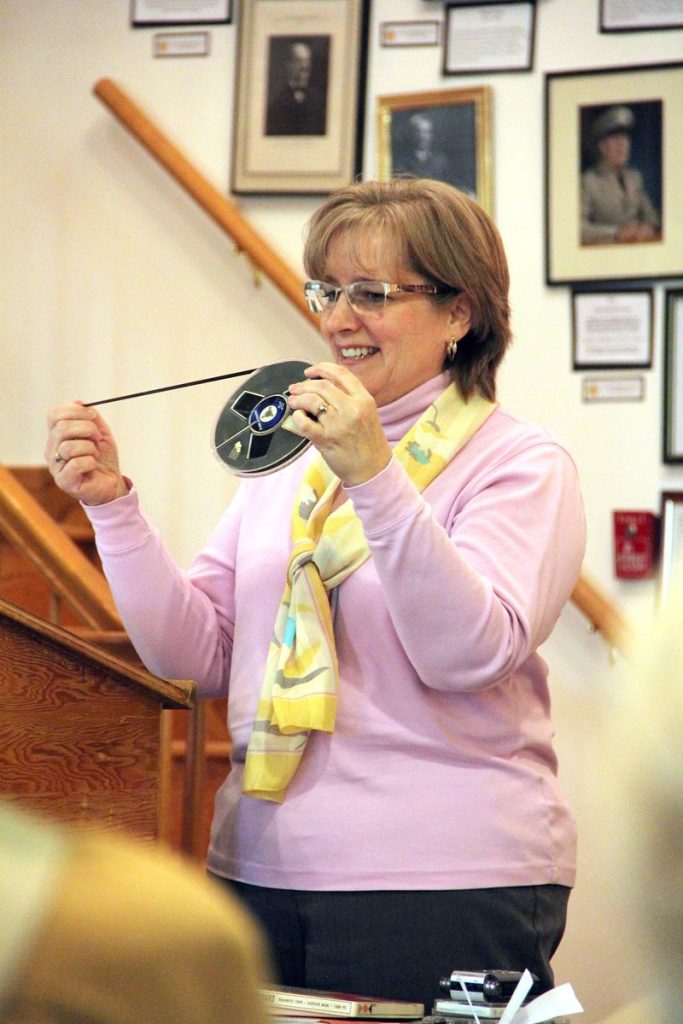
She showed the audience several mediums in which the news and programming was played on the station, including: 1-track tapes or a cart, reel to reel so it could be edited. Programs would come on reel to reel which caused issues, because the reels would be put on backward, and the students wouldn’t realize playing classical music that they were playing backward.
“That doesn’t happen so much with digital media,” she said. They moved to beta tapes, and even smaller to digital audio tapes.
“Now when we go out to do a news interview, we use a digital recorder, some reporters will use their phone,” she said. “It’s quite a difference from reel to reel, which it was really good in its day and the minute you got that edit right you were just in heaven, but now we have the digital, and we work so hard, because we know we can get it even better when it’s on a computer. So those are some of the changes that have happened over the years at KXCV as well as all radio stations I think.”
KXCV is unique she said, in that all of the announcers are students. Students are announcers, reporters, news readers and sports engineers. They’re on the air from 5:30 a.m. to 1 a.m.
“It’s a great opportunity for our students,” Holly said.
The station has 6 members on the professional staff and a student staff of 13.
After the presenters spoke, the crowd listened to several old advertisements: a JELLO ad from 1955, the beginning of a Dragnet episode and pieces of historic radio that is available on archives.org.
From 9 a.m. to 3 p.m. a coffee shop and bake sale well be held at the museum located at 110 N. Walnut.
The museum will close Dec. 12 through March 6, 2018, but during normal hours, the museum is open from 1 to 4 p.m. Tuesdays through Fridays and other times by appointment. There is no charge for admission, but donations are welcome. For more information call 660-582-8176 or 660-582-3957.
SKYE POURNAZARI/DAILY FORUM
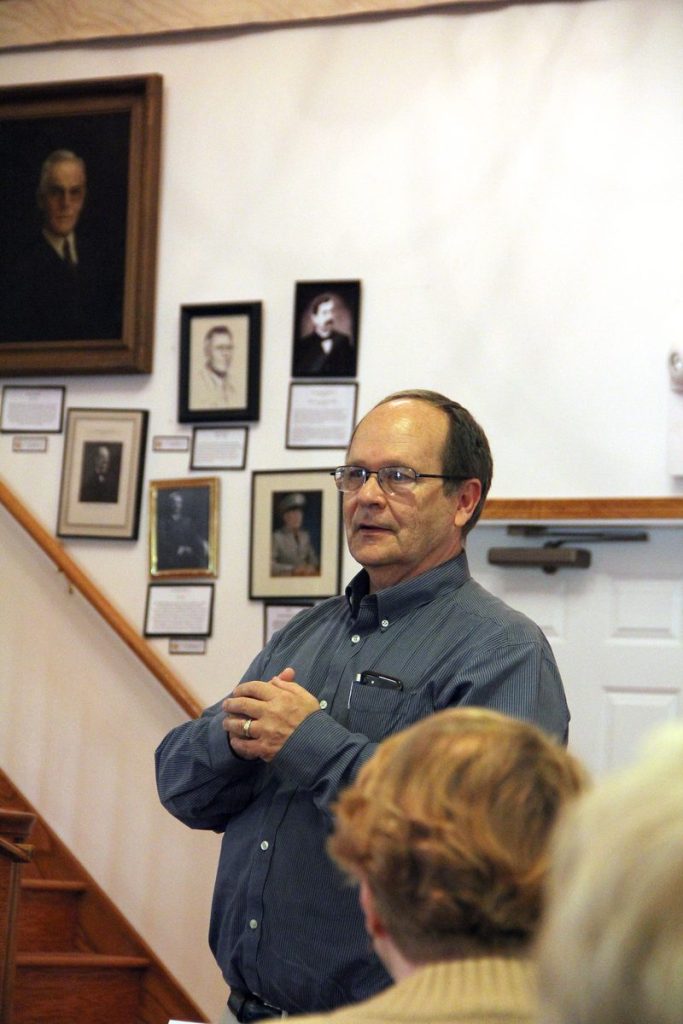
Fomer KMA radio personality Chuck Morris speaks Sunday about the history of KMA to the crowd at the Nodaway County Historical Society Museum.
SKYE POURNAZARI/DAILY FORUM
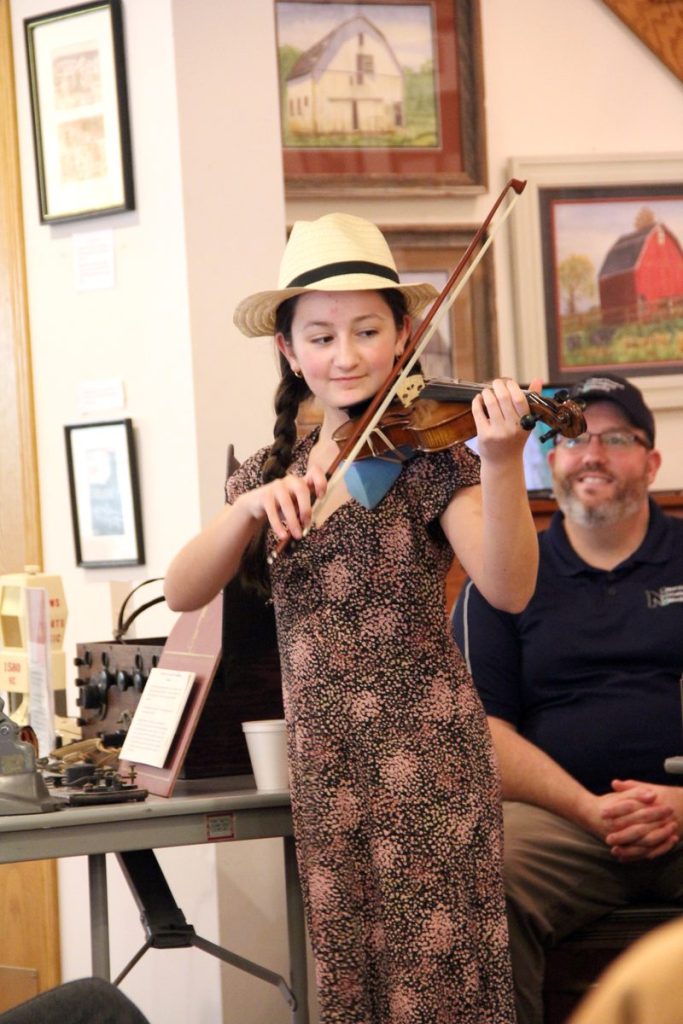
Violinist, Hadley Cline performed Sunday, at the Nodaway County Historical Society Museum’s radio presentation. She played, “Boil That Cabbage Down,” and Bach’s “Gavotte in G Minor.”
SKYE POURNAZARI/DAILY FORUM
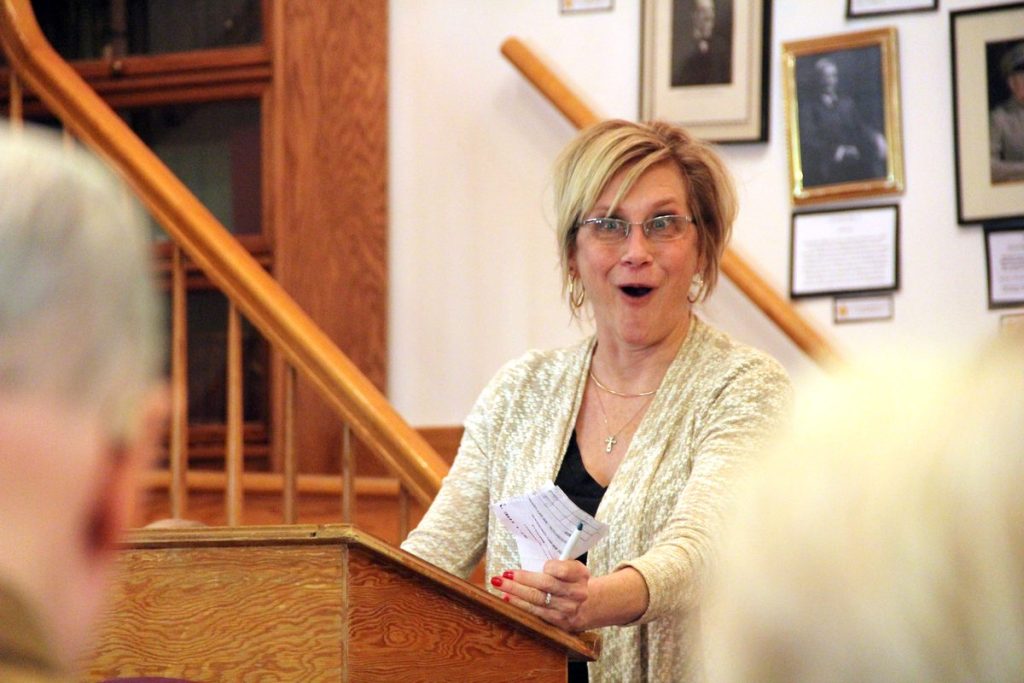
Joyce Cronin, manager of KNIM-FM-AM Radio laughs with the crowd Sunday, at the Nodaway County Historical Society Museum’s radio presentation.
SKYE POURNAZARI/DAILY FORUM
Patricia Holly KXCV personality, shows Sunday, an old reel to reel used at the station to the audience at the Nodaway County Historical Society Museum’s radio presentation.
SKYE POURNAZARI/DAILY FORUM
William Murphy shows an old audion tube to the audience Sunday at the Nodaway County Historical Society Museum’s radio presentation.
SKYE POURNAZARI/DAILY FORUM
William Murphy shows an old radio set Sunday to the audience at the Nodaway County Historical Society Museum’s radio presentation.