Elks add drop sites to boost deer hide collection for gloves
FILE P HOTO
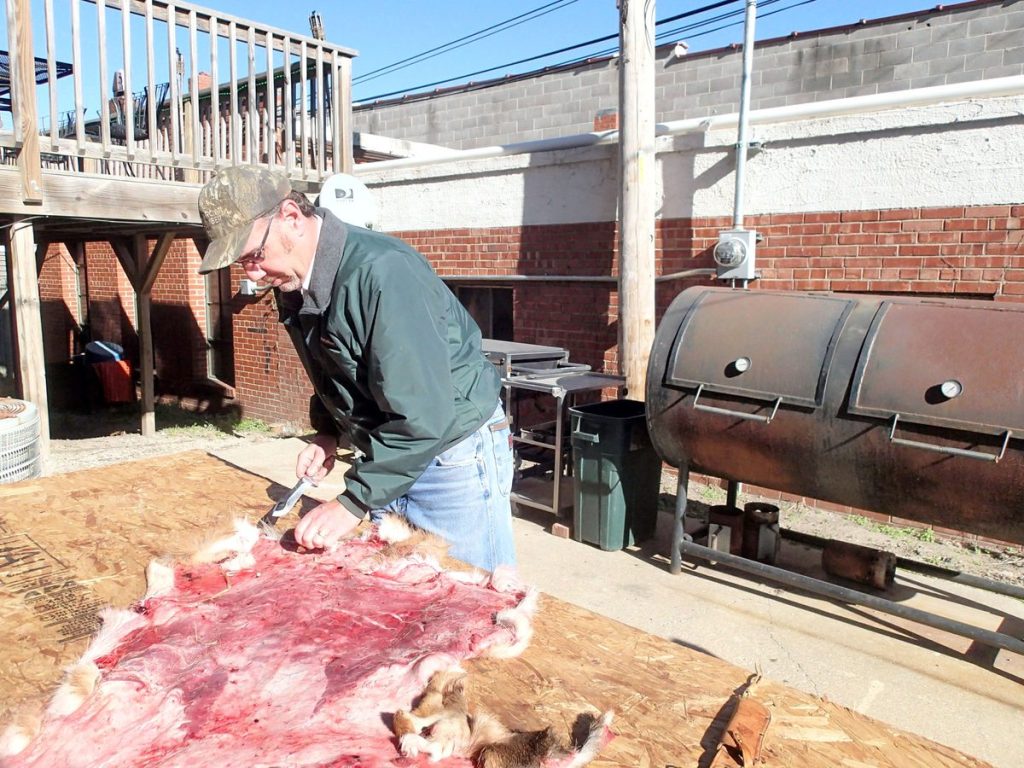
John Nelson, exalted ruler (president) of Maryville Elks Lodge No. 760, removes fat and flesh from a donated deer hide last year just outside the lodge’s headquarters at 115 N. Main St. The local organization is accepting deer hides offered by area hunters this deer season at 10 locations throughout Nodaway County and in Grant City as part of the Elks’ national Veterans Leather Program, which works to transform thousands of hides from 20 states into supple deerskin gloves for use by wheelchair-bound vets.
MARYVILLE, Mo. — In an effort to bolster its deer hide collection this year, the Maryville Elks Lodge added several collection sites where hunters can drop off their skins.
Last year Maryville Lodge 760 of the Benevolent and Protective Order of Elks collected 102 hides for the Elks’ National Veterans Leather Program using two local drop sites.
Exalted Ruler John Nelson thinks the local lodge can do a lot better than that, and to help achieve a goal of growing the number by as much as 100 percent, six drop sites have been added throughout Nodaway County and one in Grant City.
The following sites will have covered Leather Program bins: Elks Lodge, 115 N. Main St. and Consumers Oil Co. at the corner of First and Depot streets in Maryville; Great Plains Grain in Hopkins, MFA in Sheridan, American Legion in Burlington Jct., Barnard Tavern, MFA in Conception Jct. and MFA in Grant City.
The Elmo Community Building will store the hides in a deep freeze until the Elks can pick them up, as will the Skidmore location downtown by the old gas station.
Nelson said his goal for the drive this year is to contribute at least 200 hides to the Missouri portion of the effort, which last year sent 5,756 hides to tanning operations.
Over about the last five years, Missouri has been the program’s top hide producer nationwide.
The tanneries de-hair and process the hides then ship the finished leather to a factory where it is cut, trimmed and stitched into both fingerless and full-finger protective wheelchair gloves.
It requires about 3 square feet of deerskin to make a pair of gloves, and in 2016 Elks Lodges in approximately 20 states collected more than 16,000 hides and distributed 3,400 pairs of gloves to wheelchair-bound veterans.
In addition, the Elks donated 33,000 square feet of leather to be used in craft kits for recovering veterans.
Estimates place the total value of the Elks’ nationwide donation to more than $400,000, considering deer hide sells for $4.50 per square foot.
Before any of that can happen, however, the hides have to be separated from any remaining fat and flesh, cured with salt, and folded with the deer hair facing out in order to prevent spoilage.
It’s a messy, greasy, time-consuming task that last year was taken on mostly by Nelson, himself a deer hunter and fellow Elk Nick Thompson.
Justin Driskell, Jeremy Thompson and Steve Day also have joined this year’s effort.
The work of preparing the hides, which must arrive at a tannery before they spoil, is the only cost to local lodges for participating in the program, Nelson said. All tanning, manufacturing and distribution costs are covered by the Elks’ National Foundation.
“There is no reason not to do this at our level,” he said.
As for hunters wishing to help out, Nelson said he appreciates it when donors make an effort to remove foreign matter like dirt and gravel.
“The cleaner the hide is the better,” he said, “But I would not discourage anybody from dropping off a hide of any type as long as it has not started to decay.”
Telltale signs that hides have begun to spoil include smell and being able to pull out the hair with one’s fingertips.
“If you can pull the hair off, it’s no good,” Nelson said.
Beyond providing needed help for veterans in care facilities and elsewhere, Maryville’s exalted ruler — that’s Elk-speak for president — said the hide collection effort is part of a new overall emphasis on service being undertaken by local lodge membership.
The organization currently funds scholarships and supports such local nonprofit organizations as the New Beginnings Counseling Center and the Maryville Young Players drama camp. But Nelson said he believes there is potential to do more, and that reviving participation in the Veterans Leather Program is important.
Nationally the “Gloves for Wheelchair Veterans” program dates back to 1948.
Elks officials say, the federal government still does not budget funds for leather wheelchair gloves for residents and patients in veterans’ homes and hospitals.
“While there is a committee of Elks on the job, therapists will never experience a shortage of leather,” the Elks National Veterans Service Commission has pledged.