Human touch at the heart of disaster exercise
TONY BROWN/DAILY FORUM
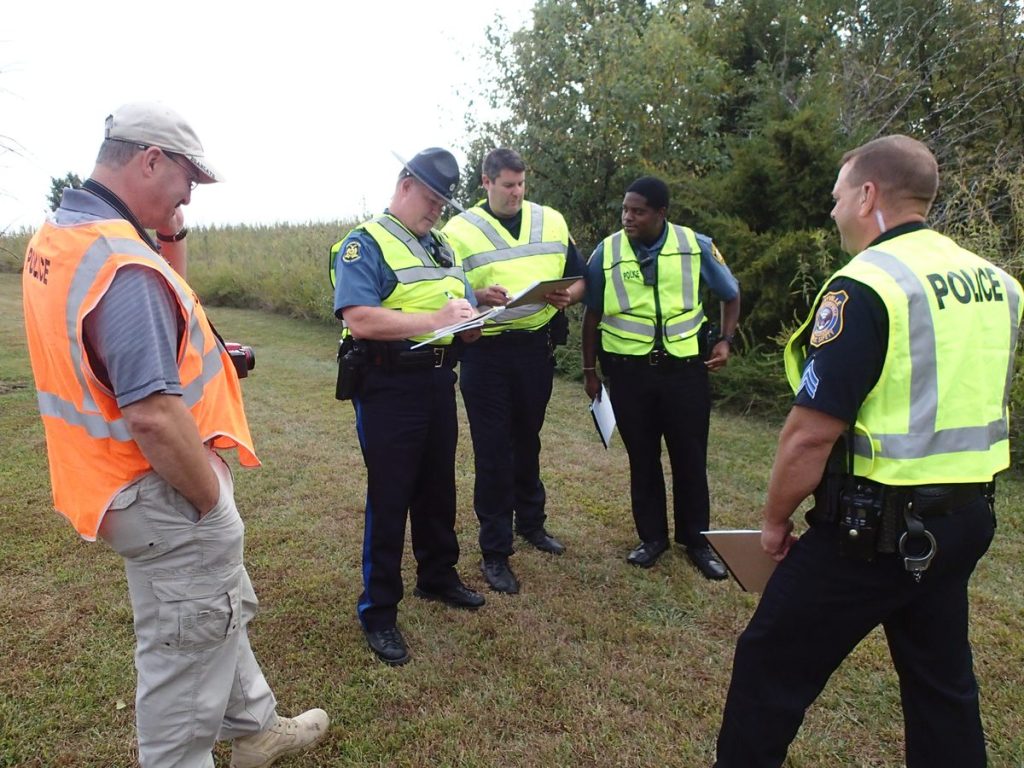
Mike Ceperley, left, emergency management coordinator at Northwest Missouri State University, meets with a group of peace officers following a Missouri Hope exercise Friday at Mozingo Lake that sought to illustrate the importance empathy and emotional de-escalation when dealing with survivors following a major crisis or natural disaster. Also pictured from left are Missouri State Highway Patrol Trooper Dale Reuter, Maryville Public Safety Officer Aaron Jones, Northwest Police Department Officer Adam McNairy and MPS Sgt. Mike Stolte.
Missouri Hope, an annual disaster response exercise held over the weekend at the Mozingo Outdoor Education Recreation Area, is designed primarily to provide field training for college students from Northwest Missouri State University and elsewhere preparing for careers as first responders and crisis managers.
But the large-scale exercise, during which participants simulate the aftermath of a devastating tornado, also provides training for dozens of professional first responders from across the region, including firefighters, police, sheriff’s deputies, ambulance crews, nurses and National Guard medics.
The in-service side of the drill was on display Friday afternoon during a disaster psychology/de-escalation session — one of three scheduled over the weekend — designed to provide peace officers with the insight needed to finesse high-stress situations involving people in various states of emotional and physical crisis.
Mike Ceperley, a former Northwest Missouri State police officer who now serves as the university’s emergency management coordinator, came up with exercise in response to real-life situations that arose following a devastating tornado that destroyed much of the southwest Missouri city of Joplin in 2011.
Ceperley said a number of peace officers assigned to provide security within the storm zone, where more than 150 people were killed and 2,000 buildings destroyed, had to be relieved from duty — not because they were unable to perform standard policing tasks, but because they were emotionally and mentally unprepared to deal with people pushed to the limit of what many human beings can bear.
“Post-disaster several responders were sent home,” Ceperley said. “They had to be told, ‘You’re creating a disruption, leave.’ And they weren’t emergency medical technicians or firefighters, they were law enforcement. And that made me wonder, what’s the difference?”
After doing some research, Ceperley said he decided that while most police officers receive solid training with regard to the technical and physical parts of their jobs, they too often lack the “soft skills” needed to deal with folks whose lives have been shattered by events beyond their control.
“In most situations, say dealing with a domestic violence call or an accident or a shoplifter, people are usually in a cognitive frame of mind,” he said. “But when you’ve lost everything, when the block you live on is gone, you can’t always recognize that you’re in a different place, and that needs a different response (from law enforcement). We need to think more empathetically.”
Friday’s five-hour psychology/de-escalation module included some classroom instruction and then moved to Redden Village, a Mozingo Lake mock-up of a ravaged town in which metal shipping containers serve as damaged buildings. The area also contains piles of rubble and usually an overturned vehicle or two.
The four officers participating in the exercise where told they were arriving on scene about 30 hours after the storm hit, and that each had just finished a 12- or 15-hour shift doing their regular jobs. According to the scenario, each officer had slept only four or five hours out of the preceding 24.
They were also informed that a little girl was missing somewhere in the devastated town, and that at least one body had been located.
After hand-correcting what turned out to be a flawed map of the area, the officers moved in to set up a perimeter and establish site security.
Then a series of volunteer role players tried to infiltrate the perimeter, each with his or her own set of problems and circumstances.
One woman spoke only Spanish and couldn’t make it clear to officers what she needed or what she was looking for. There was also a couple who insisted on being allowed to comb the rubble in an effort to find their missing teenage son. Another “victim” posed as a diabetic who said she needed to enter her damaged home in order to retrieve a supply of insulin.
Mostly the officers kept their cool, stayed polite and sought to steer the role-players toward assistance while keeping them outside the perimeter.
However, as officers continued to deal with the series of pleas and demands, their perimeter grew smaller, opening up the possibility of unauthorized civilian access to a dangerous area.
During a group discussion after the exercise concluded, Maryville Public Safety Sgt. Michael Stolte talked about doubts he experienced in denying the diabetic access to her residence.
What if the woman had displayed symptoms indicating the onset of diabetic shock, he asked? What if he believed she might die before reaching a field hospital some distance away?
Stolte’s MPS colleague, Officer Aaron Jones, who acted as “incident commander” during the drill, observed that often in such a situations the best option is to radio for help, no matter how strong the urge to solve the problem yourself.
“You’re still a hero if you call 911 and ask for the paramedics,” he said.
Missouri State Highway Patrol Trooper Dale Reuter, another participant, said he believed the key to those kinds of tough calls is to focus on what action will bring about the optimum, or at best the least harmful, result.
“I learned a long time ago that you always want to be a part of the solution, not part of the problem,” Reuter said.
Also on hand for the exercise was April Haberyan, a nurse and associate professor of psychology at Park University.
Haberyan said it’s important for police facing such wrenching scenarios to try and put people first.
“What we’re really focusing on is compassion and emotional intelligence,” she said. “For the officers in this kind of situation, there is often no jail, no vehicles, it’s just you. We don’t want that ‘command voice.’ A lot of times it’s going to be the soft skills that are important.”