
Street striping crew shows its Bearcat colors
TONY BROWN/DAILY FORUM
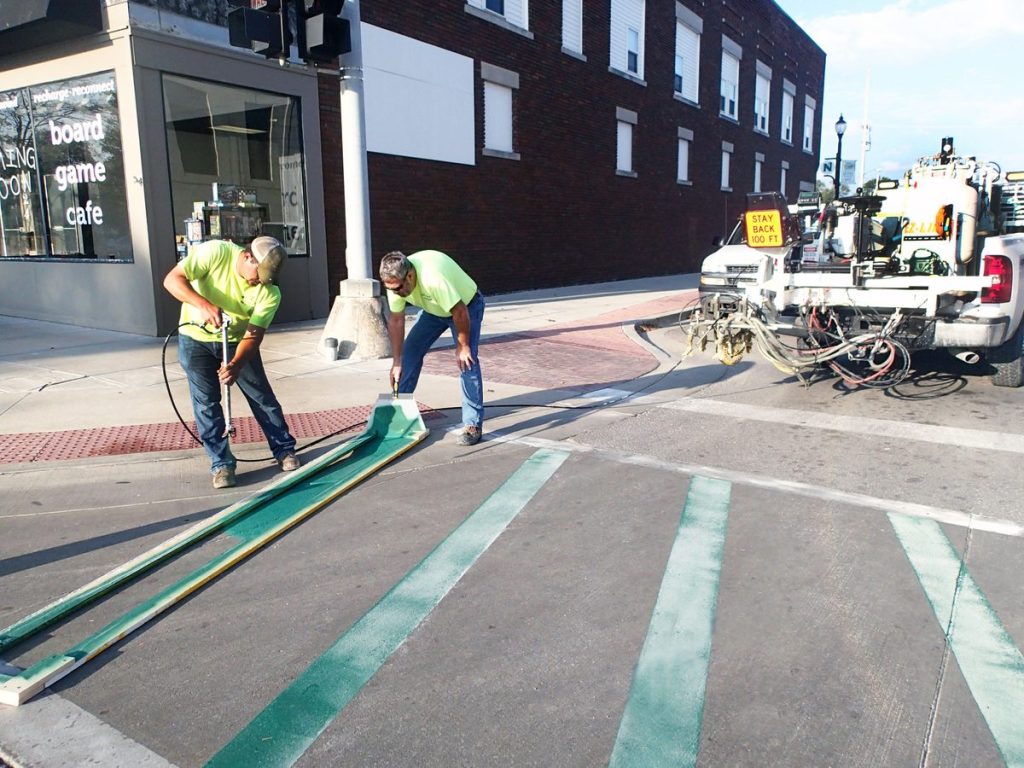
Maryville Department of Public Works crewmen Javan Rucker and Todd Puckett apply green striping Friday morning to the Fourth and Main crosswalk on the courthouse square. The city is experimenting with Bearcat/Spoofhound-colored crosswalks in an effort to reinforce Maryville’s “title town” reputation for winning athletics teams carried out within the larger context of rejuvenating the central business district.
Even though it was the first day of fall on Friday, things got a little more spring-like in downtown Maryville as a pair of Public Works crewmen striped a set of crosswalks at Fourth and Main with forest green paint.
The decorative touch — reflecting the official color of both the Maryville High School Spoofhounds and the Northwest Missouri State University Bearcats — came just in time for Northwest’s Family Weekend festivities on Saturday and may soon spread to other intersections.
City Manager Greg McDanel said Friday the green crosswalk experiment is being made in response to suggestions offered by Arkansas-based downtown revitalization consultant Ron Drake.
Drake’s two visits to Maryville this year included meetings with business owners, local officials and civic leaders and resulted in a number of recommendations, such as sprucing up the city’s faded street markings and emphasizing Maryville’s “title town” reputation for winning athletics teams, especially within the central business district.
McDanel said greening up Maryville’s crosswalks may be one way to begin addressing both those concerns.
“The crosswalks needed refreshing, so we though why not be creative with it,” he said.
At Fourth and Main, workers also sprinkled the freshly applied paint with tiny reflective beads designed to enhance crosswalk visibility, especially at night. The new marks were applied using the city’s pickup truck-mounted street-striping rig, purchased last year at a cost of around $50,000.
Anticipating Drake’s observation, the city purchased the striping machine because it was obvious that many vehicle and pedestrian markings were in rough shape, while the cost of hiring contractors to restore them was becoming impractical.
McDanel said the contractor-performed striping in 2015 of a single street — newly repaved West South Avenue — cost $13,000.
He added that striping a mile-long stretch of North Main Street last year after a fresh asphalt overlay could have cost as much as $30,000 if the city had not acquired its own paint truck, which allowed the centerline to be reapplied at a fraction of that cost.
However, it should be noted that in the case of South Avenue, the contractor used thermoplastic paint, which, while a lot more expensive than the traditional street-striping paint the city uses, is far longer lasting.
There has been some debate among city officials about which option is really cheaper — durable thermoplastics or in-house applied latex. In the end, it was decided that latex is the more affordable option, even though it must be renewed with considerable frequency.
McDanel said Friday he believes the city’s striping machine, which has seen extensive use in both 2016 and this year, may already have paid for itself.
If it hasn’t, he said, the city will almost certainly recoup its investment next year as it undertakes $1.25 million in fresh asphalt overlays financed with anticipated revenues from a voter-renewed capital improvements sales tax.
McDanel said the city’s striper gives crews considerable flexibility and can be configured to apply dual or single stripes, dashed stripes and parking lot markings. A hand-held paint wand used in conjunction with wooden stencils allows for the custom design of crosswalks and other features.
Once a routine line item in municipal budgets, street striping became a vexing problem for cities nationwide about 40 years ago when federal and state agencies began banning the use of lead-based paint.
The stuff looked good and it lasted great, but it also washed into storm drains and polluted streams and rivers. Lead, of course, is extremely toxic, especially to children, and can cause nervous system damage, stunted growth, kidney damage and delayed cognitive development.




