Heart & Sole walk seeks to curb cardiac disease
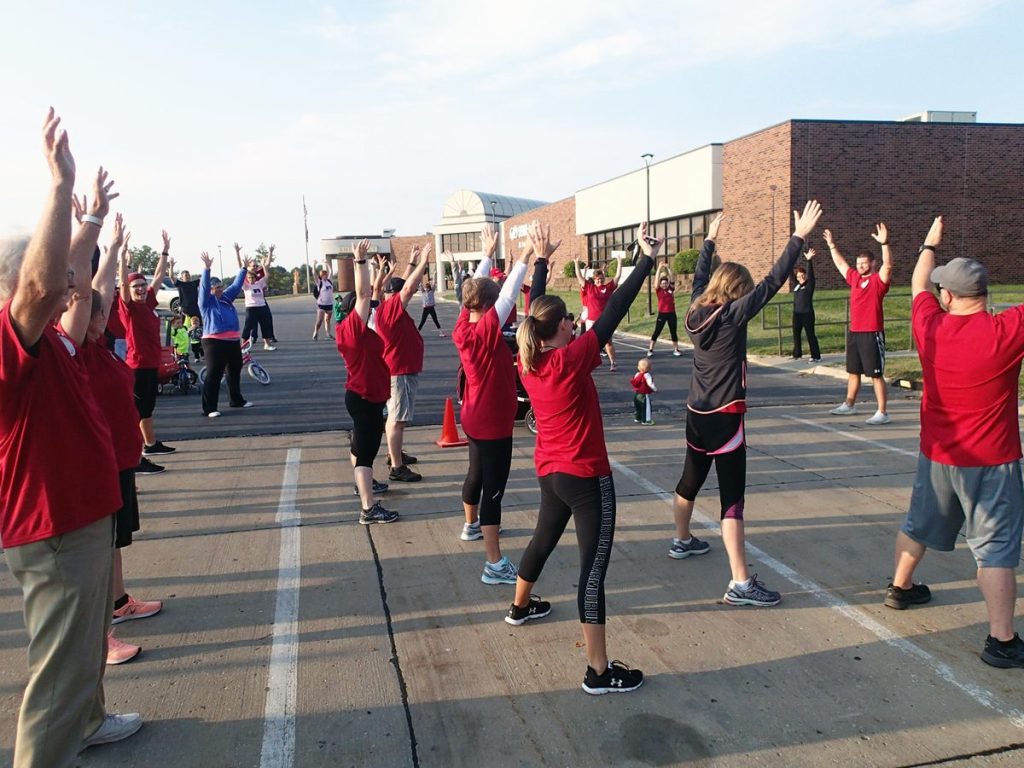
TONY BROWN/DAILY FORUM
Participants in Saturday’s Heart & Sole 5-kilometer walk were led through a series of stretching exercises by Luke Lancaster in the parking lot of SSM Health St. Francis Hospital. In part a fundraiser for the American Heart Association, the annual event is really intended as an awareness-builder in the fight against cardio-vascular disease, the No. 1 cause of death in Nodaway County and other parts of northwest Missouri.
About 60 people — a number of them heart attack and heart disease survivors — gathered in the parking lot of SSM Health St. Francis Hospital Saturday morning for the sixth annual Heart & Sole 5-kilometer walk.
Unlike a host of similar events that take place throughout the summer and fall, this 5K doesn’t focus on crossing the finish line first or even achieving a personal-best time.
No. The Heart & Sole walk is about staying alive and committing to the kinds of lifestyle changes that can prevent heart attack and stroke and improve the odds for long life and health for those at risk of, or already suffering from, cardio-vascular disease.
Participants in the annual walk pay a registration fee, and the hospital donates the proceeds to the American Heart Association. But St. Francis Community Relations Manager Rita Miller said raising money isn’t the main point.
Rather, she said, St. Francis wants to get the word out that Nodaway County, which statistics show to be one of the healthiest counties in Missouri, has a weight problem — and it’s killing us.
“Cardio-vascular disease is the No. 1 killer for residents in our area,” Miller said. “We want to remind people that they have to take care of their hearts.”
So what is it about northwest Missouri and heart disease?
Well, said Miller, not to put too fine a point on it, the Maryville area is smack dab in the middle of “Midwestern-sized portions” land, meaning that we eat too much of the wrong kind of food and don’t get enough exercise.
What’s more, one bad habit reinforces the other, which results in way too many people being — no nice way to say it — fat.
Miller said local statistics show that almost one in three Nodaway Countians aren’t just overweight but are in fact obese, meaning they exceed their ideal weight, based on height, age, sex and build, by at least 20 percent.
Most folks who carry that much extra poundage are very aware that weight is a lot easier to put on than to take off. But St. Francis cardiac rehab nurse Barb Jensen said common sense, patience and commitment are better strategies for achieving and maintaining heart health than crash dieting and intensive exercise.
In other words, leave the doughnuts alone and go for a walk.
And in fact that’s why the Heart & Sole event is a walk instead of a run. For those no longer young and not in the best of shape, the quest for heart health is generally a matter of persistence and goal-setting, not pain and strain.
“Just keep moving,” said Jensen, explaining that any moderate exercise sufficient to elevate one’s heart rate is, literally, a step in the right direction.
She recommends at least 150 minutes of walking, or similar exertion, each week. That’s 30 minutes a day for five out of seven days.
What’s more, you don’t have to do the whole 30 minutes at once. Ten minutes three times a day works almost as well.
The second essential, Jensen said, is a sensible diet that keeps fat, salt and sugar at a minimum.
Sounds simple, but as many members of “chubby nation” know, it’s easier said than done. So support from friends and family members helps, Jensen said.
“I think people are more successful if they have someone supporting them and doing it with them,” she said, adding that signing up for an exercise class at the Maryville Community Center or joining other groups that engage in physical activity can help those seeking better heart health stay focused and committed.
Aside from diet and exercise, a third leg of the heart-health stool is timely medical screening, which advanced technology is rendering both accessible and affordable.
Before participating in Saturday’s walk, 5K participants listened to brief remarks from Greg Duncan, a Guilford-area farmer and agriculture retailer whose advanced vascular disease was diagnosed in time — that is before he had a heart attack.
Duncan’s cardio-vascular calcium test revealed that he was, or near enough, a walking dead man, with three arterial blockages, one of which was diagnosed at 100 percent.
Two of the blockages were opened with stints, a third is being treated through cardio rehabilitation at St. Francis — in other words diet and exercise.
“That’s the new thing,” Duncan said, “not just the stints but treating the disease.”
Duncan emphasizes that much of his new lease on life is due to technology, and he urged people at risk for heart disease — and especially those who have a family history of cardio-vascular problems — to get checked out.
A screen like the one that may have saved his life, he said, costs about $50, is administered without pain or discomfort and takes only 15 minutes.
“It’s a walk-in deal,” Duncan said, “and it gives you a starting point. That’s how I got down the road without experiencing a heart attack.”
On a final note, Duncan told Saturday’s walkers not to wait or procrastinate when it comes to heart disease, which is often a silent killer presenting few, if any, symptoms.
“You don’t need to have symptoms,” he said, noting that, for years, he wrote off persistent pain in his shoulders to middle age and farm work. “Don’t wait.”