Maryville council sets sights on 2018 budget
TONY BROWN/DAILY FORUM
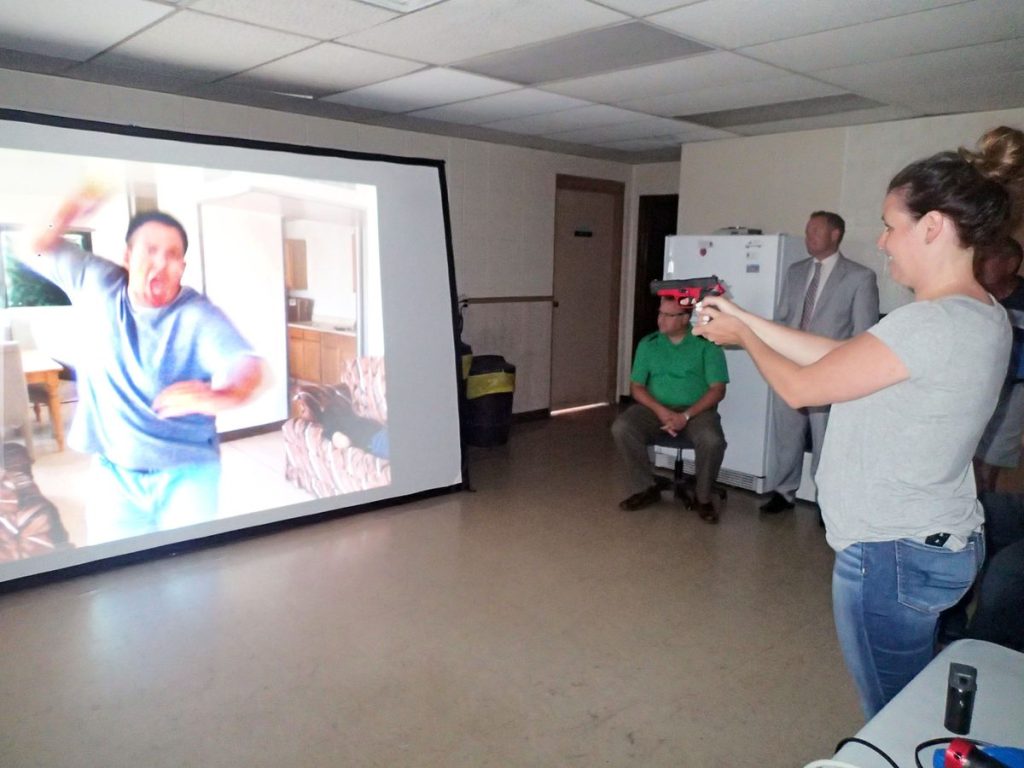
City Councilwoman Rachael Martin fires a computer controller designed to mimic a semiautomatic handgun at a virtual assailant during a deadly-force police training exercise Wednesday evening at Maryville Public Safety headquarters. All five council members participated in a series of similar simulations, which served as a team-building exercise prior to an hour-long study session designed to introduce budget priorities for fiscal 2018.
The annual series of late-summer budget sessions leading to the Maryville City Council’s adoption of a spending blueprint for the new fiscal year got underway with a literal bang this week as council members took part in a deadly-force police training exercise at Maryville Public Safety headquarters.
Administered via interactive computer gear and a large projection screen, the simulation is designed to expose police officers to a variety of potentially violent scenarios that require them to make split-second decisions about the use of handguns, Tasers and pepper spray.
On Tuesday, Councilman Jerry Riggs succeeded in downing an armed “suspect” with a headshot using a hand-held device designed to mimic a semiautomatic pistol, while Councilwoman Rachael Martin fatally shot an attacker who rushed her in the course of a domestic dispute.
Others fared less well.
Councilwoman Rene Riedel, for example, failed to stop an “active shooter” rampaging inside a school when her virtual bullet struck the killer’s body armor.
Council members participated in the simulations as a team-building experience before tackling a list of staff-proposed budget priorities later Tuesday evening, but Maryville Public Safety officers have been running through similar scenarios this week as part of their regular training.
The simulator, together with its human operator, travels to Maryville annually under a risk-management program sponsored by the Missouri Intergovernmental Risk Management Association, the city’s liability insurance provider.
Maryville Public Safety Director Keith Wood said the virtual situations provide officers with skills and insights that can improve performance — and save lives — in the field.
“I believe it’s as important, if not more important, than the actual (firing) range work that we do,” Wood said.
As for the budget session at City Hall, the council quickly left the virtual world behind and began grappling with the realities of a new fiscal year set to begin Oct. 1.
City Manager Greg McDanel started off his presentation by saying that 2017-2018 will be a challenge with regard to operational spending, even though voter-renewal of Maryville’s half-cent capital improvements sales tax has paved the way for a number of major projects.
These include design and construction a new police and fire station, traffic-flow improvements on South Main Street between South Avenue and the north entrance to Wal-Mart and a major asphalt street overlay program carrying an estimated cost of between $1 million and $2 million.
Both the street initiative and a groundbreaking for the police/fire station are scheduled for next year, but McDanel said a number of factors will likely delay the start of work on South Main until 2019.
While as much as $6 million worth of financing should be in place for capital improvements by April 1, McDanel said funds available for general operations are limited, and that, overall, the city is facing a tight budget year.
Tax revenues have been fairly flat, he said, while expenses, especially for health insurance, are expected to rise. Health premiums for the city could increase as much as 30 percent next year, according to current estimates.
In an effort to ease the fiscal impact, McDanel said the city may have to raise deductibles and attempt to offset out-of-pocket costs to employees using such strategies as health reimbursement accounts, prescription benefits, supplemental insurance programs and healthy lifestyle incentives.
Pressure on operational spending has also been exerted by the diversion of capital improvement revenue over the last couple of years to pay off debt incurred to finance now-completed projects. The tapering off of revenue available for new capital spending has forced the city to dip into reserves, which McDanel said are nearing acceptable minimum balances.
Another factor contributing to the tight-budget scenario is a 12- to 15-percent increase in municipal salaries implemented over the past three years following a market-based evaluation of city pay scales.
In order to increase revenue in the face of these rising costs, McDanel asked the council to consider placing a use tax before voters that, if approved, would function much like a local sales tax collected on goods purchased out of state or via the Internet.
Most of this week’s budget discussion revolved around spending priorities to be set by the council and incorporated into a draft budget being prepared by municipal staff.
The council is already pretty much committed to major projects such as the police/fire station, street overlay work, South Main improvements and continued development of the conference center under construction at Mozingo Lake Recreation Park.
McDanel said that while the park, which has its own revenue streams and a solid fund balance, is in good fiscal shape, significant capital spending beyond the existing construction contract will be required if the conference center is to reach its full potential as a “community and regional asset.”
Examples, he said, include silo demolition, planned creation of an events lawn and the purchase of special equipment and amenities, such electronic golf simulators.
Additional capital improvement needs citywide, McDanel said, include concrete street repairs, the paving of Hawk Road between Highway 46 and Northwest Missouri Regional Airport; permanent downtown traffic signals and the intersections of Main and Third and Fourth streets; sewer line and lift station improvements; continued work to eliminate storm water infiltration into the sanitary sewer system; and city-funded infrastructure designed to further economic development.
Other suggested budget priorities offered for consideration included an analysis of revenue from fees and permits, charges that in some cases have remained unchanged for a number of years; revision of the sign code; a rebranding effort addressing the city’s website, social media presence, logo and other public-awareness and marketing tools; and renewed emphases on tourism, industrial recruitment and workforce recruitment.
The next step in the process will be detailed consideration of a draft budget during a pair of study sessions scheduled for 5:30 p.m. Monday, Aug. 28, and Monday, Sept. 11. Approval of the city’s 2017-2018 spending plan is set for the regular council meeting at 7 p.m. Monday, Sept. 25.