Ag school readies for move to Hubbard Center
TONY BROWN/DAILY FORUM
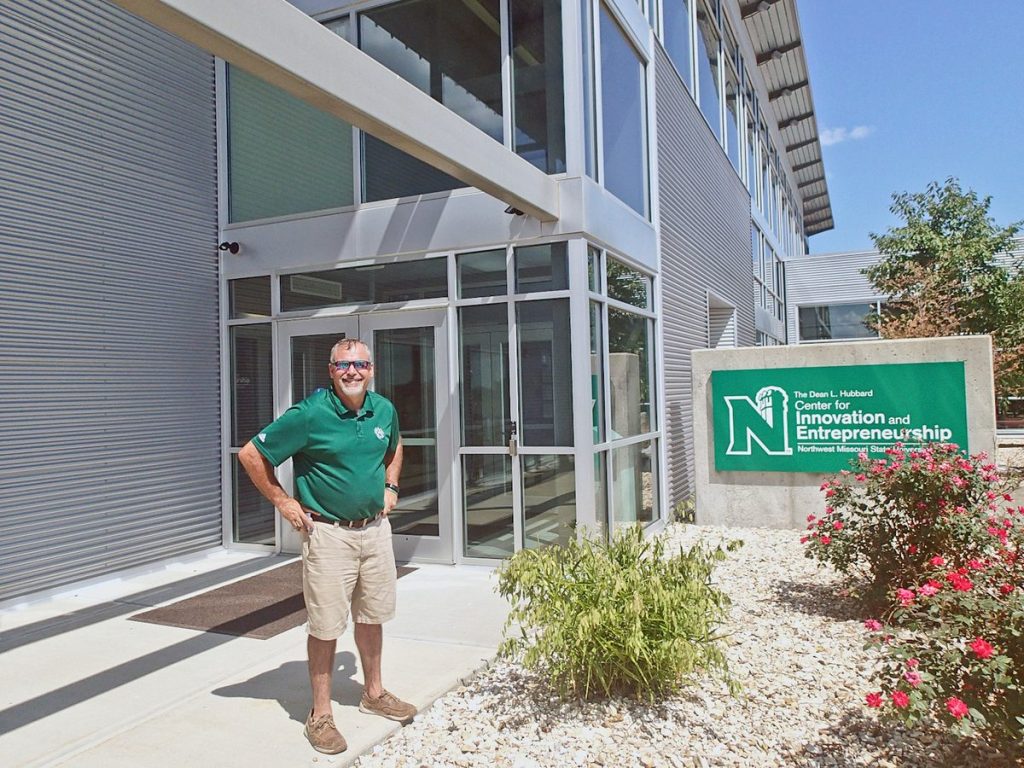
Rod Barr, director of the School of Agricultural Sciences at Northwest Missouri State University, stands beside one of the entrances to the former Dean L. Hubbard Center for Innovation and Entrepreneurship, much of which is being repurposed to serve as the rapidly growing ag program’s new academic home.
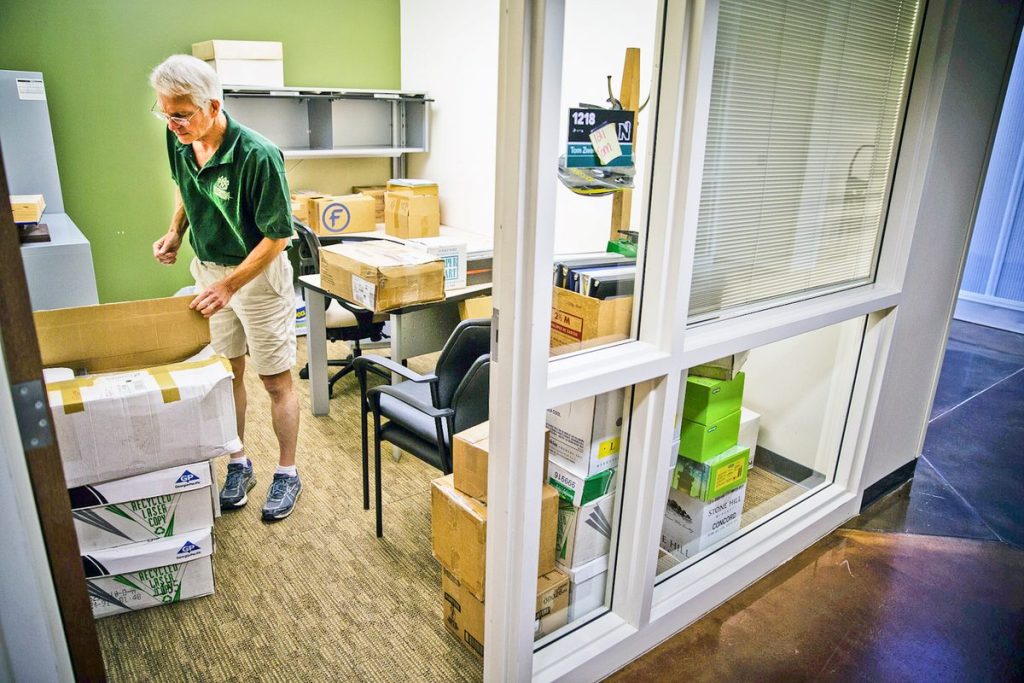
Much of the lab gear is still sitting around in boxes; chairs, desks and workstations are still being assembled; and faculty members are in the process of unpacking reference binders, files, reports, textbooks and other academic paraphernalia.
But by the time a new semester begins Aug. 28 at Northwest Missouri State University, the former Dean L. Hubbard Center for Innovation and Entrepreneurship will have been transformed into the Hubbard Center for Innovation — home of Northwest’s School of Agricultural Sciences.
New classrooms, offices, meeting areas and laboratories have been carved out of the former CIE’s 46,000-square-feet of floor space as part of a $980,000 summer renovation project that also included renovating the Alfred McKemy Center for Lifelong Learning.
Like much of the Hubbard Center, McKemy is also being repurposed as an ag facility and will serve the school’s nearly 700 students with a 100-desk classroom, media studio and a commodities-trading simulation area.
Though primarily given over to agriculture studies, the Hubbard Center will continue to house a number of natural science programs, including those dedicated to nanotechnology (a discipline involving the study of objects measuring a billionth of a meter or less); chemistry; and biology.
In addition, a portion of the complex will still offer a couple of laboratories for use by private-sector technology companies, a vestige of the CIE’s original purpose, which was to serve as a combination academic facility and business incubator.
But come this fall, the focus inside the massive, glass-and-steel structure completed in 2010 at the north end of campus will be on agriculture, which, as ag school Director Rod Barr pointed out during a tour of the building this week, has become one of Northwest’s fastest-growing academic divisions.
New ag facilities added at the Hubbard Center over the summer include a teaching laboratory, an applied research laboratory, five classrooms, a conference room and offices for Barr and the school’s 14 other faculty members.
Until now, the school — formerly classed as a department — was based in the upper level of the Valk Center east of the Administration Building. That structure, consisting mostly of classrooms and offices, will remain the home of Northwest’s Department of Humanities and Social Sciences, which occupies the lower floor.
Possible uses for Valk’s upper level are still being discussed by university administrators.
Barr said Tuesday that moving the School of Agricultural Sciences to the Hubbard Center reflects the importance of an academic unit that has grown 40 percent over the past five years in terms of the number of students served. The school grew by 11 percent last year alone.
“This is the newest building on campus,” Barr said, “and when you associate this building with agriculture, it becomes a selling point for who we are and what we do.”
Academic majors offered by the school include agribusiness, agriculture education, agricultural science, agronomy, animal science, animal science (pre-veterinary) and horticulture.
Barr said he believes the school is growing like a bumper crop due to a number of factors, including a comprehensive focus on agriculture as a single industry with many interrelated components.
Agribusiness majors, for example, commonly take courses in animal science and agronomy, and all students seeking a degree within the discipline are required to take chemistry. They also often sign up for coursework in biology and other natural sciences.
Barr continued that an increased number of “profession-based” learning opportunities at Northwest’s R.T. Wright Farm north of Maryville has added luster to the school as well, along with private-sector partnerships involving Bayer, the multinational chemical, pharmaceutical and life-sciences company, and seed specialists Beck’s Hybrids.
Last spring, the school hosted a meeting of its Professional Advisory Committee, a group embracing 65 professionals from all sectors of the industry charged with reviewing and improving Northwest’s ag curriculum and the workplace readiness of new graduates.
“We have a great connection between academics and industry,” Barr said.
Now that the Hubbard Center and the McKemy Center have been integrated into Northwest’s agriculture infrastructure, fundraising efforts continue to move forward for eventual construction of a proposed 28,000-square-foot Agricultural Learning Center at the R.T. Wright Farm.
When completed, Barr said, the center will serve as a multi-use facility dedicated to laboratory research and agricultural product development and processing. The facility, which carries an estimated cost of $8.5 million, will also provide space for classrooms, ag industry meetings, workshops, shows, career development events and the promotion of “agricultural literacy” among the general public.
SCOTT WEDDLE/NORTHWEST MISSOURI STATE UNIVERSITY
Assistant Professor of Agriculture Thomas Zweifel unpacks notebooks and other belongings inside his office at the former Hubbard Center for Innovation and Entrepreneurship. Renamed the Hubbard Center for Innovation, the ultra-modern facility, completed in 2010 as a combination academic building and high-tech business incubator, will reopen this fall as the primary classroom/laboratory venue for Northwest’s School of Agricultural Sciences.
SCOTT WEDDLE/NORTHWEST MISSOURI STATE UNIVERSITY
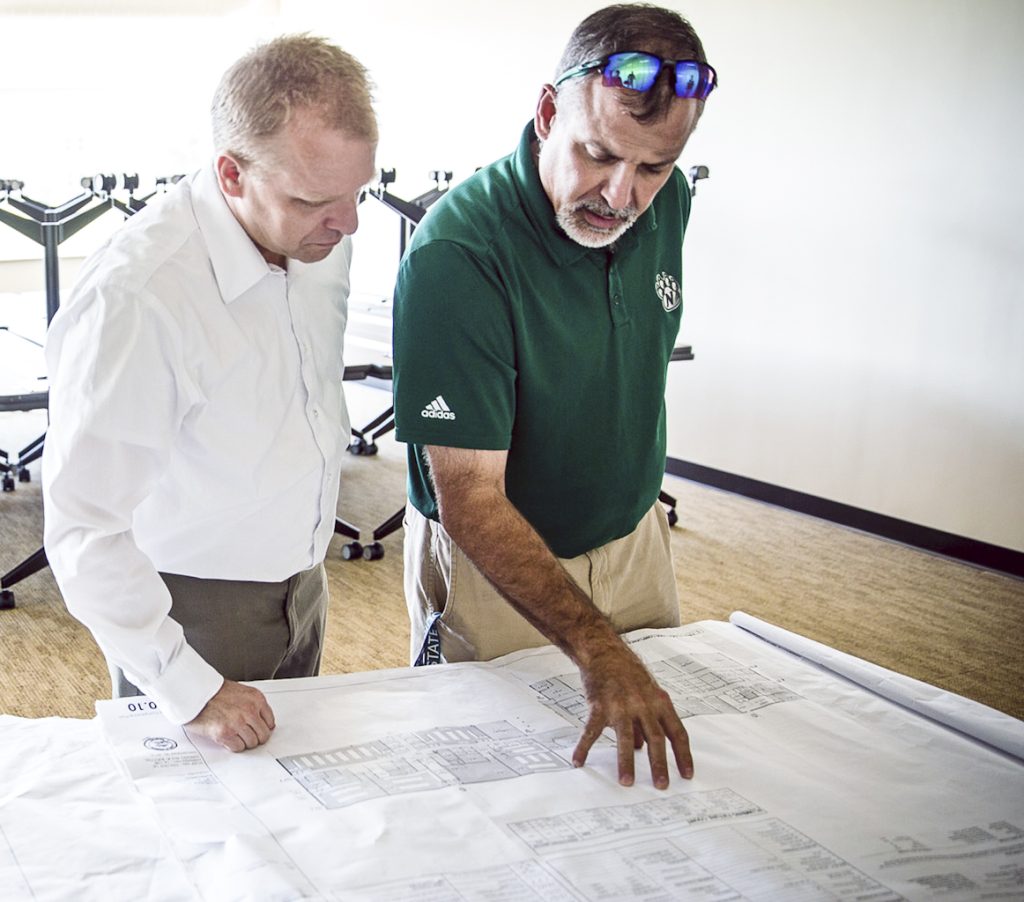
Scott Kuhlemeyer, senior projects manager for Northwest Missouri State University’s Office of Facility Services, left, and School of Agricultural Sciences Director Rod Barr, examine schematic drawings used during the recently completed remodel of the former Hubbard Center for Innovation and Entrepreneurship — now the Hubbard Center for Innovation. The center is to open this fall as the ag school’s primary academic and research facility.