Withers’ success traces back to Northwest days
COURTESY OF NORTHWEST MISSOURI STATE UNIVERSITY
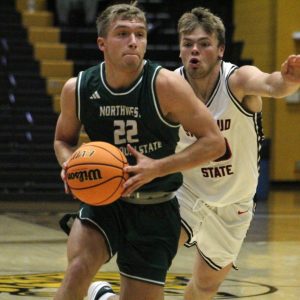
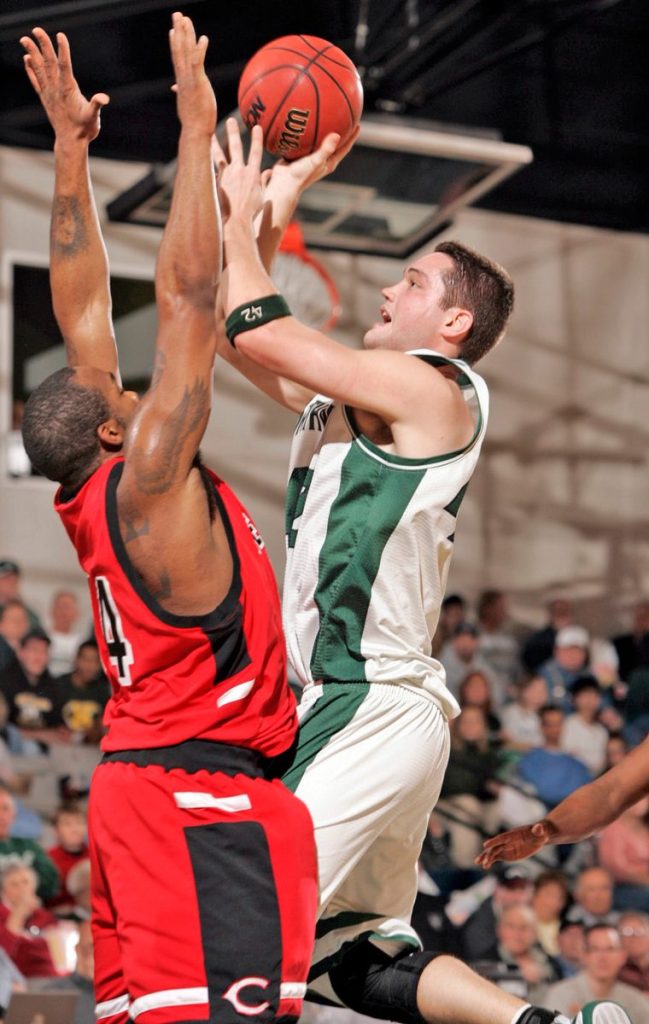
Former Northwest Missouri State forward Matt Withers goes up for a shot in Bearcat Arena over an opponent. He played at Northwest from 2004-2008. Withers recently recieved his docterate in marriage and family therapy from Florida State University.
A famous motto for the NCAA is “There are over 400,000 NCAA student-athletes, and most of us will go pro in something other than sports.”
While Northwest Missouri State University certainly sends more athletes to the professional ranks than the average Division-II school, it also sends plenty of its former athletes to excel in other professions.
A leading example of a former Bearcat, who has taken his lessons from Northwest and has translated them into the rest of his life is former men’s basketball player Matt Withers.
Withers’ journey has culminated in earning his docterate from Florida State University in marriage and family therapy and accepting a position as a professor at California State University, Chico — commonly referred to as Chico State — but before that his collegiate career began in Maryville.
The crowd favorite was a three-year starter for the Bearcats. After his senior season in 2008, he knew his basketball playing career was likely over, but he also knew that his time at Northwest had sparked an interest in a future career.
“I was always interested in psychology and I majored in psychology at Northwest,” Withers said. “I knew I wanted to be involved in that somehow. I looked at sports psychology, because of my background in sports, but then the summer before my senior year at Northwest, I did two internships and both of them allowed me to sit in on therapy sessions.
“One of them was a drug-treatment program that had some adolescents and some adults and the other was a residential treatment center for adolescents. For each one, I was able to see individual sessions, which is more along the lines of psychology, but I was also able to see some family sessions and that is where I saw a lot more of the change that happened. That is what got me more interested in doing the family-aspect of it.”
Withers’ other major career interest was to get into coaching, but he sees some cross-over elements between coaching and psychology.
“There is a lot of overlap,” Withers said. “You need to work well with teammates. You have to know when to be a leader and know when it is someone else’s turn to lead and you need to step back.”
Withers wanted to get closer to his hometown in Taylorsville, Utah, and continue to explore his passion for psychology. Withers entered the master’s program in marriage and family therapy at Utah State University in Logan, Utah.
“I was looking to get closer to family and Logan is only about an hour and a half from where my family is,” Withers said.
While completing his master’s degree in 2010, Withers began to work at a community center which also did work with prisoners at the Utah State Prison.
“I wasn’t really interested in getting a PhD at that point, I just wanted to work,” Withers said. “I ran a program at the Utah State Prison called the ‘Family Reunification Program.’ In that program, I worked with female inmates, who were within about a year of being released from prison. They all had children, who they would be the parent for when they got out.
“I’d do individual sessions with them and group sessions. We’d also do a family playtime, where every week their family would come in and they’d be able to play and interact with them more than they could in a typical visit.”
Withers’ work for the prisoners had a big impact on him and further sparked the idea that this was the right career-path moving forward.
“I really enjoyed working at the prison, obviously it has its own positives and negatives,” Withers said. “It was really rewarding and it was great to see the changes that those inmates went through. I was able to see that bond form with their children.”
Withers continued to work with the prisoners and their families for a little more than a year, before he left the community center to join a private practice.
“The hope there was that I could do more of what I was trained for with the marriage therapy and the family therapy,” Withers said. “With the community center, I was doing more of the individual and group sessions, but I wanted to get back into the family-type settings, because I think that is where you see the most change.”
Withers worked with the private practice for two years, but the more he worked the more questions began to pop up for him.
“As soon as I started getting into the field, I started having more questions like, ‘Why do we see this type of relationship?’ or ‘How does depression impact this relationship?’ I just didn’t have the answers to it,” Withers said. “Specifically, in the prison, I wanted to set up a study to see if what I am doing is actually beneficial in the long run, but I didn’t have the training to set up a research study.”
Then a co-worker had an interesting idea.
“It had me thinking that I needed more training to answer some of my questions,” Withers said. “I had a supervisor that I went to asking questions and he would say, ‘That seems like a question that you would be able to answer if you had a PhD.’ So we started talking about that … About a year into working at the private practice, I began researching different programs and applying to them. I got accepted into Florida State which is one of the top programs in my field.”
Before going to get his PhD, Withers took an additional job to help save money to go back to school.
“For the last year before I left, I worked at a short-term behavior hospital and ran the adolescent program in that hospital,” Withers said. “We had adolescents that came into that program with pretty severe depression, thoughts of suicide or attempted suicide. They would come into our hospital and they would only stay for three to seven days. They would see a psychologist and then I would do a full assessment, do group therapy and family therapy.”
After earning his PhD, Withers will now turn his attention to teaching others to provide the same kind of help that he has provided. He tracks that entire journey back to his days in Maryville.
“Looking back, I learned the basics of pretty much everything I use now, I learned at Northwest from coach (Steve) Tappmeyer and my teammates,” Withers said. “I learn how to be a good teammate and work well with others. Coach Tappmeyer’s big thing with me was that I could always work harder and he would always use the phrases, ‘knock that door down,’ or ‘get out of your comfort zone,’ or ‘get your edge back.’ Even though I thought I was working hard, there was always another level and that told me that no matter what I am doing, I need to get to the highest level possible. A master’s program is pretty hard, but a PhD is a whole different level, so I wouldn’t have been able to do that if I didn’t hear coach Tappmeyer in the back of my head.
“I learned how to be — not just a hard worker and good teammate — but I learned how to be a man through Northwest.”