
Excessive heat on tap for Nodaway County
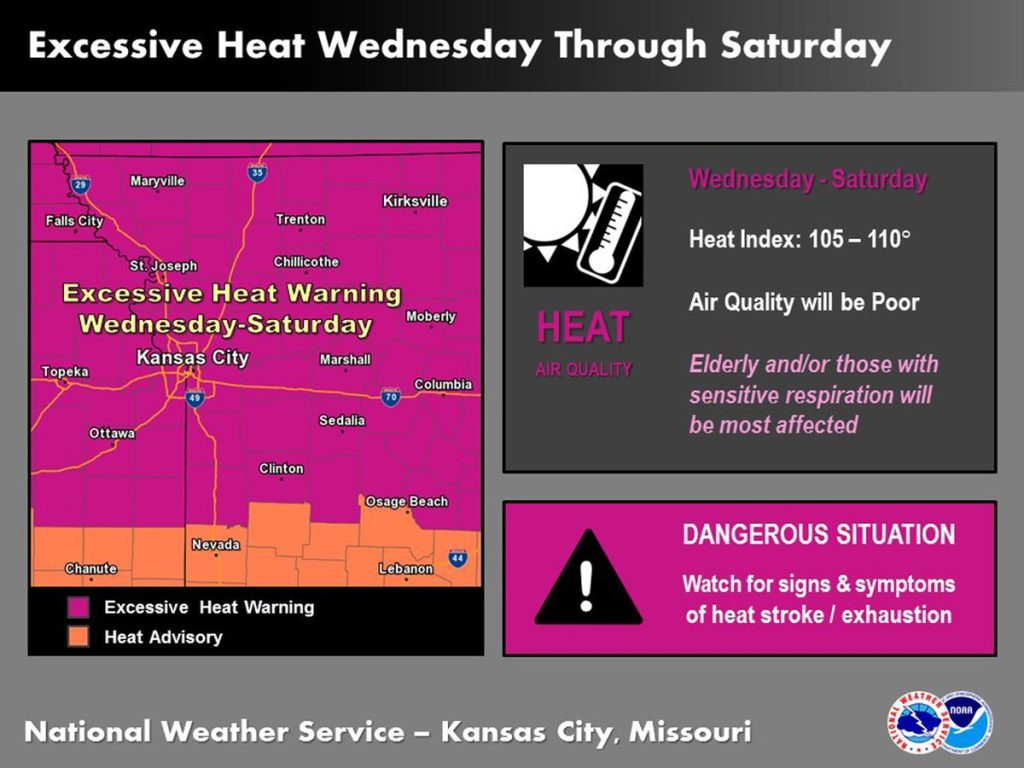
NATIONAL WEATHER SERVICE GRAPHIC
This graphic shows that most of the state of Missouri is now under an Excessive Heat Warning from Wednesday at noon to Saturday at 8 p.m. Excessive Heat Warnings indicate certainty that there will be multi-day periods of high heat indexes accompanied by higher low temperatures, providing little relief from debilitating heat conditions.
While it doesn’t take a meteorologist to tell someone that summer is hot, experts are predicting that this week’s excessive temperatures could pose some risks.
The National Weather Service in Pleasant Hill has issued an Excessive Heat Warning, effective starting at noon today and running until 8 p.m. Saturday evening for counties in northern Missouri along the Iowa Border, including Nodaway County.
Meterologist Ryan Cutter said the warning indicates confidence in the conditions headed this way.
“We’ve gotten more confident in the fact that it will be brutally hot between now and Saturday,” Cutter said. “There were going to be storms that rolled through that had the potential to make temperatures get a little cooler, but the storms are moving far enough north that it won’t affect us at all.
“The biggest threats with an excessive heat warning is really over heating, suffering from heat exhaustion or heat stroke, and that’s when your body’s ability to regulate temperature goes down. That gets particularly dangerous for us because, when we can’t keep ourselves cool, we find ourselves in heat distress.”
Currently, temperatures from today through the end of the week range in the mid- to upper-90s, with heat indexes predicted to be in the 105-110 degree range. While storms may lower the heat, Cutter said it’s important to remain weather-aware during these times.
“Just like with any other storm, we issue warnings and watches in general to raise awareness that the weather carries a bit of a hazard,” Cutter said. “Here, we’re warning people that the hazard is high heat.
“Granted, people understand that it’s summer, but even so, we want people to focus on the fact that there are precautions you have to take to make sure that the heat doesn’t affect your wellbeing. Drink lots of water, work in the shade if you can, and if not, wear light-colored and loose-fitting clothing and a hat to keep the sun off you as much as possible.”
The other issue that excessive heat presents, according to Cutter, is a threat to the air quality.
“When you have heat like this, the air doesn’t move as quickly,” Cutter said. “Pollutants stay where they are, and the air gets thick with what’s being put in it because it’s not moving.
“This problem is a lot more prevalent in bigger cities, but it’s still something to watch out for.”
The other issue that this week’s heat wave presents is the fact that the heat won’t necessarily go away at night. Cutter said the low temperatures would be in the mid- to upper-70s which, while providing some relief from the triple-digit heat indexes, won’t allow for some people – especially those without air conditioning in their homes – to recover from the day’s temperatures.
The important thing is awareness, according to University of Missouri Extension nutrition and health education specialist Tammy Roberts, because illnesses such as heat cramps, heat exhaustion, and heat stroke can settle in for anyone if they aren’t careful.
Young children, senior citizens, people who are obese, and people who are already physically ill are at the greatest risk of developing heat-related illnesses in periods of high heat. Roberts said the best way to prevent heat-related illnesses is to drink plenty of fluids.
“Water is always a great choice,” Roberts said. “Fluids with electrolytes are recommended for long periods of heavy sweating.
“Digesting food also creates heat in the body, so if the heat is bothering you, eat smaller but more frequent meals. Remember, shade and water are your friends.”