Missionaries seek aid for African hospital
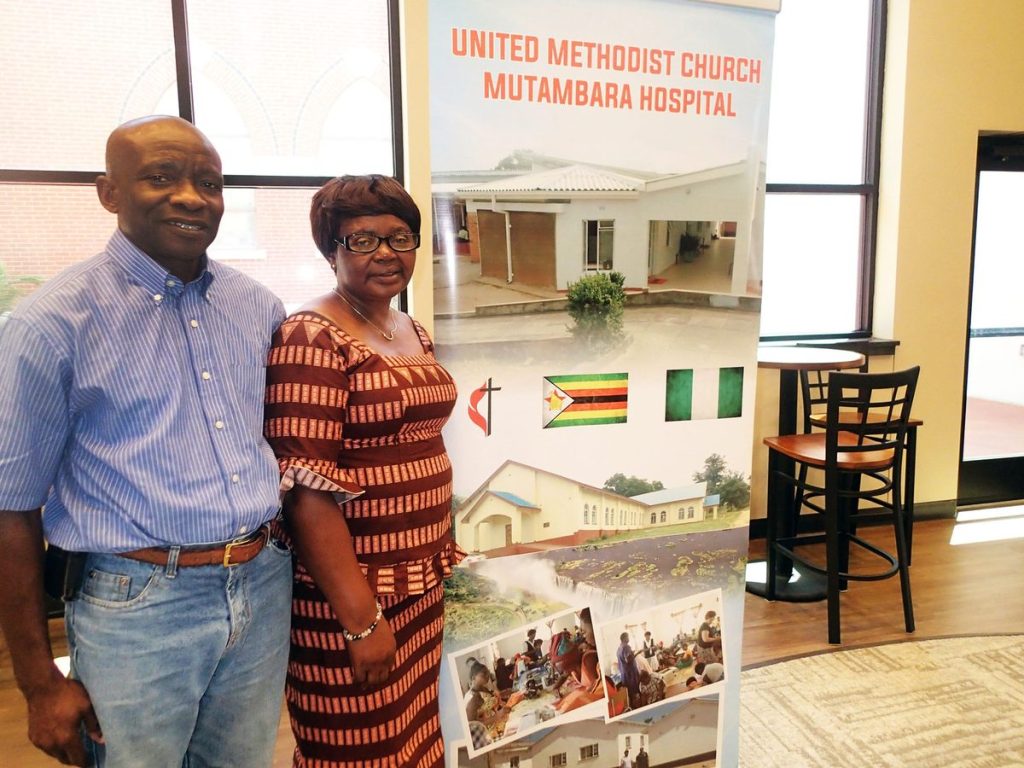
TONY BROWN/DAILY FORUM
Dr. Emmanuel Ufonna Mefor, a physician, and his wife, Florence O. Mefor, a nurse, met with members of the First United Church of Maryville last week during a visit to the United States designed to acquaint churches in several states with challenges confronting the Mutambara Hospital and its associated ministries in eastern Zimbabwe.
Members of the First United Methodist Church of Maryville played host to a brother and sister in the faith last week, a couple who traveled thousands of miles from the Republic of Zimbabwe in southern Africa to share a message of need and hope.
Dr. Emmanuel Ufonna Mefor, a physician, and his wife, Florence Mefor, a nurse, are United Methodist Church Board of Global Ministries missionaries in the large “village” of Mutambara, an impoverished community of about 50,000 people on the eastern edge of the province of Manicaland.
For the past decade, the Mefors, have administered the Mutambara Hospital, part of a UMC mission center that also includes an elementary and secondary school, four smaller hospitals, 22 clinics and a 247-acre farm.
First United Methodist has had a “covenant relationship” embracing both financial and spiritual support for the Mefors since 2010, when church member Christopher Miller traveled to Zimbabwe as a volunteer charged with conducting an administrative assessment of UMC medical and hospital missions there.
Currently on leave, the missionary couple stopped in Maryville during a tour through Iowa, Kansas, South Dakota, Colorado and Missouri focused on meeting with congregations who have helped support their work.
Once known as Southern Rhodesia, after British businessman, mining magnate, politician and arch-imperialist Cecil Rhodes, Zimbabwe achieved independence from white minority rule in 1980. However, under the administration of strongman President Robert Mugabe, the country has for decades been plagued by poverty, economic turmoil, violence, political corruption, disease and hunger.
That legacy has spawned a tide of human want and suffering that missionaries like the Mefors are battling to turn.
It has not been easy, said the Rev. Chris Komorech, First United Methodist’s director of ministries.
About 10 years ago, Komorech and the Mefors said, Zimbabwe’s ailing economy led to widespread food shortages that had an especially devastating impact on pregnant women, many of them still in their teens.
The crisis led Mutambara Hospital to begin offering a basic breakfast of cornmeal porridge to expectant mothers staying in a hospital-run shelter.
In 2008, the Mefors came to the United States and convinced a number of churches to support the program in hopes the frequency of meals could be increased from one to three each day.
As word spread, the number of women helped by the nutrition initiative grew from a dozen or so to as many as 80.
Dr. Mefor said women reside at the shelter for as long as eight weeks.
Over the past five years, in an effort to stretch the program’s dwindling resources as far as possible, the hospital has started farming in an effort to raise its own food.
Presently, the ministry raises corn, soybeans, winter wheat and vegetables on about 250 acres of land in order to provide basic nutrition for mothers awaiting childbirth.
Churches from South Dakota have provided used tractors, cultivators, sprayers and harvesting implements along with training in repair and maintenance.
Komorech said that while the ag initiative is growing, it is not yet sustainable and requires an annual subsidy of at least $10,000 a year. That level of support, he added, is expected to diminish as the program continues to develop.
On other fronts, the Mefors are seeking help from U.S. churches for improvements to the 70-year-old hospital, which Dr. Mefor said is in need of new ceilings, floors and fixtures. Priorities include expanding and equipping the small and inadequate delivery room.
Additional challenges embrace high mortality rates for both infants and mothers and a lack of resources with regard to post-natal care and immunizations.
Other persistent needs comprise assistance to grandparents raising children orphaned by the southern Africa HIV/AIDS pandemic.
While in Maryville, Dr. Mefor appealed to local Christians to remember that, according to scripture, Jesus Christ — said to be God in human form — is personified by the hungry, poor and sick.
He then tied that concept to the biblical injunction commanding believers to love their neighbors as themselves.
“Your neighbor is the God you don’t see,” he said. “We cannot turn our backs on all these problems.”