Judge: Drug court to continue despite cuts
TONY BROWN/DAILY FORUM
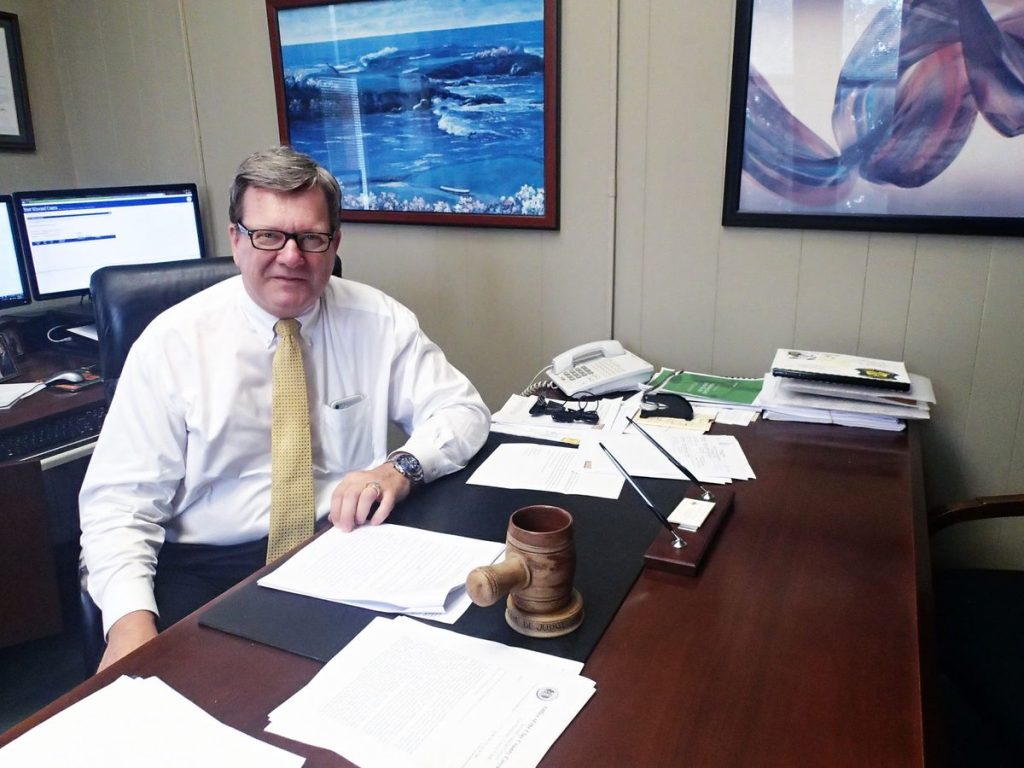
Presiding Missouri 4th Judicial Circuit Judge Roger Prokes, shown here in his Nodaway County Courthouse office, said this week that the five-county circuit’s drug court program will continue despite a significant cut in state funding for fiscal 2017-2018. Prokes called the initiative a proven success that saves the taxpayers money and allows offenders to remain employed in their home communities while undergoing counseling and treatment.
Presiding Missouri 4th Circuit Judge Roger Prokes said Wednesday that a “drug court” program designed to rehabilitate habitual drug users from across the circuit’s five counties will continue despite a significant cut in state funding.
Prokes said 123 people from Atchison, Gentry, Holt, Nodaway and Worth counties have been placed in the program over the past 15 years, and that 67 — well over half — have graduated.
A total of 18 offenders are currently enrolled. All of those offenders will remain in the program despite the reduction, Prokes said.
According to the judge, drug court is far less expensive for taxpayers than an alternative 120-day rehab program administered by the state Department of Corrections that requires offenders to remain in custody in a DOC facility.
While Prokes described both efforts as effective, he said the cost to taxpayers for the 120-day program is around $10,000 per participant, whereas the price tag for successfully completing the year-long drug court program is approximately $4,000.
In addition, he said, drug court participants remain in their home communities where they can enter or remain in the workforce while striving to rebuild their lives on a number of fronts.
Under Missouri’s fiscal 2017-2018 budget, so-called “treatment court” programs statewide received a $1.8 million reduction in core funding, which Prokes said translates to about a $10,000 cut for the drug court program in the 4th Circuit, more than 25 percent less than in 2016-2017.
The 4th Circuit received $37,200 for drug court during the current fiscal year, which ends June 30, and will get $32,290 in 2017-2018. However, $5,000 of that amount must be spent on a similar program that seeks to rehabilitate persistent driving-while-intoxicated offenders.
Established last fall with its own funding stream, the 4th District’s DWI court had no impact on drug court funding during the current fiscal year.
Prokes said drug court, which is administered by Associate Circuit Judge Edward Manring, has proved successful for a number of reasons, including the involvement of Maryville’s New Beginnings Counseling Group, which he said has worked to reduce costs, a savings that allowed more offenders to be enrolled in the program.
Drug court participants, he said, move through a four-tier process with each tier lasting about three months. Initially, offenders undergo treatment, counseling or group therapy at least five nights a week and are required to appear in court three times a month.
Offenders must also meet frequently with their parole officer and undergo regular drug screenings. Participation in a 12-step program, such as narcotics anonymous, is encouraged.
Prokes said these requirements become gradually less strict as the offender advances through the program, and that the emphasis on overcoming addiction, as opposed to punishment, yields real rewards for participants who persist until graduation.
“At first you see people saying, ‘OK, I’m here because I don’t want to go to prison,’ said Prokes, who added that participants often shift their priorities in favor of family, work and the opportunity to rebuild their lives as the months go by.
It is also not unusual, he said, for offenders within the program to provide each other with emotional support and encouragement as the chains of addiction begin to weaken.
The bottom line, Prokes said, is threefold: “It keeps families together, it allows people to be employed in their communities and it save the taxpayers money.”
Given those plusses and the relatively high graduation rate, Prokes said the funding cut is unfortunate.
Still, he said he understands that “everybody in Jefferson City has their hand out,” including proponents of medication-assisted drug treatment, an approach that will receive $1 million from the state next year.
Prokes said he finds the concept of “taking drugs so you won’t take drugs” illogical, and thinks the money would be better spent on drug court, a program he pledged will continue in the 4th Circuit despite the reduced level of funding.
Seeking private donations in support of the program is one option, he said. Also, offenders who can afford it contribute $30 a month to help pay for their own treatment. Those funds have built up over time, so the program has a small financial cushion.
In addition, New Beginnings is committed to the program, Prokes said, and plans to keep offering counseling services “even if they’re running on fumes.”
“Any resource we can find we’re going to use,” he said.