
Students research parking situation in downtown Maryville
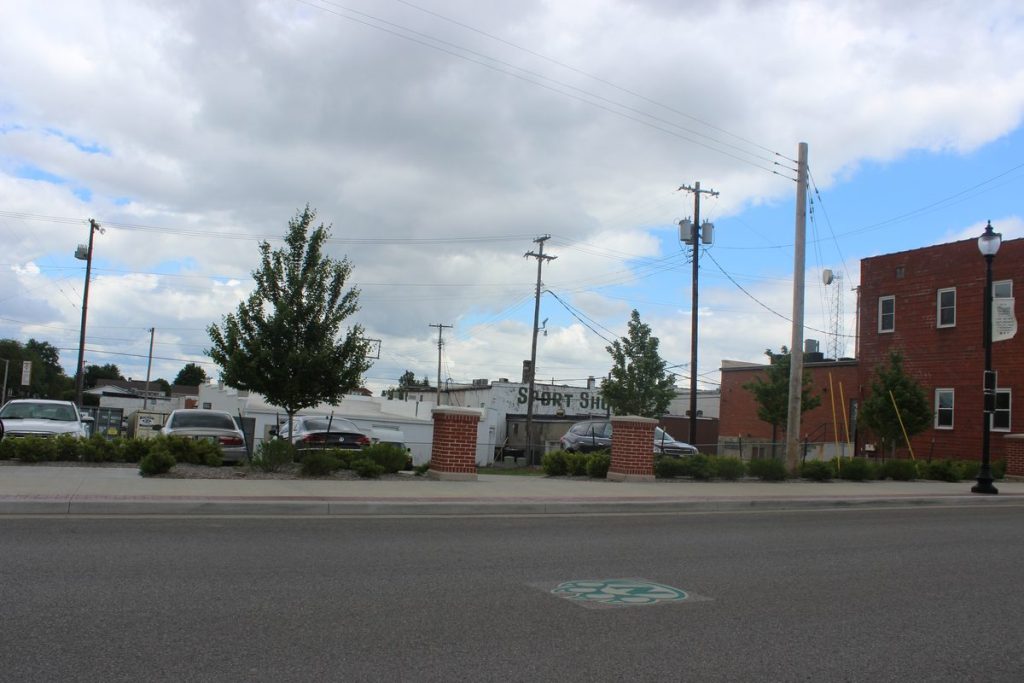
TOM PINNEY/DAILY FORUM
Pictured is an unpaved parking lot on the northeast corner of West Fourth and North Buchanan Streets. Recently, the urban geography class at Northwest Missouri State University completed a parking study of downtown Maryville for MDIO, which is now being considered by the city.
A common complaint in downtown Maryville is that there isn’t enough parking. So, one professor and his class decided to do something about it.
Kevin Romig, Northwest Missouri State University assistant professor of geography and Maryville Downtown Improvement Organization design committee chair, was part of a discussion during an MDIO meeting where he heard that complaint. As the professor of the urban geography course at Northwest, Romig made it a project for his students.
“I’m always looking for service learning opportunities for the urban geography class,” Romig said. “I love doing projects that are applicable and give my students hands-on experience.”
For no charge to MDIO, Romig and his students conducted a parking study for downtown Maryville. The parameter for the study covered an area from Second Street north to Fifth Street, and from North Buchanan Street east to North Market Street.
“The first group was the Census Group, and they took a census of all of the parking spots within our set parameter,” Romig said. “They compared that number with the number of businesses and residences in the parameter.”
In total, the group counted 560 parking spaces, with 260 in off-street lots. The other 300 were located on the street as either angled or parallel parking spaces.
Their math checked out to approximately 12.7 parking spaces per business, which the report noted was lower than the average of 18 around the United States. The discussion on the parking situation was that it was “rather tight” due to the fact that the parking spaces served both businesses and loft apartments in the area.
The second group was the Geometric Group, and their job was to measure the right-of-way in the area to discern the best type of parking given the layout of the area.
The third group, the Research Group, was responsible for researching the current best practices and standards for different styles of parking. As part of their job, they were told to research the benefits and drawbacks of making Third and Fourth Streets one-way to accommodate reverse parking on those streets.
After those three groups finished their work, their finished product was sent to the fourth group, known as the Visualization Group. This group, led by Romig, prepared the report for the MDIO.
“We weren’t there to make suggestions or endorse any particular changes, or any change at all,” Romig said. “It was our job to put together everyone’s findings so that MDIO had something to work with.
“We put together our report with all of the charts and diagrams and gave it to MDIO president Matt Gaarder. The next step is completely up to them.”
The class presented three scenarios in the report. The first was noted as the most cost-effective, and contained the suggestion that the city make public lots downtown more well-known by putting up more signage directing drivers to them.
The second scenario increased the quantity of on-street parking spaces by 12 by changing the parallel parking available on the south side of the 100-block of West Second and West Fifth Streets to 45-degree angled parking. The report noted that the scenario was “intended to keep the flow of street traffic in the downtown area constant while increasing the quantity of on-street parking.”
Scenario Three was noted as the “most aggressive change.” In this scenario, Third and Fourth Streets were changed to one-way streets between North Buchanan and North Market Streets, with Third Street traveling east and Fourth Street traveling west. In doing so, the city would be able to institute reverse parking between Buchanan and Main on Third and Fourth Streets.
The report noted that this “makes the most sense for the MDIO since the businesses are located on the opposite side of the street from the courthouse.” Benefits included the fact that car doors would not open into oncoming traffic, that motorists were protected from oncoming traffic by their car doors, trunks could be unloaded on sidewalks, and that this creates more parking spaces than parallel configurations.
Gaarder said he was happy that the class could do the project for the city.
“We always hear about how parking is an issue downtown, so we wanted to see if there was anything to do about it,” Gaarder said. “The next step is that we shared the study with the city manager, so now we’re going to see if there’s anything to take from it, whether to improve parking or to make people realize that there are more spaces downtown than they think.”
The study was authored by Madison Adler, Bonnie Butler, Austin Colwell, Billy Crawford, Ashley Culbertson, Matthew Day, Colden Hillyer, Graham Hoffman, Samantha McCauley, Quinn McCollum, Austin Motsinger, Nicholas Present, Jared Ware, Shane Williams, and Romig.