
Change a constant for veteran police chief
By TONY BROWN Staff writer
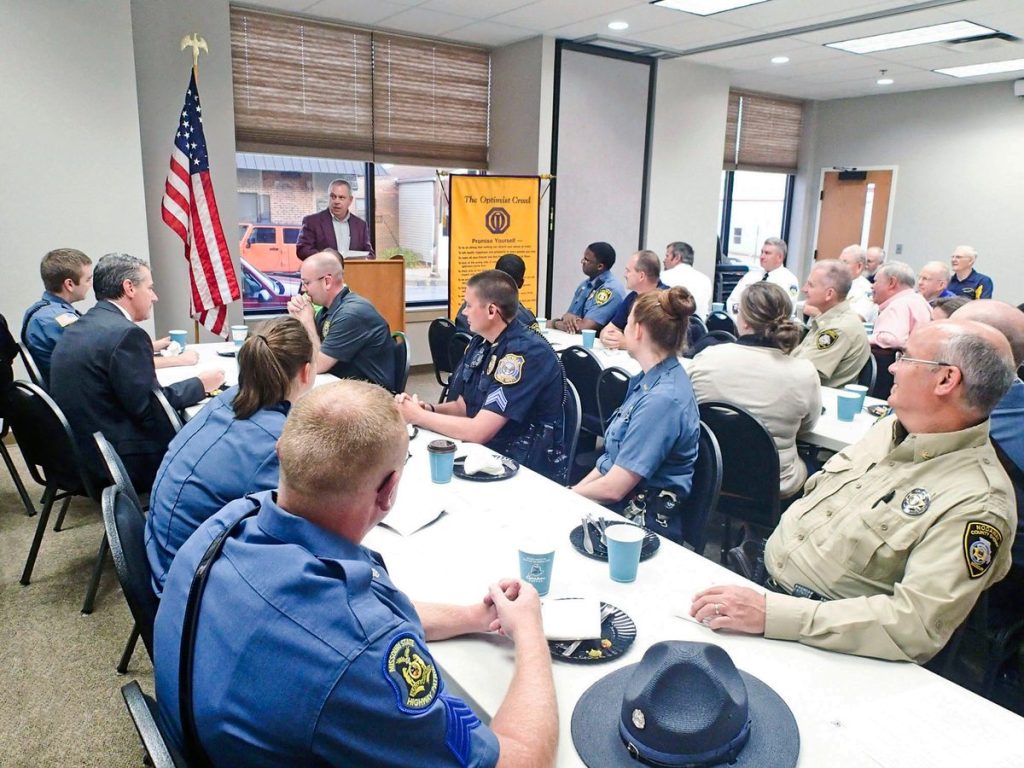
5-19-17 optimist law enforcement CUTLINE TONY BROWN/DAILY FORUM Maryville Public Safety Director Keith Wood speaks Thursday before members of the local Optimist Club and about 30 other justice system professionals during the service organization’s annual salute to law enforcement. The long-time chief reflected on the many ways in which police work has changed over the decades.
Even though he lived through them and helped shape them, Maryville Public Safety Director Keith Wood couldn’t help but sound a little amazed Thursday morning while recounting the changes that have occurred within law enforcement over the course of his 40-year career.
Wood’s comments were delivered during the local Optimist Club’s annual breakfast saluting peace officers and other justice system professionals.
In addition to club members, the gathering at the Nodaway County Administration Center was attended by about 30 of Wood’s colleagues from a half-dozen agencies, including the Nodaway County Sheriff’s Office, Northwest Missouri State University Police Department, Missouri State Highway Patrol, Maryville Treatment Center (state Department of Corrections), Nodaway County Juvenile Office, and the Division of Probation and Parole (state Department of Corrections).
Wood, who heads Public Safety’s police and fire divisions, has served as Maryville’s police chief for 28 years. He began his career as a commissioned officer in 1977 in Clinton, a city of about 9,000 people located near the western arm of Truman Lake.
When he first pinned on a badge, Wood said, there were no training requirements for officers in Missouri, though a mandatory 120-hour course for new recruits was established the following year.
Today, he said, the minimum requirement for beginning officers is 700 hours, with some undergoing as many as 1,000 hours of classroom and field preparation before receiving their initial field assignment.
Even for veterans, school is never really out, since all peace officers in Missouri must complete 48 hours of continuing professional development every three years in order to retain their commissions.
One reason for all that training, Wood said, is that there is a lot more to learn, since even the profession’s most basic tools and techniques have undergone sweeping change.
The once-standard six-shot .38-caliber revolver and 12-gauge shotgun have long since given way to a variety of semi-automatic pistols and patrol rifles, and the two- and four-channel car radios Wood used as a young cop have evolved into digital rigs that offer almost endless communication options.
Also, where officers once carried little more than a gun and a pair of handcuffs, bullet-resistant vests and Tasers have become standard, along with laptop-equipped patrol cars and vast databases that provide near-instant information, whether police are searching for a missing child or chasing a bank robber.
And then, Wood said, there are the cameras — and cameras, and cameras, and more cameras.
Body cameras are a given for many agencies these days, including MPS, as are dash cams in patrol vehicles.
Wood said the resulting flood of video has forced departments to come to grips with storage and review technologies that require both time and money to implement and maintain.
But while using police cameras effectively can be a challenge, Wood said he believes the new reality in which almost every move, word and action is recorded has made officers better at their jobs and enhanced their ability to enforce the law and protect the public.
Along with new opportunities created by technology, however, have come challenges, and a number of those challenges revolve around unrealistic expectations.
For example, Wood said, while DNA evidence has “changed the world” in terms of prosecuting criminal cases, it has also created juries whose members believe in the “CSI factor” and expect police to pull incontrovertible evidence out of a magic computerized hat.
Such TV-cop-show perceptions, the chief said, “are not our friend.”
But while exotic gear and access to cyberspace have transformed the way officers work, and the way the public views that work, even more profound changes have to do with how culture and society have affected the way cops think and act.
When Wood began his career, Missouri’s blood-alcohol content standard for drunken driving was .12. Now it is .08, a change he hailed as very positive.
Another example of shifting cultural norms is the way officers handle domestic violence. At one time, Wood said, police acted more or less as counselors, putting a stop to the immediate conflict then offering what they hoped was good advice and hoping for the best.
“It didn’t work very well,” he said.
These days, by way of contrast, when someone assaults a spouse or partner the act is viewed as a crime often resulting in an arrest and formal charges.
On other fronts, a series of national tragedies — the 1999 Columbine High School killings, the 9/11 terrorist attacks, 2014’s racial unrest in Ferguson — have affected policing policies and techniques on a profound level.
When an “active shooter” attacks, Wood said, police used to simply “set up a perimeter and wait for the SWAT team to arrive.” But these days, he added a little sadly, “We know there is no time for that.”
In a similar vein, racial conflicts have led police departments to take a long, hard look at what they do and how they do it.
Of all the complex issues affecting modern law enforcement, said Wood, who grew up during the civil rights era of the 1960s and early ’70s, race has proved to be one of the most persistent and troubling.
“I thought we had come a long way as a nation,” he said, looking back on policing during the pre-Ferguson era. “But we still have a long way to go.”
Still, Wood is encouraged by the trend in his profession toward community policing and proactive crime prevention.
“We want to be a binding force as opposed to a force that divides people,” he said, adding that the constant throughout his life as a cop has been the willingness of officers to aid and protect others.
“When we have a heart for service, it drives us all to a better place,” Wood said. “… And when there is a call for improvement, we respond.”




